49 works in this view — arrow keys or swipe to move between them.
Dance in Art
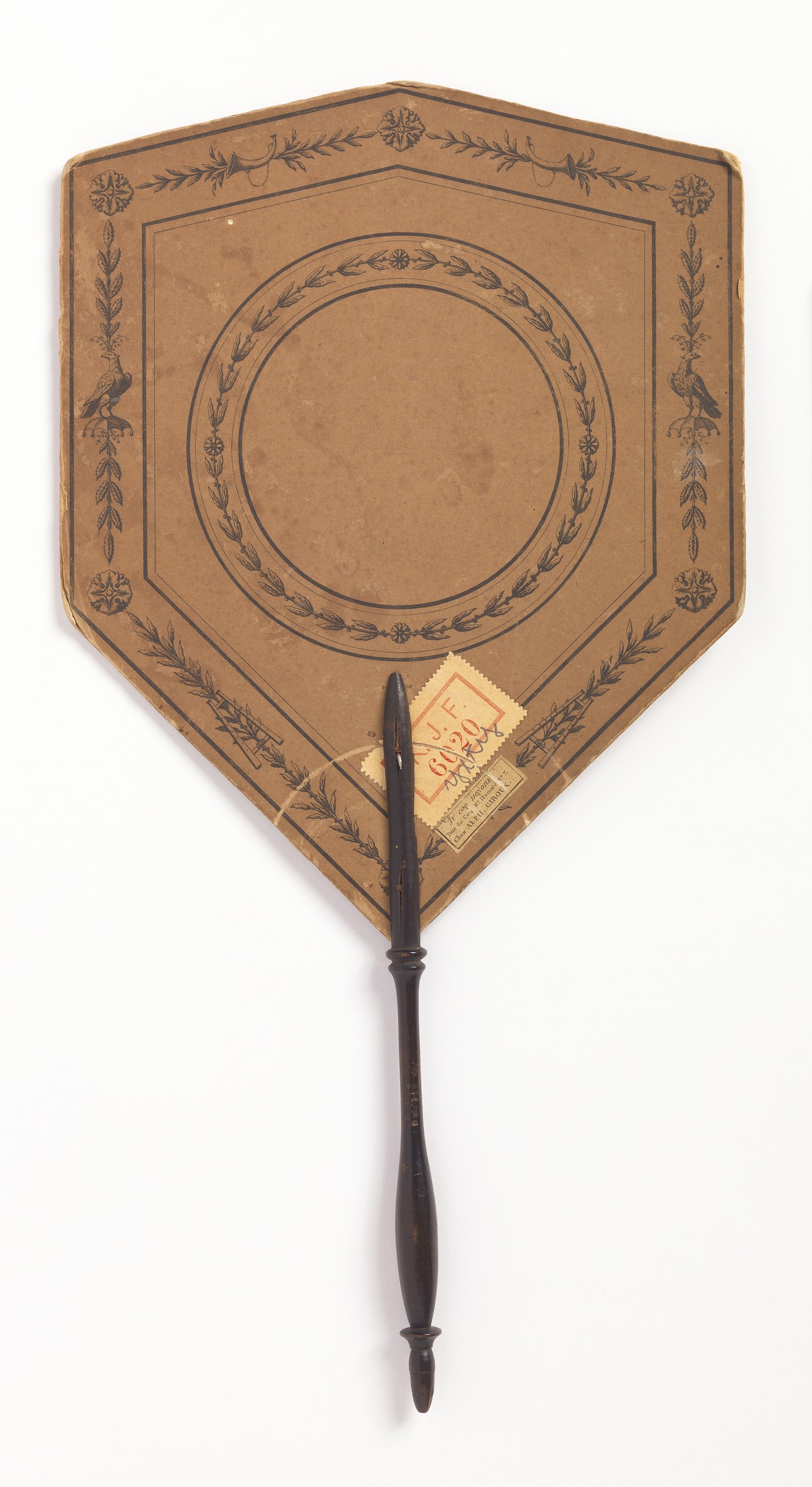
Handscreen, early 19th century
Unknown artistUnknown artist
- Source:
- Wikimedia Commons
- Rights:
- Public domain — free to use, share and adapt.
- Recorded as:
- public_domain
For dance historians, the fan documents how dance was visualized and commodified in the Regency era—frozen in the moment of performance, stripped of rhythm and music, transformed into a static allegorical image. For students of material culture, it shows how dance imagery circulated through the domestic sphere, how a moment of performance was miniaturized, reproduced, and placed in the hands of wealthy women as an accessory to their own social performance. The work reveals the close entanglement of dance with neoclassical design ideology: the dancer's body becomes a text for reading virtue, her gesture made legible through the conventions of classical art.
What you are looking at
A shield-shaped handscreen with a dark wooden handle, its surface decorated in the neoclassical taste with delicate pen-and-ink line work. The center medallion contains an oval composition showing a female dancer in classical drapery, her body in profile and turned toward an unseen audience or court. She plays a tambourine, her arm raised in a gesture of performance. Flanking her stand two male figures in military dress—one a soldier or guard holding aloft a standard inscribed "Simplicité, Constance." The scene is framed by concentric circles of laurel wreaths and floral motifs, with additional ornamental bands of repeating leaf and flower patterns forming a border around the medallion. Beyond the central image, the entire shield face is ringed with symmetrical botanical engravings: paired eagles or birds at cardinal points, and vertical garlands of ferns and flowering vines separated by small rosette forms. The overall effect is of a refined domestic or court object, its imagery celebrating both military virtue and cultivated entertainment.
The dancing
The dancer occupies the central focus, her weight appears to rest on one leg while the other supports her rotation, her body held in the upright, lifted carriage characteristic of early nineteenth-century neoclassical taste. Her right arm is raised high to play the tambourine, the instrument held at shoulder height in a gesture of active performance rather than static display. The two male attendants flank her symmetrically; their posture is formal and ceremonial, with the standard-bearer holding the banner upright in an attitude of honor rather than movement. The composition is entirely frontal and processional—no interaction between the figures, no reciprocal gesture or closed hold; instead, each figure occupies its own space within a heraldic arrangement.
The dance depicted
The image depicts a court dancer performing what appears to be a stylized pantomime or allegorical entertainment rather than a codified dance technique. The tambourine and the formal presentation to assembled courtiers suggest a solo performance piece, possibly one of the spectacular dances staged in European courts in the early nineteenth century. The inscription "Simplicité, Constance" on the standard—Simplicity and Constancy—indicates that the dance itself is didactic or allegorical, a visual argument about virtue as much as an exhibition of movement. The dancer's posture and the classical drapery identify the work as belonging to the neoclassical revival in dance and design that dominated the Regency and early restoration periods, when artists sought to revive ancient Greek ideals of form and comportment.
How it was made
This is a composite object: a paper or card shield-shaped panel with pen-and-ink or engraved line decoration, attached to or mounted on a turned wooden handle, creating a functional hand fan for use in drawing rooms or at court. The technique appears to be engraving or fine pen-work on a cream or buff paper stock, with the elaborate floral and heraldic borders suggesting either hand-drawn imitation of engraving or a printed engraved design hand-colored or left bare. The construction as a fan indicates it was a luxury domestic object intended for display and use among the wealthy, its decoration signaling refined taste and familiarity with classical allusion. The presence of a printed label affixed to the verso confirms it was a manufactured object from a known maker, now lost to the catalogue record.
About this work
This is a decorative hand fan from the early nineteenth century, its shield-shaped face depicting a court dancer performing with a tambourine before assembled military and civilian witnesses. The image is an artifact of the neoclassical revival that dominated Regency aesthetics, a period when dance, design, and domestic objects all drew on classical Greek ideals of beauty and virtue. The fan serves as both a functional accessory and a visual text—its central scene framed by heraldic and botanical ornament, its inscribed motto asserting that dance itself was a vehicle for moral instruction. As an object, it reveals the status of dance in the social world of the upper classes: a spectacle to be witnessed from a formal arrangement, a performance of virtue and grace refined through artistic convention rather than technical virtuosity.
How to look at it
Attend first to the dancer's posture and the position of the tambourine: she is caught in the act of striking or shaking it, her body rotated, her weight shifted. Note that this is a moment of *action*, not a static pose—the artist has chosen to show music-making as a bodily event. Then look outward from the central medallion: the concentric circles of laurel and flower work frame the scene as something precious and ceremonial, elevating the dance from mere entertainment to an allegorical statement. Finally, observe how the two attendant figures are arranged: they do not interact with the dancer but rather witness her, their positioning establishing a hierarchy of attention. The fan teaches us how the Regency eye looked at dance—always framed, always formal, always laden with meaning beyond the movement itself.
The period
The fan dates to a moment of intense interest in classical revival across all the arts. The neoclassical movement, dominant in design and painting from roughly 1760 to 1830, extended to dance: the era saw the rise of the *danse d'action*, narrative ballets set to music, and a fashion for "Grecian" costume and pose in theatrical performance. The inscription "Simplicité, Constance" on the standard reflects Enlightenment values—the idea that art and performance should instruct and refine, not merely entertain. The tambourine, the drapery, the formal court setting, and the heraldic frame all place this object at the intersection of court culture and the emerging leisure consumer market of the industrial age.
Where it lives
The fan is held by Wikimedia Commons, with no current accession number or location recorded. The catalogue record notes only that it is an early nineteenth-century handscreen; a printed label visible on the verso suggests it came from a known maker, but the maker's identity is not recorded in the catalogue.
Dance in this work
Questions about this work
What is a handscreen and why would someone own one?
A handscreen (or hand fan) was a portable accessory used primarily by women in drawing rooms, at the opera, or in public to shield the face from heat or sunlight, or simply to gesture with elegantly. This example is too ornate and decorative for practical cooling; it was a luxury object, a display of refinement and taste. The elaborate imagery on the face would have been admired during social occasions, making it both functional and a conversation piece.
What does 'Simplicité, Constance' mean, and why is it on a fan?
"Simplicité" (simplicity) and "Constance" (constancy or steadfastness) are classical virtues. By inscribing them on a banner held aloft in a dance scene, the maker asserts that the dancer's performance embodies these moral values. This reflects the neoclassical belief that the arts—including dance—should refine character and instruct viewers in virtue, not merely provide entertainment.
Is this a real performance or an imagined one?
Most likely an imagined or allegorical scene rather than a record of an actual court spectacle. The formal arrangement, the heraldic framing, and the didactic inscription suggest the artist created a visual argument about dance and virtue rather than documenting a specific event. However, the style of the dancer's dress and the presence of military attendants are consistent with the court performances and theatrical entertainments of the Regency era.
Why a tambourine specifically?
The tambourine was associated in neoclassical art and design with Bacchic revelry, celebration, and ancient Greek festivity. Placing one in the dancer's hands immediately signals to a contemporary viewer that this is not a ballroom dance but a staged, stylized performance evoking classical antiquity. It also gives her an instrument with which to create rhythm, making her a musician as well as a dancer.
More dance artwork





