49 works in this view — arrow keys or swipe to move between them.
Dance in Art
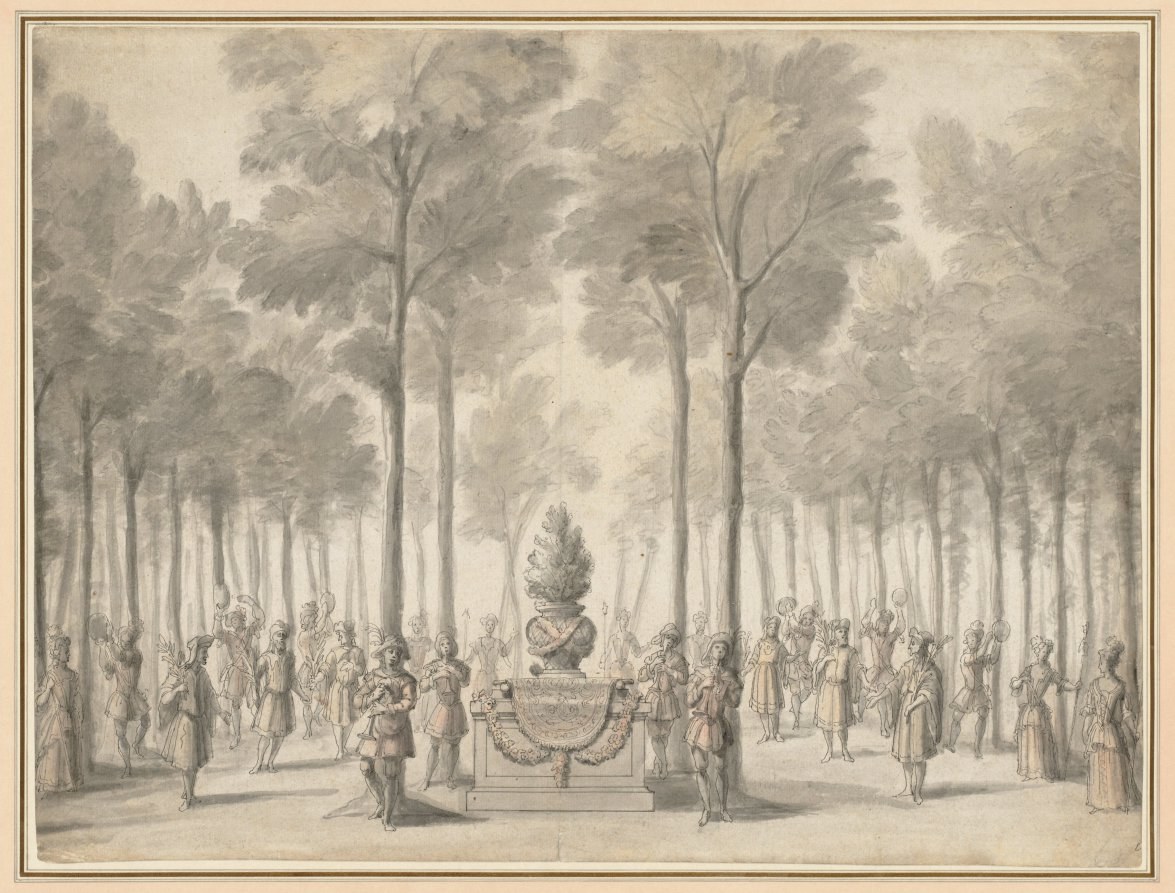
Design for the Divertissement from "La Pastorale" (First Entrée of the opera-ballet "Les Muses" by Danchet and Campra")
Jean I Bérain (French, 1640–1711)
- Medium:
- pen and black ink and brush and gray wash with red, blue, and yellow wash, with graphite
- Collection:
- Drawings
- Source:
- Cleveland Museum of Art
- Rights:
- Public domain — free to use, share and adapt.
- Recorded as:
- CC0
Bérain was the principal designer of the Opéra during this period, and his stage designs were instrumental in shaping what French theatrical dance looked like. This drawing shows how the dance was framed, spatially organized, and visually conceived in one of the most prestigious and influential theaters in Europe. For dance historians, it is evidence of the relationship between design, stage space, and choreographic possibility in the period when ballet was beginning to separate from opera.
What you are looking at
A formal gathering of shepherds and shepherdesses assembled in a wooded grove, rendered in delicate pen and wash with subtle color accents. The figures are distributed across a spacious clearing flanked by tall, slender trees whose foliage creates a luminous canopy overhead. At the center stands an ornamental stone plinth or altar, decorated with swags of drapery, which serves as the focal point of the composition and the object of the gathering's devotion. The figures wear pastoral costume—loose tunics and dresses in the style of theatrical bucolic dress—and are arranged in small clusters, some standing in reverent posture around the central monument, others scattered through the grove in attitudes of celebration or homage. The light is even and diffuse, filtered through the trees, creating an atmosphere of genteel, theatrical nature rather than wild landscape. The drawing's handling is precise and economical: the trees are rendered with quick, assured strokes to suggest depth and volume, while the figures are more carefully articulated, their poses and relationships clearly legible.
The dancing
The figures are distributed in loose spatial groups rather than in a coordinated ensemble. Many stand in relaxed, upright postures with arms at ease or gesturing toward the central monument in attitudes of presentation or veneration; a few figures appear to be in conversation or performing a gentle inclination of the torso toward the altar. None are shown in the rigid alignment or formal hold of a structured court dance. The bodies suggest a processional or ceremonial gathering rather than a synchronized dance step, though some figures have the poised, weighted stance of trained performers. The variety of poses—some standing forward, some in profile, some at three-quarter—suggests movement and liveliness within an overall formal occasion rather than the stillness of pure ceremony.
The dance depicted
This is a design for a *divertissement*—a lighthearted, self-contained musical and choreographic interlude within the larger opera-ballet *Les Muses*. The catalogue describes it as the third scene of the first entrée, titled "La Pastorale," in which shepherds and shepherdesses pay homage to a deity in a pastoral setting. The image is a *machine* or stage design rather than a notation of actual steps; it tells us about the spatial arrangement, the visual composition, and the dramatic action rather than the technique of the dancing. The scene depicts a formal processional or ceremonial homage, likely danced to the accompaniment of soft instruments (flutes and musette) in a mode befitting the pastoral and allegorical conventions of early 18th-century French opera-ballet. The emphasis is on grace, visual spectacle, and courtly decorum rather than virtuosity or complex footwork.
How it was made
This is a drawing in pen and black ink with brush and gray wash, heightened with discrete applications of red, blue, and yellow wash and graphite. The technique is characteristic of the working designs prepared for the stage: it is refined enough to communicate the visual intention clearly to the scenic artists and performers, but economical and summary enough to allow for revision and adjustment. The gray wash establishes light and shadow, while the colored accents—particularly the red of costume details and the blue of drapery—signal the actual pigments to be realized on stage. This is a *maquette de théâtre*, a professional design tool, and its presence in a collection of drawings (rather than as an artifact of performance) indicates it was preserved as a record of an important production or as an example of the designer's practice.
About this work
Bérain's design for the Pastorale divertissement is a document of a crucial moment in French theatrical history: the opera-ballet as it was practiced at the height of the reign of Louis XIV and into the early 18th century. The work is not a choreographic record—no steps are noted—but a visual and spatial design that shaped how the dance would be seen and experienced. The drawing shows an understanding of the pastoral allegory as a stage spectacle combining architecture, costume, and the arranged bodies of trained performers into a unified and carefully balanced composition. It is a design for a spectacle that was itself designed to delight the eye and the ear in equal measure.
How to look at it
The viewer should attend to the spatial organization: notice how the central monument anchors the composition and how the figures are arranged to frame it without obscuring it, creating a kind of visual dance around the fixed point. The woodland setting is not incidental—it provides a frame and a context that elevates the human figures while keeping them in proportion. The variety of poses, the scattering of the figures, and the quality of light all suggest a moment of graceful, gentle action rather than frozen ceremony. The drawing invites the eye to move through the space, following the implied relationships between the figures and the monument, much as the actual spectators at the Opéra would have been guided through the scene by the choreography.
The artist
Jean I Bérain (1640–1711) was the dominant stage designer of the French court and the Paris Opéra during the reign of Louis XIV and the early years of Louis XV. He worked across opera, ballet, and comedy, and his designs were celebrated for their elegance, wit, and technical ingenuity. His drawings were widely circulated in engraved form and influenced theatrical practice across Europe. Bérain's work represents the fusion of classical architectural principles with the fantasy and ornament of Baroque design, always in service of creating a unified and delightful visual spectacle.
The period
The opera-ballet was invented and perfected in France in the late 17th and early 18th centuries, as a form that gave equal weight to dance, music, and spectacle. *Les Muses*, with text by Danchet and music by Campra, premiered in 1703, a year of significant artistic production at the Opéra. The *divertissement* was an essential structural component of the form: it was the moment at which the spectacle could pause and pleasure itself in a brief, self-contained scene of music and dancing. The pastoral setting was a stock device in French theatrical art of the period, connoting simplicity, innocence, and natural grace. Bérain's design reflects the aesthetic priorities of the era: visual clarity, balanced composition, graceful proportion, and the integration of architecture and the human figure into a unified stage picture.
Where it lives
The drawing is held in the Drawings collection at the Cleveland Museum of Art. As a design from a major production at the Opéra, it was likely preserved by the theater or by Bérain's studio as a record of an important commission; it later entered a collecting tradition that valued such materials as evidence of theatrical practice and artistic genius.
Dance in this work
Questions about this work
Was this actually danced the way it looks in the drawing?
The drawing shows the stage design and spatial arrangement, not the actual choreography. Performers would have moved through and around this space, but the specific steps and movements are not notated here. Bérain's design set the visual and spatial frame within which the choreography unfolded.
What is the central monument?
It appears to be an allegorical or heraldic monument—perhaps a bust or urn dedicated to a muse or deity being honored in the scene. In opera-ballet, such objects often served as visual anchors for the dramatic action and as focal points that gathered the gaze of both performers and spectators.
What does 'divertissement' mean?
A divertissement (literally 'diversion' or 'entertainment') was a lighthearted, self-contained musical and choreographic episode within a larger work. It allowed the performers to display their skills in a brief, pleasurable interlude and gave the audience a moment of relaxation and delight between the main dramatic scenes.
How do we know this is a design and not a record of an actual performance?
The drawing was made before or during the production to guide the construction of the set and the arrangement of the performers. Its precision, its architectural notation, and its presence in Bérain's archives as a design tool (rather than a performance document) all indicate its function as a directive for execution rather than a documentation after the fact.
More dance artwork