43 works in this view — arrow keys or swipe to move between them.
Dance in Art
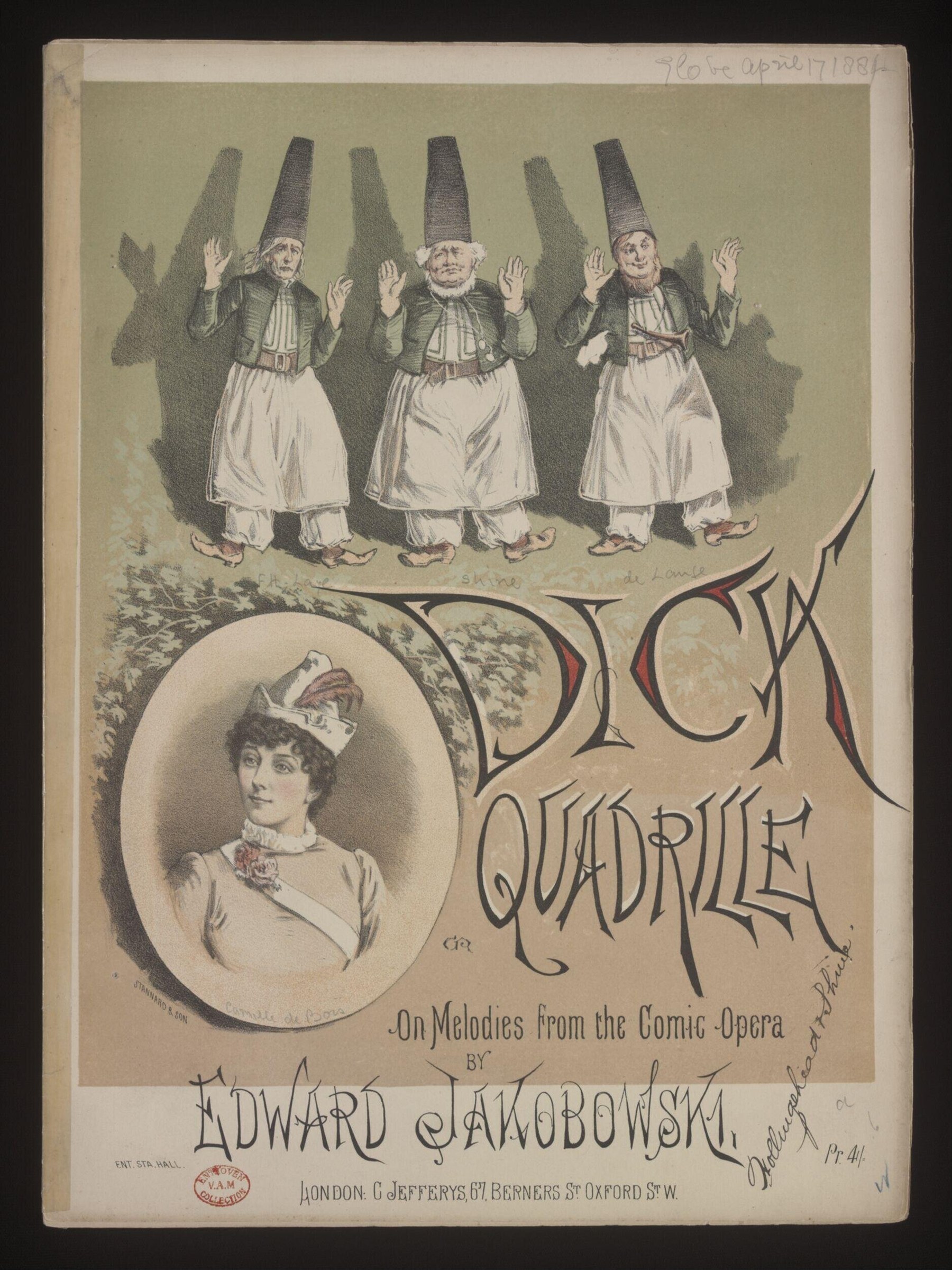
Dick Quadrille
Jakobowski, Edward
- Dance:
- Quadrille
- Era:
- Late 1800s (Victorian Ballroom)
- Source:
- Victoria and Albert Museum
- Rights:
- Rights vary by item — check the source record before reusing this image. Source record ↗
- Recorded as:
- Check V&A creditLine
This work documents the inseparable entanglement of comic opera, ballroom dance, and popular music in the late nineteenth century. For historians of dance, it reveals that quadrille music and quadrille dancing were thoroughly commercialised products, consumed through scores, theatrical performances, and the visual culture of the parlour. The image also captures a particular mode of theatrical representation—the use of ethnic or folk costume as shorthand for comedy and exoticism, a convention that shaped how dance was visualised and gendered on the stage.
What you are looking at
This is a chromolithographic cover or title page for a musical score, divided into two distinct registers. The upper half shows three women in identical poses wearing tall conical hats, white peasant skirts, and decorative bodices with crossed lacing. They stand shoulder-to-shoulder with arms raised to shoulder height, palms outward in a gesture of surprise or greeting, their faces animated with broad smiles. Behind them looms a dark mass of four additional figures in similar dress, creating a chorus effect. The lower half presents a formal oval portrait of a young woman in Edwardian dress—upswept hair crowned with an ornate tiara, a rose brooch at her throat—gazing outward with composed dignity. Between the two scenes sprawls the ornate title "DICK QUADRILLE" in Art Nouveau lettering, with "On Melodies from the Comic-Opera" inscribed below, and the composer's name "EDWARD JAKOBOWSKI" at the bottom.
The dancing
The three women in the upper section are static and symmetrical, their posture uniform and statuesque rather than genuinely balletic. Their raised arms and outturned palms suggest a stylised folk gesture rather than refined dance technique. The stance is upright and frontal, with no suggestion of weight transfer, turnout, or the fluidity expected of theatrical dance of any kind. The legs are largely hidden by full skirts, making footwork impossible to assess. This is costume and attitude rather than a depiction of movement in the classical or even pantomimic sense.
The dance depicted
The quadrille was a four-couple social and theatrical dance of French origin, immensely popular in the nineteenth century across Europe and America. It consisted of five figures performed in a square formation, combining elements of the contredanse with galop-like sections. The title announces this as a piece of "Dick Quadrille" music—likely a set of quadrille variations on themes from a comic opera of that name. The image does not show actual quadrille formation or technique; instead it uses the quadrille as a framework for costume spectacle. The three costumed women are not engaged in the dance itself but are presented as characters—likely chorus or comic roles from the operatic source material—recognisable by their matching folk-inspired costumes and the conical hats typical of Eastern European or Russian comic opera stereotypes.
How it was made
This is a chromolithograph, a colour lithographic print produced by layering successive stones, each carrying one colour. Chromolithography allowed affordable mass production of vibrant, multi-coloured covers for sheet music, making them accessible to middle-class households and music shops. The technique was at its height of popularity in the 1880s–1900s and shaped public taste in graphic design and character representation. The delicate tonal gradation in the portrait and the bold graphics of the title lettering showcase the medium's capacity for both refinement and legibility. Such covers functioned as advertisement, character memorabilia, and collectible artwork—objects people kept and displayed for pleasure.
About this work
This is a sheet music cover for a quadrille composition by Edward Jakobowski, a prolific composer of comic operas and ballroom music in the late Victorian era. The work sits at the intersection of theatrical music and social dance: the quadrille was equally at home in the ballroom and on the comic opera stage, and Jakobowski's output often capitalised on that overlap, adapting operatic melodies into dances for domestic and theatrical performance. The image uses costume and character portraiture to sell the music, creating a narrative frame (the mysterious woman below, the comic chorus above) rather than depicting the dance itself. It is a record of how Victorian culture packaged dance and music for consumption: spectacle, celebrity, and melody in equal measure.
How to look at it
The cover operates as a visual contract between performer and buyer: the elegant portrait below promises sophistication and refinement, while the comic chorus above hints at the fun and spectacle of the actual opera. Notice how the three women are frozen in an identical, almost doll-like pose—this is not a naturalistic moment of dance but a theatrical tableau, a convention of comic opera illustration. The conical hats and folk costume, combined with the broad smiles and gestures, read as 'foreign' and comedic to a Victorian English eye. The composition is symmetrical and formal, designed to be legible at a glance when displayed in a shop window or on a parlour piano.
The artist
Edward Jakobowski (c. 1840–1906) was a composer of German-Bohemian origin who settled in London and became one of the most prolific writers of comic opera and light music in Victorian Britain. He composed over forty operettas and comic operas, many of which premiered at London theatres such as the Gaiety and the Prince's. Jakobowski was equally successful as a ballroom composer, producing dance music—quadrilles, polkas, waltzes, lancers—that was published as sheet music for amateur performance. His work was unambitious musically but commercially astute: he understood exactly what the Victorian middle class wanted to hear and to play.
The period
The 1880s–1890s marked the height of the comic opera boom in London, driven by the success of Gilbert and Sullivan and competitors like Jakobowski. Quadrilles, though originating in eighteenth-century France, remained enormously popular as formal social dances well into the Victorian era; they were taught in dancing schools, danced at balls and at-homes, and constantly reproduced in new musical arrangements. The commodification of sheet music—particularly the investment in chromolithographic covers that made the product visually striking—reflects the growth of a mass market for domestic music-making. Women, especially, were expected to be able to sight-read and perform such pieces at home. Simultaneously, on the professional stage, comic opera made exoticised or folk-costumed female characters (often in troupes or choruses) a standard attraction.
Where it lives
This cover is held by the Victoria and Albert Museum in London, part of their extensive collection of Victorian sheet music covers and theatrical ephemera. It is dated April 17, 1888, by a hand inscription at the top of the page. The object is part of the printed matter collection, representing the mass market for music and theatrical imagery in the late nineteenth century.
Dance in this work
Questions about this work
What was a quadrille and who danced it?
A quadrille was a four-couple square dance that evolved from French contredanses in the early nineteenth century. It became enormously fashionable in European and American ballrooms and remained a standard element of formal dancing well into the twentieth century. It required no special training—any educated person was expected to know it—and it was danced at balls, private parties, and social events. The dance combined figures of standing and promenading with faster galloping sections, and it was always accompanied by a live orchestra or band.
Who was Edward Jakobowski?
Edward Jakobowski was a prolific composer of comic operas and ballroom music, based in London during the late nineteenth century. He capitalised on the huge market for both theatrical music and domestic dance music, producing over forty operettas as well as countless quadrilles, waltzes, and other social dances designed for amateur musicians to play at home. His music was popular and accessible rather than innovative, but he understood his market perfectly.
Why is this comic opera costume on a quadrille score?
Jakobowski's business model was to compose an operetta, then immediately publish arrangements of its melodies as quadrilles, lancers, and waltzes for home performance. Buyers could see the opera, then purchase the music to dance to the same tunes in their own parlours or at balls. The cover image links the score to the operatic spectacle and celebrity, making the commodity more desirable.
What does the oval portrait represent?
The portrait is likely of an actress or performer from the original opera production, making her a celebrity endorsement for the sheet music. This was common practice—a famous performer's face on a cover increased sales. The refined, Edwardian styling of the portrait contrasts with the comic rustic costumes above, suggesting a range of characters and situations in the opera.
More Quadrille artwork