49 works in this view — arrow keys or swipe to move between them.
Dance in Art
Viviane
Jules Chéret (French, 1836–1932)
- Medium:
- color lithograph
- Collection:
- Prints
- Source:
- Cleveland Museum of Art
- Rights:
- Public domain — free to use, share and adapt.
- Recorded as:
- CC0
This poster documents the visual language through which ballet was marketed and understood by the general public in late 19th-century Paris—not as technical virtuosity but as ethereal fantasy and emotional intensity. It is a rare survival of the commercial ephemera surrounding theatrical performance, and as such offers insight into what audiences were promised and what values the dance world wished to project. For historians of dance, it captures the residual Romanticism of 1880s European ballet in a moment before the Russo-ballets would revolutionize artistic ambition.
What you are looking at
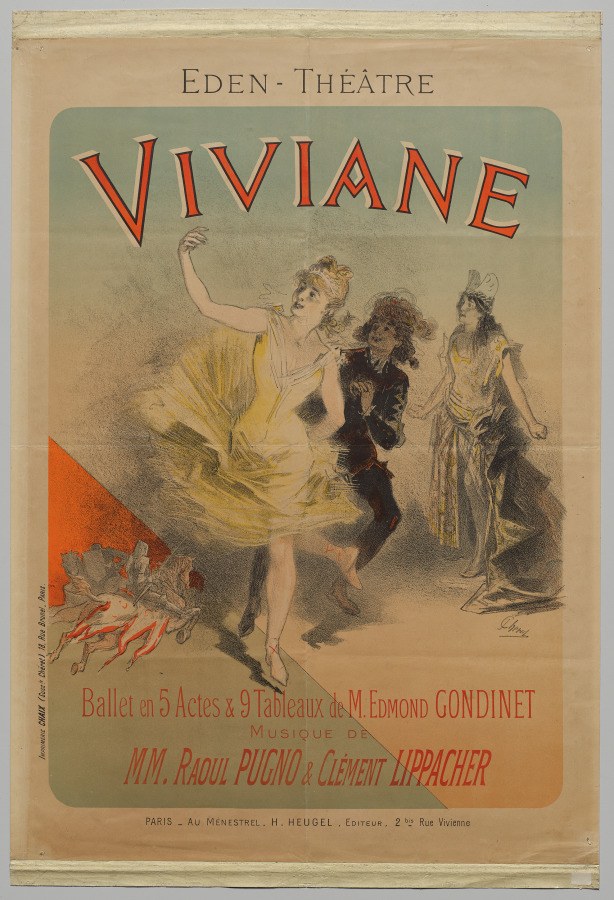
A theatrical poster announces *Viviane*, a ballet in five acts with nine tableaux choreographed by Édmond Gondinet, performed at the Éden-Théâtre in Paris. The composition centers on a bare-legged female dancer in a diaphanous yellow-gold gown, captured mid-leap or in an exuberant upward gesture, her arms raised and body elongated in a pose of weightless abandon. She is surrounded by three additional figures: a darker-haired woman in black to her right, and two further figures in the background rendered in lighter tones—one in classical drapery. The setting is ethereal and undefined, rendered in soft earth tones with a greenish-tinted upper border that frames the scene. A red flag or fabric element appears in the lower left corner, adding a note of drama. The typography and color scheme—bold red letters for the title, warm ochre background, stylized linear treatment of the figures—are characteristic of 1880s French theatrical lithography.
The dancing
The principal dancer dominates the composition with a vertical, ascending line—her body stretched upward in a pose suggesting either a sustained jump or an ecstatic upward reach, with both arms raised expressively. Her bare legs and lightweight costume suggest the classical ballet vocabulary of the period. The surrounding figures are less clearly defined: one woman appears to observe or support the central action, while the two background figures suggest a narrative context or dramatic ensemble. The artist has used abbreviated gestural lines rather than anatomical precision, relying on silhouette and outline to convey motion and emotional intensity rather than technical correctness.
The dance depicted
This is a theatrical ballet of the late Romantic period, created during an era when narrative pantomime-ballet dominated European stages. *Viviane* belongs to the category of féerie—spectacular, fantastical stage works combining dance, dramatic action, and elaborate scenery. The poster emphasizes the spectacle and emotional intensity of the work rather than technical virtuosity. The central figure's upward gesture and the surrounding figures suggest a moment of transformation or transcendence within the narrative. The ballet appears to belong to the Romantic tradition in its valorization of the ethereal, weightless quality of the female dancer and its dreamlike, undefined setting, though the work's specific choreographic style cannot be determined from the image alone.
How it was made
This is a color lithograph, a reproductive printing technique that allowed for mass production and wide circulation of theatrical publicity. Lithography's capacity for soft tonal gradation and bold linear design made it ideal for theatrical advertising in the late 19th century. The poster employs the characteristic chromolithographic palette of the period—warm ochres, soft greens, and bold red typography—applied across multiple stones to create luminous color. The technique allowed for rapid production and distribution to promote performances, making this both an artwork and a commercial object designed to reach a broad urban audience in Paris.
About this work
This is a theatrical advertisement for a five-act ballet performed at the Éden-Théâtre in Paris around 1886, designed by Jules Chéret, the master of Belle Époque poster art. The work exemplifies the late Romantic ballet tradition, emphasizing spectacle, narrative drama, and the ethereal qualities of the female dancer. As a lithographed poster, it documents both the aesthetic conventions of theatrical dance promotion and the visual culture of late 19th-century Paris, where such images were ubiquitous on the streets and in public spaces.
The poster captures a pivotal moment: a dancer in ecstatic upward gesture, surrounded by a dramatic ensemble, set against an undefined ethereal landscape. It is a work of theatrical propaganda designed to seduce the public into attending a commercially significant entertainment. The composition prioritizes emotional impact and visual charm over narrative clarity, reflecting the priorities of both the artist and the impresarios who commissioned such work.
How to look at it
Observe the vertical thrust of the central figure's pose—the raised arms, stretched legs, and elongated body line communicate weightlessness and transcendence, visual ideals of Romantic ballet frozen at a moment of maximum expressivity. Notice how Chéret uses outline and silhouette rather than anatomical detail to convey the figure's grace and movement; the woman's yellow drapery seems to float rather than be bound by gravity. The surrounding figures are rendered more sketchily, their function narrative rather than chorographic—they contextualize the central moment without competing for attention. This is a work designed to be read quickly from a distance, to seduce through color, composition, and the promise of spectacle rather than through narrative clarity.
The artist
Jules Chéret (1836–1932) was a French lithographic artist and a pioneer of the modern poster. He is widely credited with transforming the poster from a text-heavy announcement into a visual art form, developing the technique of chromolithography and establishing conventions that would define Belle Époque design. Chéret worked prolifically for theatrical venues, music halls, and commercial enterprises in Paris, creating thousands of designs that flooded the city's streets and shaped the visual environment of the period. His style—characterized by loose brushwork, bright colors, dynamic compositions, and graceful female figures—became synonymous with the artistic vitality of Paris in the 1880s and 1890s. He was celebrated in his lifetime as a master of the medium and received official honors from the French state.
The period
The 1880s in Paris was a period of intense theatrical competition and innovation. The Romantic ballet tradition, though in decline as a serious artistic form, persisted in commercial theaters and music halls in the form of féerie—spectacular, mixed-genre entertainments that combined dance, pantomime, and scenic extravagance. The Éden-Théâtre, where *Viviane* was performed, was one of several venues catering to popular audiences with such productions. This was also the era in which the poster emerged as a major art form, with chromolithography enabling the rapid, colorful reproduction of images. Simultaneously, in Russia, the Imperial Ballets were undergoing a classical revival under Marius Petipa, while in Paris and Western Europe, ballet was increasingly seen as a popular entertainment rather than a serious art form—a status that would change dramatically with the arrival of the Ballets Russes in 1909.
Where it lives
This is a color lithograph held in the Prints collection. The record identifies it as created around 1886 for the Éden-Théâtre in Paris. Such posters were typically printed in large quantities and distributed as street advertisements; this survival represents one of the many impressions produced from the same set of lithographic stones.
Dance in this work
Questions about this work
What was the Éden-Théâtre and why would they commission this poster?
The Éden-Théâtre was a popular theater in Paris catering to middle-class audiences seeking entertainment. Theaters of this type competed fiercely for audiences and invested in visually striking posters to advertise their productions. A Chéret poster was both a marketing tool and a mark of prestige—his designs were so admired that they became collectible objects in their own right, adding cultural cachet to a commercial entertainment.
Is this a realistic depiction of how the ballet would have looked?
No. The poster sacrifices narrative clarity and technical accuracy for visual impact and emotional appeal. It conveys the *feeling* of the ballet—its aspiration toward the ethereal and transcendent—rather than documenting actual choreography or staging. The undefined setting, the stylized poses, and the soft, dreamlike palette are all designed to entice rather than to document.
What does the upward gesture mean?
It likely represents a moment of apotheosis or transformation within the narrative of *Viviane*—a peak moment of emotional or dramatic intensity. Such upward, expansive poses became iconographic for representing transcendence, ecstasy, or supernatural transformation in theatrical imagery of the period. The exact meaning would require knowledge of the ballet's scenario, which is not preserved in common sources.
Why was Chéret so important to theatrical imagery?
Chéret essentially invented the modern theatrical poster by combining bright color, dynamic composition, and graceful figure drawing with commercial purpose. Before him, theater posters were primarily text with minimal illustration. His work established the visual language through which theater was sold to the public, and his designs became so popular that they were collected and admired as artworks independent of their advertising function.
More dance artwork





