49 works in this view — arrow keys or swipe to move between them.
Dance in Art
Nautch Dancer
Waylande Gregory (American, 1905–1971)
- Medium:
- ceramic
- Collection:
- Decorative Art and Design
- Source:
- Cleveland Museum of Art
- Rights:
- Public domain — free to use, share and adapt.
- Recorded as:
- CC0
Gregory's work documents the actual movement vocabulary of a performer whose dances were considered shocking and 'wicked,' and it does so from a position of sustained looking rather than journalistic snapshot. The sculpture is evidence that American sculptors of the interwar period took vernacular and non-Western performance seriously as subjects for formal study. The choice to freeze a moment of inward contraction rather than outward display also suggests a more nuanced engagement with the dancer's body than the follies' marketing language ('shaking,' 'wicked') conveyed.
What you are looking at
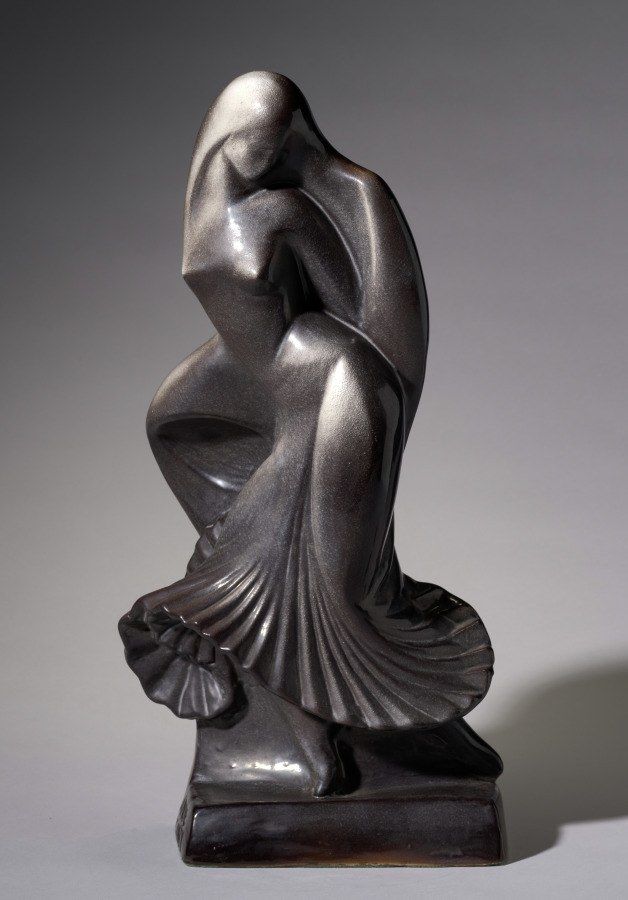
A dark patinated bronze ceramic sculpture depicts a single female dancer in a sinuous, inward-folded pose. The figure's body coils tightly upon itself: the torso twists sharply, the head bows forward and to the side, one arm wraps across the body while the other extends downward, and the legs are drawn up and tucked. The lower body transitions into a flared, deeply pleated skirt or dress that flares outward from mid-hip, its rigid vertical pleats creating a shell-like or fan-like base. The entire composition is frontal but compressed, reading as a taut spiral of movement frozen mid-gesture. The sculpture stands on a low rectangular plinth and is lit to emphasize the modeled musculature of the exposed upper torso and the dramatic play of shadow and highlight across the pleated fabric below.
The dancing
A single dancer is shown in extreme contraction and introspection. The spine curves in a pronounced C-shape, with the head dropped and turned away from the viewer. The weight appears concentrated and inward; there is no extended line or reach. The arms frame the torso rather than articulate outward. The pleated lower garment dominates compositionally, its rigid vertical folds giving the figure an almost architectural base. The musculature is rendered with anatomical attention, emphasizing the exertion of the held position.
The dance depicted
This depicts the nautch dance, the Indian classical form performed in Western theatrical contexts in the 1920s–30s, particularly by Gilda Gray in the Ziegfeld Follies. The nautch dress (the fitted, elaborately pleated garment visible here) was central to the performance's exoticist appeal in American vaudeville and follies productions. The pose captures not the expansive or high-energy vocabulary of Western theatrical dance, but rather an inward, tightly controlled moment—likely one of the 'wicked torso movements' and body isolations that made the form transgressive and scandalous to American audiences. The sculpture reads as a study of restraint and bodily autonomy rather than spectacle.
How it was made
The work is a ceramic sculpture, hand-modeled and patinated with a dark glaze that creates strong modeling through light and shadow. The material allows Gregory to render both anatomical musculature and fabric texture—the pleated skirt is carved with decisive parallel lines that catch light and create volume. Ceramic permits the kind of intimate, observational detail that came from sketching live performances; it was a medium favored by American decorative sculptors of the 1920s–30s for gallery and private collection. The darkened surface gives the work a bronzed, permanent quality despite its clay base.
About this work
This is a ceramic sculpture of an American vaudeville dancer, Gilda Gray, captured in a moment from the nautch dance as it was performed in American popular theater of the late 1920s. Waylande Gregory created it after carefully observing Gray's performances from the wings of the theater in Cleveland, without a formal modeling session. The work sits at the intersection of American modernist sculpture, the history of Orientalism in Western entertainment, and the documentation of theatrical movement. It is significant both as a portrait of a specific performer and as evidence of how an avant-garde sculptor approached the challenge of freezing a moment of transgressive, non-Western dance into permanent form. The sculpture treats the body not as a classical ideal but as an instrument of isolate, controlled movement—a reading that departs from the spectatorially oriented exoticism of the follies themselves.
How to look at it
Attend to the moment of maximum contraction and interiority. Gregory has not chosen an open, display-oriented pose but rather a moment of recoil or self-containment. Notice how the pleated skirt—the garment's most visually distinctive feature—is carved with individual lines that echo the folds of actual cloth, and how these lines anchor and enlarge the lower body. The modeling of the upper torso shows the specific musculature of spinal flexion and torsion. The head's downward turn and the inward pull of the arms suggest not seduction or spectacle but a dancer fully engaged in her own body's intelligence and control. This is a different reading of the nautch than the follies audience may have experienced.
The artist
Waylande Gregory (American, 1905–1971) was a prolific modernist sculptor and ceramicist working in the interwar and mid-century United States. He is known for figural sculpture in diverse styles ranging from realism to stylization, executed in both ceramic and bronze. Gregory frequently drew subjects from American popular culture, entertainment, and everyday life—he modeled dancers, musicians, athletes, and laborers with an eye for movement and character. His practice bridged craft and fine art; he was equally at home in ceramic manufacture and gallery sculpture. Gregory's willingness to study live performance and to translate three-dimensional movement into static form makes him an important bridge figure between sculptural modernism and the documentation of American theatrical culture.
The period
The 1920s–30s were the height of exoticist performance in American theater. The Ziegfeld Follies, Gilda Gray's primary venue, marketed 'Eastern' and 'primitive' dances alongside jazz-inflected numbers, all aimed at white, urban audiences seeking transgression and novelty. Simultaneously, American modernist sculptors of the period—influenced by Cubism, abstraction, and primitivism—were turning to the human figure and to American subjects as sites for formal innovation. The nautch dance was understood in the West as sexually charged and culturally distant; Gregory's decision to capture it in ceramic and to study it with the same formal attention given to classical ballet or modern dance was itself a kind of reframing. The sculpture thus reflects both the era's appetite for exoticist spectacle and a sculptor's attempt to take that spectacle seriously as movement.
Where it lives
The work is held in the Decorative Art and Design collection of the Cleveland Museum of Art, reflecting its status as an American craft-modernist work of significance to decorative and sculptural traditions. The sculpture's presence in a decorative arts collection rather than a fine art collection reflects the interwar period's more fluid boundaries between craft and art—and the fact that Gregory was understood as both a sculptor and a ceramicist of importance.
Dance in this work
Questions about this work
Who was Gilda Gray and why was the nautch dance considered 'wicked'?
Gilda Gray was an American dancer famous for her 'shaking' and isolate torso movements, performed to jazz and blues music in the 1920s. The nautch dance, which she incorporated into the Ziegfeld Follies, was a Western theatrical appropriation of Indian classical costume and movement. For American audiences of the 1920s, the combination of an exoticized 'Eastern' aesthetic, a form-fitting pleated dress, and highly articulate torso work read as sexually transgressive—'wicked' in the language of the era. The dance occupied an ambiguous space between cultural tourism and female bodily autonomy.
How did Gregory study and create this sculpture?
Gregory did not ask Gray for a formal modeling session. Instead, he obtained a seat in the stage wings during her performances in Cleveland and sketched her movements over several visits. This method of live observation was common among sculptors studying dancers and athletes. Gregory then translated what he had observed into ceramic form, making decisions about which moment of movement to freeze and how to render both anatomical form and costume detail.
Why is a ceramic sculpture better than a photograph or a painting for capturing dance?
Ceramic allows Gregory to model three-dimensional form, catching light and shadow across musculature and fabric in ways that create a sense of bodily effort and presence. The material also permitted hand-carving of detail—the individual pleats of the skirt—that would be difficult to render in other media. The permanence of ceramic also gave Gregory's study of a moment of transgressive performance an archival weight it might not otherwise have had.
What does the inward, contracted pose tell us about how the nautch was actually danced?
Gregory's choice to capture a moment of inward folding and contraction suggests that the nautch vocabulary included not just outward display but also highly controlled isolate movement and self-directed bodily intention. The pose contradicts the exoticist marketing of the dance as merely 'shaking' or spectacle; instead, it documents a dancer fully engaged with her own body's possibilities and limitations.
More dance artwork





