49 works in this view — arrow keys or swipe to move between them.
Dance in Art
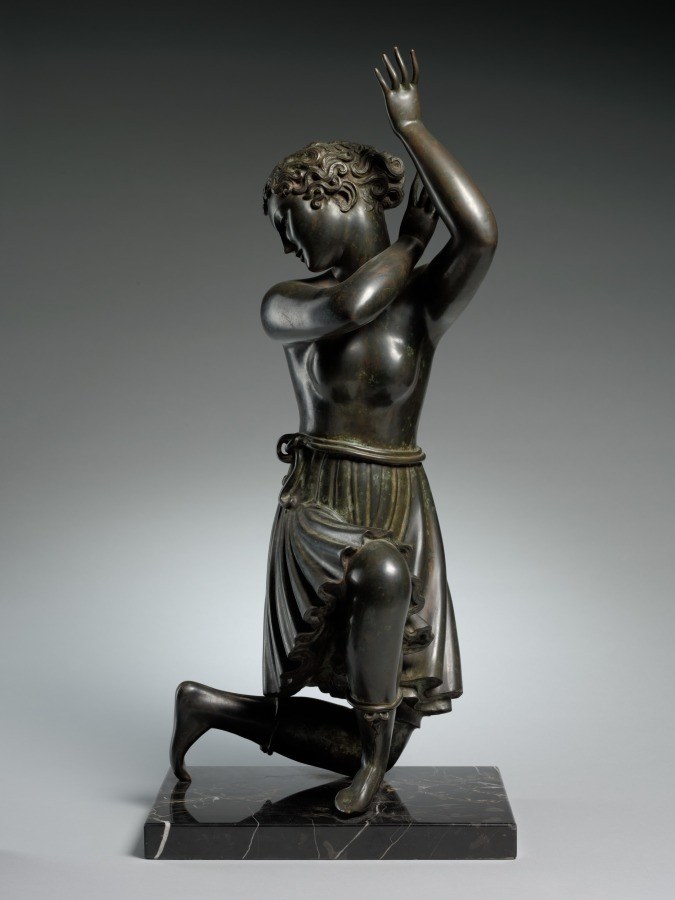
Dancing Figure
Elie Nadelman (American, born Russian Empire [now Poland], 1882–1946)
- Medium:
- bronze
- Collection:
- American Painting and Sculpture
- Source:
- Cleveland Museum of Art
- Rights:
- Public domain — free to use, share and adapt.
- Recorded as:
- CC0
Nadelman's figure demonstrates how modernist sculptors engaged with dance not as narrative spectacle but as pure movement—as a subject worthy of formal artistic investigation. The work is important for understanding how the visual arts absorbed and reflected the vocabulary of contemporary dance, translating the ephemeral into permanent form. For dancers and historians, it reveals what early 20th-century sculptors believed the essence of dance to be: balanced asymmetry, torsional energy, and the eloquence of geometric form.
What you are looking at
A bronze figure of a kneeling woman in a spiraling contrapposto pose, cast in dark patinated metal and mounted on a black marble base. The figure is nude to the waist, with drapery—rendered in sharp, geometric folds—wrapped around the hips and thighs. Her body twists in a spiral composition: the left leg is bent beneath her while the right extends or prepares to move; her left arm is raised overhead with fingers splayed, the hand opening upward; her right arm crosses her torso. The hair is rendered in tight, stylized curls. The face is turned away from the raised arm, creating a dynamic torsional tension throughout the figure. The simplified, almost Cubist modeling of the body—with smooth, rounded forms and flattened planes—is characteristic of early 20th-century modernist sculpture.
The dancing
A single female figure in a kneeling lunge or preparation pose. The raised left arm with splayed fingers echoes the position of the bent left leg beneath her, creating a rhythmic visual parallel. The torso twists sharply, the spine curved and extending upward. The weight appears concentrated in the lower body while the upper body spirals and lifts. The pose suggests a moment of unfurling or reaching, with the opposing diagonal lines of leg and arm creating forward momentum. This is a dancer's vocabulary—weight shift, core rotation, directional clarity—rendered in three dimensions.
The dance depicted
The pose cannot be confidently assigned to a specific historical dance style, but it depicts classical or modern dance vocabulary of the early 20th century. The kneeling position, spiraling torso, and reaching arm gesture suggest a moment of extension or opening common to both academic ballet and the emerging modern dance idiom. The absence of pointe shoes, the fluid asymmetry of the pose, and the modernist treatment of the body suggest this is more likely modern dance or a neo-classical ballet moment influenced by modernism. The figure embodies the expressive, continuous movement of contemporary ballet or Duncan-influenced modern dance rather than the rigid positions of 19th-century ballet.
How it was made
A bronze cast sculpture, likely created using the lost-wax process typical of modernist sculptural practice in the early 1900s. The patina indicates age and oxidation over time. The material allows Nadelman to capture both the volumetric solidity of the body and fine detail in the hair and facial features, while the smooth, simplified modeling of the limbs and torso demonstrates modernist reduction to essential forms. Bronze's permanence and the scale of the piece—intimate enough to hold but substantial—suggest this was a gallery object for an educated, affluent audience rather than a public or popular work.
About this work
This is a modernist bronze figure by Elie Nadelman, a sculptor working in the early 20th century who synthesized classical form with geometric abstraction. The work depicts a female dancer in a moment of spiraling, lifting motion—a kneeling pose that reads as both grounded and weightless. The figure exemplifies the period's fascination with distilling dance movement into essential sculptural form, treating the body as a composition of volumes and planes rather than anatomical detail.
Nadelman's practice intersected with the avant-garde dance world of his era, when artists across media were reimagining human movement through modernist lenses. This sculpture sits at the intersection of ballet, modern dance, and formalist sculpture, capturing neither a specific step nor a named style but rather the principle of spiraling, reaching motion that defined early 20th-century dance innovation.
How to look at it
Attend to the spiral. Nadelman has frozen the figure at a moment of maximum rotational tension—the hips and legs anchored, the torso and arms continuing the spiral upward and outward. Follow the line from the extended arm through the arched back and down to the kneeling legs; the composition reads as a single, continuous spiral ascending from a stable base. The artist has also paired opposing diagonals—left arm raised, left leg bent beneath—creating rhythmic visual balance. Notice how the smooth, almost abstract rendering of the body enhances the sense of pure movement; the face is simplified, featureless almost, so attention stays on the architecture of the pose rather than individual identity. This is how modernist sculptors rendered dance: not as a narrative moment but as geometric energy.
The artist
Elie Nadelman (1882–1946) was a Polish-born sculptor who worked in Paris and later the United States. He developed a distinctive modernist language that combined Classical figuration with Cubist geometric reduction. Nadelman was closely engaged with the artistic avant-garde of the 1910s and 1920s, working in multiple media and scales. His figures—often dancers, acrobats, and performers—reduced the human body to smooth, interlocking volumes, treating anatomy as material for abstract composition rather than anatomical truth. He was among the first sculptors to make dance a primary subject, producing numerous figures exploring movement, balance, and the spiral as an organizing principle.
The period
In 1916, when this sculpture was made, dance was at the center of avant-garde artistic ferment. The Ballets Russes had revolutionized ballet with radical choreography and visual design; modern dance pioneers like Isadora Duncan and Ruth St. Denis were challenging academic ballet vocabulary; and sculptors and painters across Europe were discovering in dance a pure expression of movement and form. Modernism in visual art was simultaneously engaged with primitivism, Cubism, and the geometric abstraction of the body. Dance, too, was modernizing—moving away from narrative pantomime toward abstract movement. Sculptors like Nadelman responded by making dance figures that were neither portraiture nor illustration but formal investigations into how the body moves through space.
Where it lives
The work is held in the American Painting and Sculpture collection at the Cleveland Museum of Art, part of their holdings of early modernist sculpture. As a bronze figure by a major early 20th-century sculptor, it represents the period's integration of dance into high-art sculpture practices and the status of such works in institutional American collections.
Dance in this work
Questions about this work
Is this ballet, modern dance, or something else?
It is impossible to say with certainty from the pose alone. The kneeling position, spiraling torso, and reaching arm suggest the vocabulary of both classical ballet and early modern dance. The modernist simplification of form and the absence of pointe shoes lean toward modern dance or neo-classical ballet rather than 19th-century academic ballet. Nadelman was interested in movement itself—the principle of the spiral and the extended line—rather than a specific technique.
Why is the figure kneeling?
The kneeling position allows Nadelman to create a stable base while the upper body spirals upward, demonstrating contrapposto—the Classical principle of dynamic balance through opposing forces. The pose is both grounded and weightless, suggesting a moment of lifting off, which was a central preoccupation of early 20th-century dance.
Who was Nadelman and why did he make so many dance figures?
Nadelman was a Polish-born modernist sculptor working in the early 1900s. Dance fascinated him as a subject because it was simultaneously ancient (linked to Classical Greece) and radically modern. Dancers embodied the movement and formal principles he was exploring in sculpture—balance, asymmetry, the spiral, the geometry of the body in space.
Is there a specific moment in a dance that this captures?
No. This is a composed pose that Nadelman invented to express the principle of spiraling, reaching motion. It is not a still from a choreographed phrase but rather a formal meditation on what makes a pose feel dynamic and alive.
More dance artwork





