49 works in this view — arrow keys or swipe to move between them.
Dance in Art
Equestrian Ballet in the Amphitheater of the Boboli Gardens
Stefano della Bella Italian, 1610-1664
- Medium:
- Etching on ivory laid paper
- Collection:
- Prints and Drawings
- Source:
- Art Institute of Chicago
- Rights:
- Public domain — free to use, share and adapt.
- Recorded as:
- CC0 (Public Domain)
Equestrian ballet was a precursor to and influence on early modern ballet, yet almost no trace of it survives except in prints like this. The geometric precision and theatrical framing here show how aristocratic dance was conceived as visual pattern and political allegory rather than as emotional expression or virtuosic display—a sensibility that would persist in neoclassical ballet. For historians of courtly performance and for those studying the visual culture of dance, this print is primary documentation of a spectacular form that connected horses, bodies, and space into an art form that only wealth, training, and architectural ambition could create.
What you are looking at
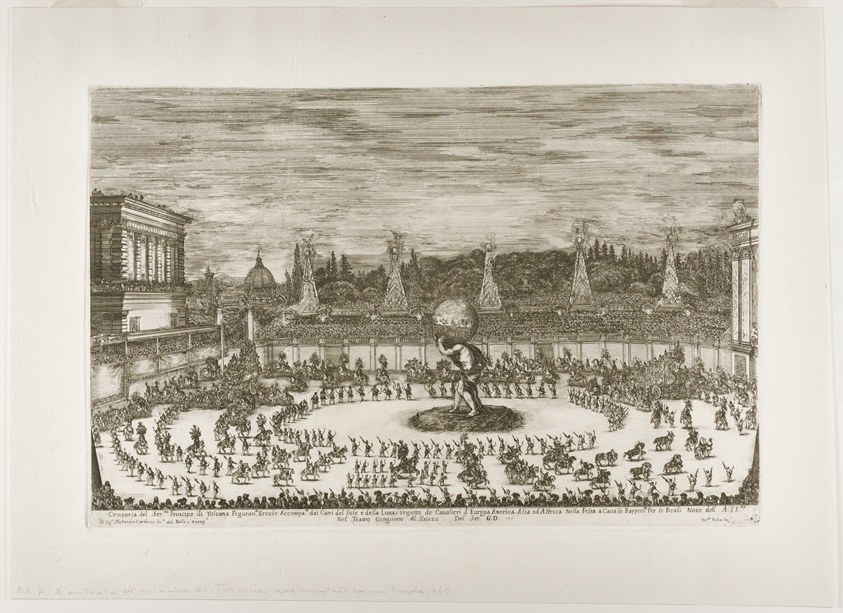
This etching presents a birds-eye view of a grand courtyard spectacle, likely the Boboli Gardens amphitheater in Florence. The composition is symmetrical and architecturally framed: colonnaded structures flank the left and right edges, with formal garden terraces visible beyond the back boundary. At the center stands an enormous sculptural figure—a male torso or atlas—around which concentric circles of precisely arranged performers are positioned. The foreground and middle ground are densely populated with spectators in period dress lining the perimeter and filling the colonnade. The etching's fine cross-hatching creates atmospheric depth, with the background fading into trees and distant structures. The scene captures a moment of formal ceremonial stillness, the crowd held in expectation or observation.
The dancing
Performers are arranged in geometric formations around the central sculpture: tightly spaced ranks moving in synchronized lines, small groups in paired or clustered formations suggesting coordinated movement. The figures are tiny at this scale, making individual gesture invisible, but their uniform positioning and rhythmic spacing convey military or balletic discipline. Mounted figures (cavalry) are distinguishable in several groups, indicating equestrian performance. The spectators—rendered in looser clusters—wear the broad-skirted and plumed dress of 17th-century nobility, their posture upright and observational.
The dance depicted
This is an equestrian ballet, a aristocratic court spectacle combining horse and rider with choreographed formation. The title identifies it as a performance in the Boboli amphitheater, which hosted such elaborate productions in Florence during the 17th century. Equestrian ballet merged horsemanship, music, and synchronized movement into a form of courtly theater reserved for the wealthiest patrons and most skilled riders. The geometric precision of the formations and the central sculptural anchor suggest a narrative or symbolic structure typical of intermezzi or court ballets, where political allegory and technical virtuosity were equally important. The artist has chosen to depict the entire event from above—a choice that emphasizes pattern, order, and spectacle rather than individual movement or emotional narrative.
How it was made
This is an etching on laid paper, a printmaking technique allowing fine detail and wide circulation beyond the original commission. Della Bella was renowned for his etchings of court festivals and military spectacles; this work exemplifies his mastery of perspective and atmospheric effect through linear hatching. Etching allowed the artist to capture complex spatial relationships and the texture of fabric, setting, and crowd with a precision that pen or chalk could not sustain. As a print, this image would have circulated among collectors and court circles across Europe, serving as both documentation and artistic celebration of Medici wealth and cultural ambition. The view from above was unusual and required considerable optical calculation, suggesting both theoretical sophistication and practical experience with perspective systems.
About this work
This etching documents an equestrian ballet, a form of courtly spectacle that combined trained horses, mounted performers, and choreographed human dancers in elaborate geometric formations. Created by Stefano della Bella, one of the 17th century's finest printmakers of court festivals, the work captures a performance in the Boboli Gardens amphitheater in Florence—a venue designed for such elaborate displays. The image is valued less for what it shows of dance as movement than for what it reveals about courtly values: precision, symmetry, hierarchy, and the fusion of multiple arts (horsemanship, choreography, architecture, sculpture) into a unified spectacle. It belongs in a gallery of dance art as evidence of a performance tradition that has largely disappeared but shaped the aesthetics of ballet itself.
How to look at it
View this print from a distance first to grasp the symmetry and spatial composition—the eye is drawn along the geometric formations toward the central male figure, then out to the colonnade and landscape beyond. Then move close to examine the fineness of the etching: the way cross-hatching creates shadow and depth, how the figures are differentiated by scale and position to indicate space, and how the artist has suggested movement through the spacing and alignment of the tiny forms. Notice the radical bird's-eye perspective—this overhead view is neither natural nor accidental; it was a deliberate choice that transforms a lived event into a pattern, emphasizing order and design over narrative or passion. Ask yourself what the artist wanted us to see: not the experience of the riders or dancers, but the geometric harmony of the entire system.
The artist
Stefano della Bella (1610–1664) was a Florentine etcher and printmaker renowned for his meticulous documentation of courtly spectacles, military encampments, and festivals. He spent much of his career in Florence under Medici patronage, producing hundreds of prints that circulated throughout Europe and served as both artistic objects and historical records. His technique was unusually refined for the period; he combined architectural precision with atmospheric effects and a keen eye for costume, pageantry, and ritual. His prints of court festivals and equestrian performances were widely collected and imitated, making him one of the most influential printmakers of the 17th century.
The period
Equestrian ballet flourished in Italy during the 16th and 17th centuries, especially at the Medici court in Florence and the courts of Mantua and Urbino. These performances were related to both Renaissance tournaments and to the development of court ballet in France; they represented a fusion of medieval chivalry, classical learning, and emerging theatrical spectacle. By 1661, when this print was made, court ballet in its pure form was already shifting toward the French style and eventually toward academic ballet as codified at Louis XIV's court. The Boboli Gardens amphitheater itself, designed in the early 17th century, was purpose-built for such spectacles and remains a testament to the architectural investment these performances warranted. Equestrian ballet was primarily a display of aristocratic power and refined taste—a form that required vast resources and was rarely accessible to common people.
Where it lives
This etching is held in the Prints and Drawings collection of the Art Institute of Chicago. It is one of several prints by della Bella documenting Medici court spectacles and represents a category of prints—festival documentation—that were both artistic objects and historical records, collected by scholars, artists, and connoisseurs as evidence of courtly magnificence and as technical exemplars.
Dance in this work
Questions about this work
What exactly is an equestrian ballet?
An equestrian ballet was a court spectacle combining trained horses and riders with human dancers and musicians, all moving in choreographed formations. It was primarily an aristocratic entertainment that merged horsemanship, dance, music, and visual symbolism into a unified theatrical event. These performances required enormous resources and were staged only in wealthy courts; they eventually declined as court ballet evolved into the form we recognize today.
Why is the view from above?
This overhead perspective was a deliberate artistic choice that emphasizes geometric pattern and architectural order over individual movement or narrative. From above, the formations become visible as abstract designs—concentric circles and radiating lines—which was precisely the point. Courtly spectacles were meant to display power through perfect order and control, and this view makes that ideology visible in a way a ground-level perspective could not.
Who would have performed in an event like this?
Equestrian ballets were performed by noblemen and sometimes courtly professionals, all riders of considerable skill. Unlike theater, which employed hired actors, these performances were acts of courtly self-display—an arena in which the aristocracy demonstrated wealth, training, and refined taste. The central figure or narrative was often allegorical or mythological, designed to reflect glory on the ruling family.
How do we know what happened if the figures are so tiny?
We rely on written descriptions, musical scores, and architectural plans that accompanied such spectacles. Della Bella's prints document the spatial and visual grandeur but not the movement itself. For historians, these images are invaluable as evidence of scale, costume, and design—they just don't tell us how the horses and dancers actually moved.
More dance artwork





