49 works in this view — arrow keys or swipe to move between them.
Dance in Art
The Opening Assembly of the Equestrian Ballet
Stefano della Bella Italian, 1610-1664
- Medium:
- Etching on ivory laid paper
- Collection:
- Prints and Drawings
- Source:
- Art Institute of Chicago
- Rights:
- Public domain — free to use, share and adapt.
- Recorded as:
- CC0 (Public Domain)
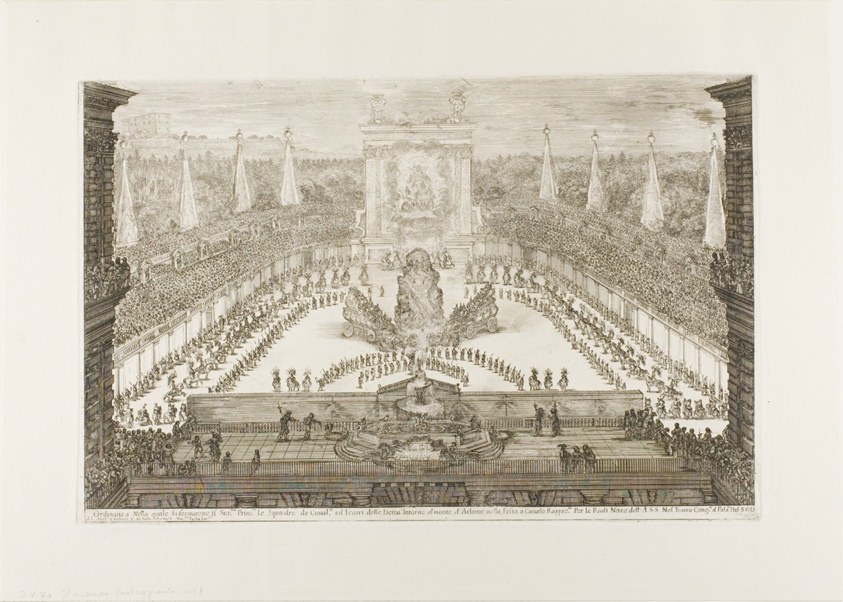
Equestrian ballet is a largely forgotten form, yet it was a major court entertainment throughout the 17th century and influenced the development of ballet itself. This etching is one of the few contemporary visual documents of how these events actually looked—the scale, the formations, the integration of riders and horses into choreographed patterns. It reveals that 'dance' in the court was understood broadly to include any rhythmic, coordinated movement of the body in ceremonial or entertainable space, not confined to figures on foot.
What you are looking at
A grand equestrian ballet unfolds in a vast enclosed arena, viewed from a elevated stage or pavilion in the foreground. Hundreds of spectators crowd the tiered galleries on both sides, their attention fixed on the performance below. The arena floor is occupied by mounted riders in formal dress, arranged in precise geometric formations and lines. At the far end stands an ornate architectural structure—a triumphal arch or ceremonial gateway—suggesting this is a state occasion of considerable importance. The space is hung with white banners or drapes from the upper galleries, creating a formal, almost sacred atmosphere. The composition is rendered in meticulous perspective, with the viewer placed as if among the nobility witnessing the spectacle; the scale emphasizes the grandeur and the coordination required to stage such an event.
The dancing
The mounted performers maintain upright, formal postures on their horses, arranged in multiple parallel lines and columns that create visual rhythms across the arena floor. The riders appear uniformly dressed in courtly attire, their bodies held in the composed, vertical carriage expected of haute école horsemanship. Rather than individual athletic gesture, the visual emphasis falls on the collective geometry created by dozens of riders moving in synchronization—the bodies matter less as individual dancers than as elements of a vast, living pattern.
The dance depicted
This is a ballet équestre or equestrian ballet, a form of court spectacle developed in Renaissance Italy and refined in the courts of Louis XIV's France during the 17th century. These performances combined horsemanship, choreography, music, and pageantry into elaborate state entertainments. The riders performed intricate patterns, formations, and processions, often with allegorical or political significance. The 'Opening Assembly' suggests this is the formal processional or inaugural moment, before the more complex figures and riding displays that would have followed. This was entertainment for the nobility, executed by noblemen and officers, and meant to demonstrate both the grandeur of the court and the military discipline and elegance of its cavalry.
How it was made
This is an etching on laid paper, a reproductive medium that allowed the distribution of this image far beyond those who witnessed the event itself. The fineness of the etched line and the dense cross-hatching used to render depth, shadow, and the mass of the crowd demonstrate the technical sophistication required to capture architectural complexity and human scale simultaneously. As a printed work, this served a documentary and celebratory function—a record of a costly, ephemeral spectacle made permanent and shareable among the literate elite across Europe. The title and inscription at the base (in French) suggest this was published as a commemorative print, likely for aristocratic and court audiences.
About this work
Stefano della Bella, an Italian printmaker working in Paris during the reign of Louis XIV, documented this equestrian ballet with a precisely rendered etching that captures both the spectacular scale of court entertainment and the formal choreography of mounted nobility. The work is a visual record of a specific historical moment—a state performance—frozen in the moment of formal assembly. For dance history, it is one of the few surviving images of equestrian ballet in performance, a form now known primarily through literary accounts and the rare surviving prints like this one. The composition demonstrates how the early modern court understood spectacle: as the coordination of human bodies (and animal bodies) in space, arranged to create visual and geometric harmony, all witnessed and ratified by the assembled nobility.
How to look at it
Attend first to the vast architecture of human and animal bodies: the eye is drawn down a rigorous perspective toward the ceremonial gateway, and the formal lines of riders guide that movement. The artist has chosen to show the assembly moment—the formation-taking, the preparation—rather than action. Notice how the individual riders are nearly interchangeable; this is not a picture of individual performers but of collective order. The crowd in the galleries frames and legitimizes the spectacle, their mass testifying to its importance. The formal dress, the banners, the arch all work together to say: this is not sport, it is ceremony, and its purpose is the display of courtly power and elegance.
The artist
Stefano della Bella (1610–1664) was a Florentine etcher and printmaker who spent much of his career in Paris, where he became a favored recorder of court life and spectacle under Louis XIV. He was prolific in documenting military maneuvers, processions, festivals, and theatrical events, producing thousands of prints that circulated among European nobility and collectors. His work is characterized by precise draftsmanship, inventive compositions that manage vast crowds and architectural space, and a gift for capturing the ceremonial moment. He was less a painter of private religious or mythological scenes and more a journalist of power, recording the visible grandeur of the early modern court.
The period
The equestrian ballet flourished in the 17th century as an evolution of the Renaissance *carosello* (carousel) and the court *ballet de cour*. As the ballet dansé was developing on the indoor stage—becoming more technically formalized and dominated by professional dancers—the equestrian ballet remained the province of the nobility itself, a way for them to perform their status and martial prowess. By the time della Bella made this etching in 1661, the form was reaching its height in the French court. The printed record was essential: these events were expensive, one-time performances (or repeated only occasionally), and their documentation in engraving and etching made them legible as cultural achievements to those who could not attend. The print circulated as evidence of royal splendor and artistic sophistication.
Where it lives
The work is held in the Prints and Drawings collection of the Art Institute of Chicago. It is a print of the type that would have been produced for sale or gift to court officials and collectors, making it a form of artistic merchandise that helped disseminate the image and memory of such spectacles.
Dance in this work
Questions about this work
Was equestrian ballet a real form of dance, or just a military display?
It was both. These events combined the precision and geometry valued in military drill with the music, costume, and choreographed pattern-making associated with dance. The riders moved to music in predetermined formations; their horses were trained to perform measured gaits and movements. It was 'dance' in the sense of coordinated, rhythmic, aestheticized movement—even though it was mounted and involved no footwork in the classical sense.
Who performed in equestrian ballets?
Nobility, officers, and occasionally professional riders hired for their equestrian skill. These were not entertainments by servants or hired performers (as ballet dansé increasingly became), but displays by the nobility themselves, designed to showcase their wealth, training, and courtly sophistication. This made them politically significant: participating in an equestrian ballet was a form of public status-making.
Why are there so few images of these events?
Because they were rare, expensive, and ephemeral. Each performance required months of planning, training of horses and riders, construction of temporary or permanent arenas, and the coordination of hundreds of people. Documentation in print was a way of extending the life of the spectacle and broadcasting its magnificence to those who did not or could not attend. Only events of major political or celebratory significance were recorded in engravings like this one.
How does this relate to modern ballet?
Modern ballet developed from the court ballet dansé, not the equestrian ballet, but both emerge from the same culture: the Renaissance and early modern court's understanding of the body as an instrument of order, beauty, and hierarchical display. Equestrian ballet represents one branch of that development—one that remained tied to the nobility and to the horse, and thus did not survive into the era of professional, foot-based theatrical dance.
More dance artwork





