49 works in this view — arrow keys or swipe to move between them.
Dance in Art
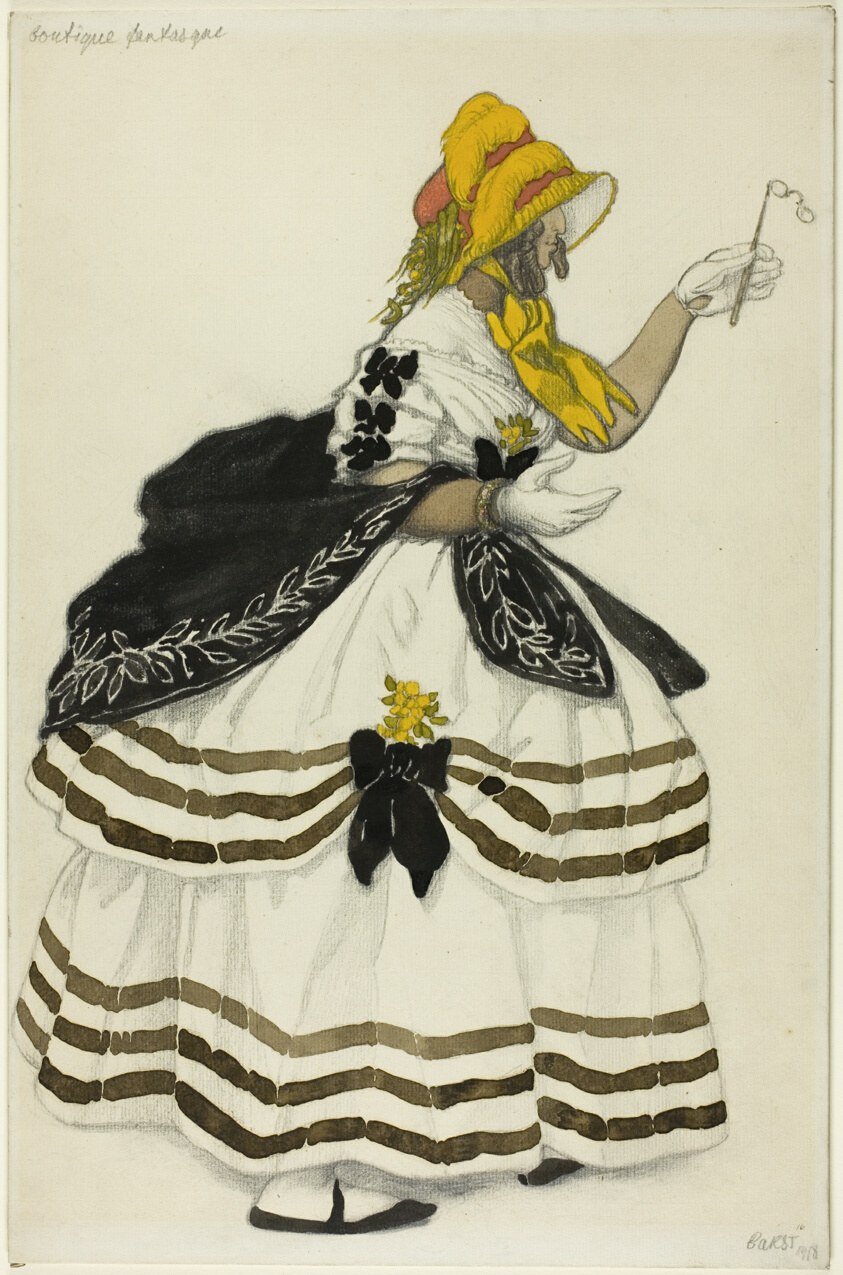
Costume Design for Woman with a Lorgnette, for Ballet Boutique Fantastique
Léon Bakst Russian, 1868-1924
- Medium:
- Watercolor and graphite, with touches of gouache and gold metallic paint, on ivory laid paper, laid down on gray board
- Collection:
- Prints and Drawings
- Source:
- Art Institute of Chicago
- Rights:
- Rights reserved by the holding institution — do not reuse without permission. Source record ↗
- Recorded as:
- AIC — rights reserved
Bakst was the supreme colorist and costume designer of the Ballets Russes, and this design exemplifies his ability to create instantly recognizable characters through dress alone. The work shows how early 20th-century ballet theater used exaggeration and visual spectacle to satirize contemporary society, and documents the aesthetic collaboration between choreography and design that defined modernist dance. For historians of fashion, theater, and ballet, this design is evidence of how dancers' bodies were framed and supported by costume as an equal partner in meaning-making.
What you are looking at
A single figure in three-quarter view holds a lorgnette (opera glasses) aloft in one gloved hand, with arm extended in a graceful arc. The dancer wears an elaborate costume dominated by a white skirt with horizontal stripes in brown and cream, layered in a full bell shape that extends to the ankles. A black embroidered cloak or cape with white leaf-pattern details is draped across the back and sides of the figure. The torso is fitted white with a black bow at the chest and a small yellow flower accent. Most striking is the headpiece: an enormous yellow plumed hat towers above the head, adorned with ribbon bows in pink and red, and topped with curling feathers. The figure stands with weight forward on the balls of the feet, creating a sense of buoyancy and theatrical presence. The composition is set against a plain cream background, focusing all attention on the exuberant costume and the deliberate gesture of the raised lorgnette.
The dancing
The single dancer is depicted in a formal but spirited pose, with the raised arm holding the lorgnette creating an elegant upward diagonal line through the composition. The stance is upright with legs positioned to suggest mobility—the body does not rest heavily on the ground but rather appears ready to move. The gloved hand is extended with fingers holding the viewing instrument, and the posture of the torso suggests a theatrical presentation rather than active dancing. The figure's profile and three-quarter orientation allow the full spectacle of the costume to be read: the volume of the skirt, the dramatic drape of the cloak, and the towering headpiece all create a silhouette of maximum visual impact.
The dance depicted
This is a costume design for a character in *Ballets Russes* or *Ballets Fantastiques* productions of the early 20th century, likely representing a fashionable society woman or caricatured aristocratic figure. The lorgnette is a prop that identifies the character as a woman of means and social pretension, a common type in pantomime and comic ballet of the Belle Époque. The exaggerated scale of the hat, the decorative excess of the costume, and the deliberate artificiality of the pose all suggest this is a character role rather than a classical corps or soloist part. The design itself does not depict active dance movement but rather the theatrical presentation and character moment—the dancer would move through the choreography in this costume, but this drawing captures a moment of character display, possibly during an entrance or a scene of social display.
How it was made
The work is executed in watercolor with graphite underdrawing, touches of gouache, and gold metallic paint on ivory laid paper mounted on gray board. This mixed-media approach was standard for theatrical costume design in the early 20th century, allowing the designer to build color and texture gradually. Watercolor permitted rapid revision and the delicate layering of transparent washes, visible in the striping of the skirt and the subtle modeling of the face. The gold paint is reserved for highlights and ornamental detail—the leaf patterns on the cloak, the decorative elements of the hat. This technique was intended for immediate practical use by costumers and dancers rather than for display, making it a working document within the theatrical production process.
About this work
This is a costume design by Léon Bakst for a character role in an early 20th-century ballet spectacle, likely created for the Ballets Russes or a related company working in the tradition of theatrical fantasy and commedia dell'arte. The figure wears the exuberant dress of a fashionable woman at play—enormous plumed hat, horizontally-striped skirt of balletic fullness, embroidered cloak, and the lorgnette as a prop establishing social pretension. Bakst's design is a masterpiece of decorative excess and deliberate artificiality, using costume to create character and comedy rather than to support classical movement. The work documents a moment in early modernist theater when dance, visual design, and satire of contemporary society converged in the productions of the Ballets Russes. This is not a record of how bodies move but of how costume can embody character, personality, and the theatrical moment.
How to look at it
Observe how Bakst uses the horizontal stripes of the skirt to create rhythm and visual movement even though the figure is static. The stripes make the skirt read as a structure of repeated units, almost architectural, which emphasizes the formality and artificiality of the costume. The towering hat draws the eye upward and outward, creating a sense of visual excess and deliberate exaggeration—this is not a realistic portrait of dress but a caricature of fashion. The raised arm and lorgnette establish the character's social pretension and vanity: she is displaying herself. The gold leaf details on the cloak and the careful handling of light suggest a luxury object, befitting a society woman. Notice how Bakst leaves much of the paper bare, allowing the cream background to read as light, which gives the figure an almost glowing, theatrical presence.
The artist
Léon Bakst (1868–1924) was a Russian painter and theatrical designer, and one of the most influential visual artists associated with the Ballets Russes. He created costume and set designs for Sergei Diaghilev's company from 1909 onward, establishing a visual language that combined historical reference, contemporary fashion, and painterly exuberance. Bakst's work was characterized by bold color, decorative richness, and an understanding of how costume moves with the dancer's body. He designed for ballets ranging from classical revivals to avant-garde experiments, and his influence on 20th-century theatrical design was profound. His costume designs exist as independent artworks—paintings and drawings in their own right—while simultaneously serving as technical documents for production.
The period
This design dates to 1918, late in Bakst's career and in the midst of World War I, when the Ballets Russes continued to tour despite the upheaval in Europe. The early 20th century saw a revolution in theatrical design and costume, driven partly by the Ballets Russes' commitment to integrating all elements of production—dance, music, visual design, and narrative—into unified wholes. The fashion world and the theater informed each other reciprocally; contemporary silhouettes and accessories like the lorgnette were both documented and satirized in ballet productions. The exaggerated costumes of Bakst and his contemporaries reflected anxieties and fascinations with modernity, luxury, and social performance that characterized the era. At the same time, such character roles and comic ballets existed in tension with the classical and modernist experiments that dominated the Ballets Russes' public reputation.
Where it lives
The work is held in the Prints and Drawings collection at the Art Institute of Chicago. As a costume design on paper, it represents the category of theatrical ephemera that documents the visual history of dance and theater production. Such designs were sometimes preserved by dancers, costumers, or the companies themselves, and many have entered museum collections where they are now treated as significant artworks rather than disposable working documents.
Dance in this work
Questions about this work
What is a lorgnette?
A lorgnette is a pair of opera glasses or a magnifying lens held on a handle, typically used by fashionable women of the 19th and early 20th centuries to view performances or other spectacles. In this design, it functions as both a practical prop and a symbol of the character's social status and vanity. The raised lorgnette suggests the character is both watching and being watched—a key element of theatrical comedy.
Was this costume actually worn?
The design would have been used by the costumers to create an actual garment for the dancer to wear in performance. Whether this exact design was executed and survives is not documented. Bakst's designs sometimes departed from what could practically be constructed or moved in, so the final costume may have been simplified or modified for the dancer's mobility and safety.
What ballet is this for?
The catalogue identifies this as a design for *Ballet Boutique Fantastique* (or *Ballets Fantastiques*), which suggests a production centered on fantasy, social satire, and theatrical spectacle rather than classical narrative. The specific choreography and music are not recorded, and without further documentation, it is difficult to determine whether this design was actually used in a specific production or was a study or proposal.
Why is the costume so exaggerated?
The exaggeration—the enormous hat, the bold stripes, the ornate cloak—serves multiple purposes: it makes the character instantly recognizable from a distance, creates a silhouette that reads clearly on stage under theatrical lighting, and establishes the character as comic or satirical rather than serious. This aesthetic was central to the Ballets Russes, which treated dance and design as equal partners in creating theatrical meaning.
More dance artwork





