49 works in this view — arrow keys or swipe to move between them.
Dance in Art
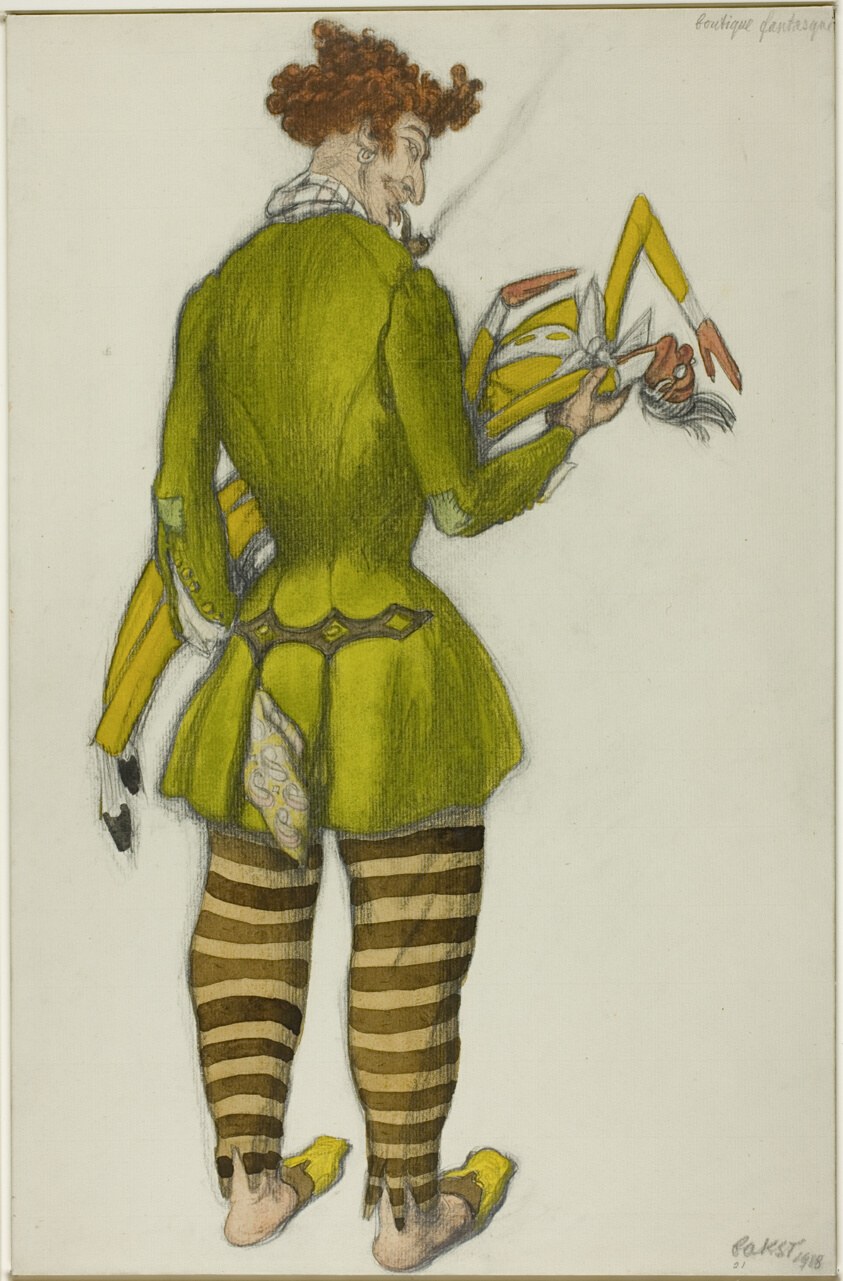
Costume Design for Man in a Green Jacket, for Ballet Boutique Fantasque
Léon Bakst Russian, 1868-1924
- Medium:
- Watercolor and graphite on ivory laid paper, laid down on gray board
- Collection:
- Prints and Drawings
- Source:
- Art Institute of Chicago
- Rights:
- Rights reserved by the holding institution — do not reuse without permission. Source record ↗
- Recorded as:
- AIC — rights reserved
Léon Bakst's costume designs defined the visual identity of early modern ballet and exerted influence far beyond the theatre. This drawing exemplifies his approach: bold color, theatrical exaggeration, and a deep understanding of how fabric and silhouette read from an audience's distance. For dancers and historians, the work demonstrates how costume design shapes performance meaning and how character roles were understood and communicated in the early twentieth century.
What you are looking at
A single male figure stands in three-quarter view against a plain background, angled to show both profile and front. He wears a vibrant lime-yellow-green jacket with a distinctive peplum waist that flares sharply over the hips, revealing decorative white fabric beneath with ornamental patterning. The jacket has substantial padding at the shoulders and deep blue-green striping along the sleeves. His legs are covered in boldly striped stockings in alternating bands of dark brown and pale cream or tan. His feet are small and turned outward, clad in yellow shoes with what appear to be decorative curls or flourishes. His face is drawn with exaggerated features—a prominent nose, sharp chin, and tousled reddish-brown curled hair—giving him a theatrical, comic character. He holds one arm behind his back and the other extends forward as if presenting or gesturing, with a painted or stylized hand. The drawing employs watercolor washes for the yellow and green tonalities, with ink outlines defining form and detail.
The dancing
A solitary figure in an artificial pose that emphasizes display over naturalism. The posture is deliberately staged—weight appears evenly distributed or slightly favoring the back leg, with the forward arm extended in a presentational gesture suggestive of court manner or theatrical convention. The turned-out feet and the exaggerated proportions of the torso (especially the pronounced peplum) suggest a dancer's silhouette, though the static pose is one of presentation rather than action. The figure reads as a character type or stock role rather than a naturalistic body in motion.
The dance depicted
This is a costume design for theatrical dance, likely for a character in an early-twentieth-century ballet or theatrical entertainment. The term 'Boutique Fantasque' (Fantastic Boutique) suggests a production of short comic or character pieces, typical of early-modernist ballet programming of the 1910s–20s. The exaggerated costume—the peplum jacket, striped stockings, and comic physiognomy—indicates a character dance or comic male role, possibly a merchant, courtier, or valet figure drawn from commedia dell'arte traditions that fed early ballet satire. The pose is one of theatrical presentation rather than technical display, suggesting mime or character acting rather than classical technique.
How it was made
Watercolor and graphite on ivory laid paper, mounted on gray board. The technique allows for rapid notation of color and silhouette—essential for costume design communication—while the graphite underdrawing provides precise definition of form. The method is typical of theatrical costume design of the period: economical, direct, and focused on the visual impact of dress rather than anatomical subtlety. The mounting suggests this was a presentation piece, possibly shown to dancers, directors, or patrons for approval before execution.
About this work
This is a costume design drawing by Léon Bakst for a male character in a 1918 ballet production. Bakst's designs were among the most influential in early-twentieth-century theatrical dance, defining the visual language of the Ballets Russes and its successors. The drawing captures the theatrical wit and coloristic boldness that made his work legendary: the lime-yellow jacket and striped stockings transform the male body into a vehicle for comic character and visual pleasure. As a design document, it reveals how Bakst translated choreographic intention into silhouette and ornament—how the peplum waist and bulging proportions would read from the audience as a recognizable character type, and how color harmony (the yellow against blue-green and warm browns) would anchor the figure within a larger stage composition.
For a dance historian, this drawing is valuable documentation of how male character roles were conceived and costumed in early-twentieth-century ballet. It demonstrates the persistence of commedia dell'arte influences in modernist dance, and the degree to which early ballet design relied on exaggerated silhouette and bright color rather than illusionistic representation. The drawing also speaks to Bakst's own practice: he was not primarily a painter but a designer for the stage, and his drawings were working documents—quick, assured, and directly purposeful.
How to look at it
Note the exaggeration of the costume's proportions—the peplum is dramatically wide, the legs are stick-thin beneath it, the shoes are small and delicate. This disproportion is deliberate: from the audience, the silhouette would read as a comic or character type instantly recognizable within theatrical convention. Watch how Bakst has used color to organize the figure: the yellow jacket draws the eye, the striped stockings anchor it, the shoes complete it. The pose itself—turned-out feet, one arm back, one arm forward—is one of presentation, not action; it shows the costume from the front and side simultaneously, allowing a viewer (dancer, director, or patron) to understand how the costume would appear in space. The careful notation of patterning (the white and ornamental details on the skirt underlay, the blue striping on the sleeves) indicates Bakst's attention to how light and movement would animate the design on stage.
The artist
Léon Bakst (1868–1924) was a Russian painter, designer, and impresario who became one of the most influential theatrical designers of the early twentieth century. He was a founding member of the Mir iskusstva (World of Art) movement and served as principal designer for Sergei Diaghilev's Ballets Russes from its founding in 1909. Bakst's designs were celebrated for their vivid color, historical and ethnographic imagination, and the precision with which he understood the dancer's body in motion. He designed costumes, sets, and lighting for over eighty productions, establishing a new standard for theatrical design as a total art form integrated with choreography. His work influenced fashion and interior design as well as dance.
The period
This drawing dates to 1918, a moment when the Ballets Russes was at the height of its influence and when theatrical design had begun to embrace modernism while maintaining links to historical and vernacular traditions. The decade following 1910 saw sustained experimentation with commedia dell'arte subjects and comic character dances—partly in reaction to the dominance of romantic and exotic narratives. Bakst's designs from this period often drew on folk and historical sources, translated through a modernist sensibility. By 1918, however, the Ballets Russes was beginning to fragment, and new directions were emerging in both dance and design—yet Bakst's approach to color and silhouette remained central to how dance was visualized for the stage.
Where it lives
This drawing is housed in the Prints and Drawings collection of the Art Institute of Chicago, indicating it was acquired as part of a collection of design materials or theatre ephemera. The mounting on gray board and the notation style suggest it was a presentation or working drawing, created for communication within a theatre company or to a client.
Dance in this work
Questions about this work
What was Boutique Fantasque?
Boutique Fantasque (Fantastic Boutique) was likely a short theatrical piece or suite of pieces in the style common to early-twentieth-century ballet programming. The Ballets Russes and similar companies frequently presented programs of short works, often comic, character-driven, or based on folk and historical subjects. The title suggests a fantastical or satirical shop or setting, possibly drawn from commedia dell'arte or pantomime traditions.
Why is this figure so exaggerated?
The exaggeration—the enormous peplum, tiny legs, comic face—is a deliberate design choice for theatrical legibility and character establishment. From the audience, such proportions would read instantly as a recognizable type: a comic servant, merchant, or courtier. Theatrical design does not aim for naturalism but for clarity and visual pleasure; the distortion is the point.
How did Bakst know how to design costumes that dancers could actually move in?
Bakst worked closely with dancers and choreographers; he understood the body in motion from experience and observation. His designs, though theatrical and sometimes exaggerated in proportion, were always conceived with the dancer's needs in mind. The peplum here, for instance, is designed to move and flare with the body, and the light shoes allow for the turned-out stance shown.
What makes this a character dance rather than classical ballet?
Character dances were theatrical dances based on folk, historical, or comic sources, performed in shoes rather than pointe, and emphasizing personality and narrative over technical virtuosity. The costume—the comic exaggeration, the reference to historical dress, the stockings rather than tights—marks this as a character role. Classical ballet, by contrast, used simpler costumes (tutus, tights, pointe shoes) that highlighted the body's lines and technical feats.
More dance artwork





