49 works in this view — arrow keys or swipe to move between them.
Dance in Art
A29: South Carolina Ballroom, 1775-1835
Designed by Narcissa Niblack Thorne American, 1882-1966
- Medium:
- Miniature room, mixed media
- Collection:
- Applied Arts of Europe
- Source:
- Art Institute of Chicago
- Rights:
- Public domain — free to use, share and adapt.
- Recorded as:
- CC0 (Public Domain)
For historians of American social dance, this miniature room offers a rare, detailed record of the ballroom environment in which early American couple dances were actually performed. It shows the spatial, social, and material context that shaped how dances like the Minuet and Cotillion were executed and experienced. Thorne's meticulous attention to period furnishings and architectural detail provides evidence about the sensory and social world of early 19th-century plantation life that written descriptions alone cannot convey.
What you are looking at
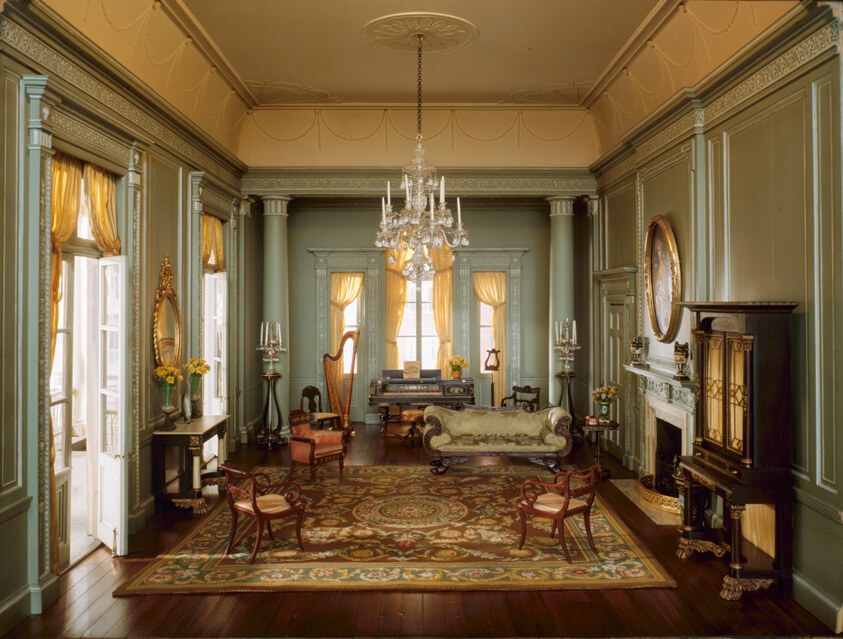
This is a meticulously crafted miniature room representing a wealthy South Carolinian ballroom of the late 18th and early 19th centuries. The space is a formal interior of considerable elegance: pale green-grey walls with classical pilasters and ornamental dentil molding, a coffered and decorated ceiling, tall multi-paned windows with golden-yellow silk drapery admitting natural light, and a dark parquet floor. A large ornate crystal chandelier hangs centrally. The room is furnished with period pieces including mahogany chairs with carved frames arranged around the perimeter, a sofa, a fireplace with mantelpiece, and side tables. The scale and arrangement suggest a space designed for social dancing and courtship. No figures are present, yet the composition and furnishings constitute a complete and historically specific stage for the formal dances of the plantation gentry.
The dancing
No dancers are depicted. The room itself is the subject, arranged to receive the figures and movements that would have filled such a space during a ball. The furniture arrangement—chairs positioned along the walls, open floor space in the center, the placement of the fireplace and windows—all reflect the spatial demands of formal couple dances performed in the presence of an observing company.
The dance depicted
Although no dancers are present, the architectural and furnishing evidence points to the ballroom dances of the American early republic: the Minuet, the Cotillion, and the Reel, which were the standard forms of social dancing in South Carolina planter society during the period labeled. The room's proportions, wall seating, and open center are consistent with the promenade and figure work these dances required. The window view and the furnishings evoke the context in which these dances were learned, performed, and used to negotiate social rank and courtship.
How it was made
This is a miniature room—a scale model or diorama constructed from mixed media to represent historical interior design. The walls, floor, ceiling, and fittings appear to be crafted from wood, plaster, paint, and period-appropriate fabrics. Such miniature rooms were an established form of decorative and educational object in the 20th century, allowing detailed study of historical interiors and furnishings at a smaller scale. This technique permitted precise recreation of architectural detail and period-accurate decoration, and was well-suited to museum display and scholarly interpretation.
About this work
This work is a miniature reconstruction of a South Carolinian ballroom dating to the period 1775–1835, a critical era for American social dancing and courtship ritual. Created in 1937 by Narcissa Niblack Thorne, a master of the miniature room genre, it documents the physical and social setting in which formal partner dances—minuets, cotillions, reels—were performed by the planter class. The room is empty of dancers, yet its every detail—the arrangement of seating, the scale and ornament of the space, the light from tall windows—speaks to the rituals and hierarchies these dances embodied. Thorne's work sits at the intersection of decorative arts history, architectural history, and the material culture of dance: she reconstructs not the moment of dance itself, but the stage upon which social choreography unfolded.
How to look at it
Observe the spatial logic of the room: note the perimeter seating and the large open floor, which are characteristic of the formations required for Minuet and Cotillion. The placement of the chandelier—central overhead—suggests the focus on the dancing couple at the room's heart, with the assembled company as observers and judges. The tall windows and formal proportions reflect the architecture of English country houses and Charleston townhouses of the period. Look at the furnishings not as mere decoration but as evidence of wealth and access: the quality of the drapery, the finish of the mahogany, the presence of the chandelier all mark this as the ballroom of a planter family of considerable means. The absence of figures paradoxically makes the space itself the subject—we see the stage set but must imagine the movement.
The artist
Narcissa Niblack Thorne (1882–1966) was an American collector and designer renowned for her meticulously researched and executed miniature period rooms. Created between the 1920s and 1960s, her rooms were intended as educational tools that would preserve and display historical interior design and decorative arts. Her collection, now held at the Art Institute of Chicago, numbers in the hundreds and spans periods from the Renaissance to the early 20th century, with particular emphasis on European and American domestic interiors. Thorne's work combined rigorous historical research with exceptional craftsmanship, making her rooms valued resources for museum education and design history.
The period
The period 1775–1835 encompasses the American Revolution and the early republic, during which social dancing remained a primary means of courtship, social advancement, and the performance of gentility among the white planter and merchant classes. The Minuet, imported from Europe, held particular prestige; the Cotillion and country dances (including the Reel) offered more open participation. South Carolina, as a wealthy planter colony and later state, maintained strong cultural ties to England and Europe, and the ballrooms of Charleston and plantation estates were stages for the display of fashion, education, and social rank. By the early 19th century, these dances were taught to children of elite families as marks of proper breeding, even as Romanticism and the rise of the waltz would eventually reshape social dancing.
Where it lives
This miniature room is held by the Art Institute of Chicago as part of its collection of Thorne's works. It was designed in 1937 as part of Thorne's larger project to document and preserve historical American and European interior design through scale models. Such rooms were originally intended for exhibition and education, allowing viewers to study period design in detail.
Dance in this work
Questions about this work
Why is there no one dancing in this ballroom?
Thorne's miniature rooms were designed as historical documents of interior design and architecture, not as narrative scenes. The empty room focuses attention on the setting itself—the proportions, furnishings, and spatial arrangements that shaped how social dances were performed. The absence of figures also allows viewers to study the architectural details without distraction.
What dances would have been performed in a South Carolina ballroom of this period?
The Minuet was the most prestigious, performed by a single couple while others watched. The Cotillion (a figured dance for sets of couples) and country dances such as the Reel allowed broader participation. By the early 19th century, the Quadrille and Waltz were also gaining popularity. These dances served as crucial rituals of courtship and social rank among the planter class.
How historically accurate is this room?
Thorne was known for meticulous research and attention to period detail. She consulted historical documents, existing examples, and expert advisors to ensure her rooms reflected the styles, proportions, and furnishings of their era. The architectural elements, wall treatment, fireplace design, and furnishings visible here are consistent with documented examples of late 18th and early 19th-century American ballrooms, particularly those in the South.
What was the significance of the ballroom in early American society?
The ballroom was where social rank, education, and eligibility were publicly performed. Mastery of formal dances demonstrated breeding and refinement; a young woman's first appearance in the ballroom was a crucial social event. For the planter class of South Carolina, the ballroom was also a space where wealth and taste were displayed through architecture, furnishings, and the ability to host elegant entertainments.
More dance artwork