49 works in this view — arrow keys or swipe to move between them.
Dance in Art
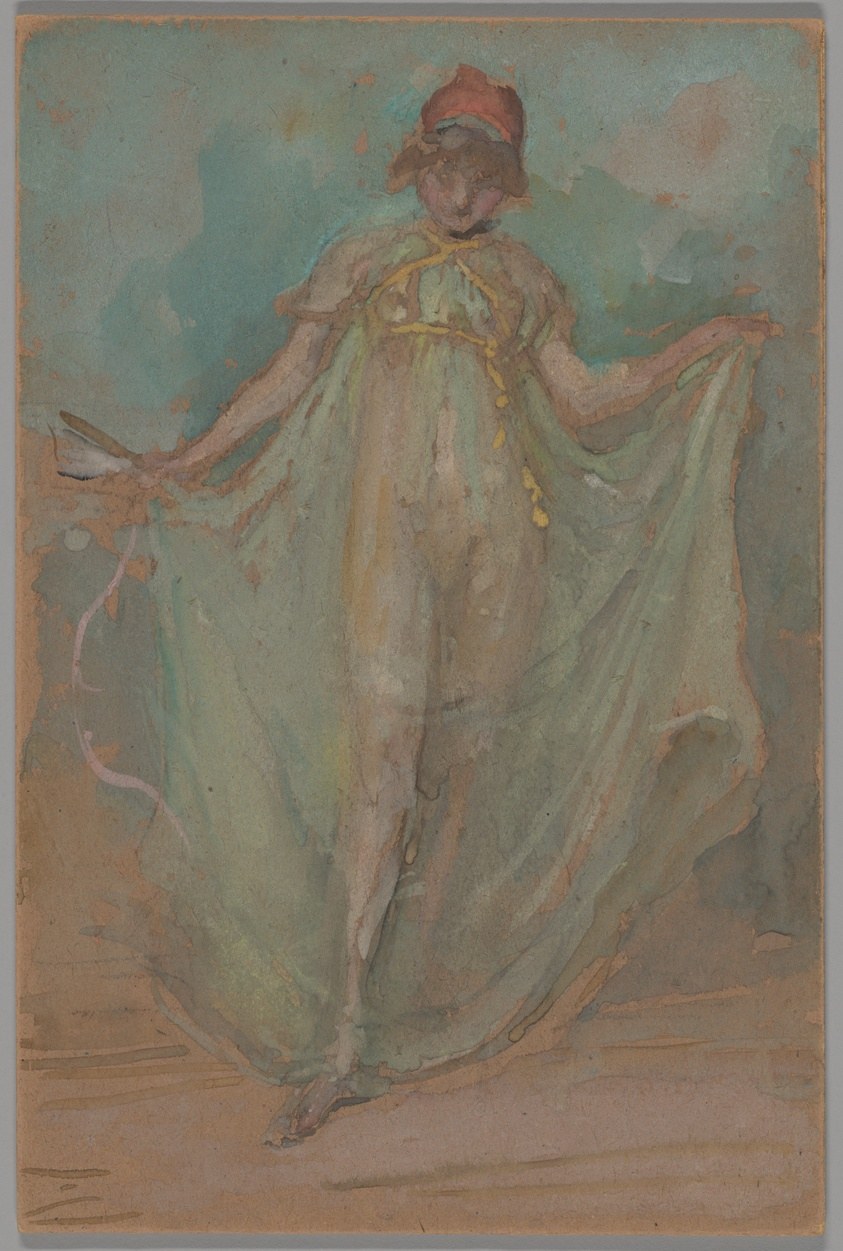
Green and Blue: The Dancer
James McNeill Whistler American, 1834-1903
- Medium:
- Watercolor and opaque watercolor over traces of black chalk on brown wove paper laid down on card
- Collection:
- Prints and Drawings
- Source:
- Art Institute of Chicago
- Rights:
- Public domain — free to use, share and adapt.
- Recorded as:
- CC0 (Public Domain)
This watercolor demonstrates the high artistic status ballet had achieved by the late 19th century: a respected artist undertook a serious study of a dancer's pose and costume, rendering it with the same care and refinement he might have lavished on a society portrait. The work is also a valuable primary document of women's performance dress and the classical bearing expected of ballet dancers in the Victorian era, showing how the body was displayed, framed, and made graceful through costume and training.
What you are looking at
A solitary female figure stands against a soft, muted background of teal and ochre tones. She wears a flowing, high-waisted classical gown in pale green and cream with delicate gold beading or embroidery at the waist. The dress has a sheer, diaphanous quality typical of Regency or Neoclassical dress. Her head is crowned with a reddish-brown cap or bonnet, and her posture is one of graceful extension: her left arm reaches out to the side while her right arm holds a length of translucent drapery that floats diagonally across her body. Her weight appears to rest on one leg, with the other subtly engaged, suggesting a moment of sustained motion rather than stillness. The composition is intimate and study-like, with the figure filling most of the vertical space, rendered in watercolor with considerable delicacy and attention to the play of light on fabric.
The dancing
A single dancer in a pose of classical elegance. Her frame is upright and composed, the torso gently engaged. One arm extends at approximately shoulder height while the other gestures downward, holding or presenting the billowing drapery. The asymmetrical arm position and the way her body angles suggest either a moment of turning or a pose held for formal presentation. The stance appears to distribute weight unevenly between the feet, implying the kind of balanced yet dynamic posture expected in classical theatrical dance. The way the fabric is managed suggests familiarity with how cloth responds to motion.
The dance depicted
This appears to be a representation of classical theatrical dance, likely Romantic-era ballet or a Neoclassical court dance form from the late 18th or early 19th century. The high-waisted Regency-period dress, the graceful arm positions, and the overall aesthetic point toward Romantic ballet of the 1830s–1850s, though the watercolor's delicate impressionistic handling is characteristic of later 19th-century practice. The figure is posed rather than caught mid-leap or turn, suggesting this may be a costume or character study rather than a dynamic performance moment. The artist has captured not action but readiness—the poised, elegant bearing expected of a professional female dancer of this era.
How it was made
The work is executed in watercolor and opaque watercolor (likely gouache) over chalk underdrawing, a medium that allows rapid, responsive working and considerable blending of color. The technique is loose and atmospheric rather than precise; the artist has used the fluid properties of watercolor to create soft transitions between the figure and background, and to suggest the transparency and movement of fabric through color gradation rather than sharp outline. This approach—combining transparency (in the thin washes of the background and dress) with opacity (in the layered highlights and the cap) was common in theatrical costume studies and figure drawings of the 1880s and 1890s, when watercolor became a favored medium for artistic studies among British and American artists. The brown paper support contributes to the overall warm, naturalistic tonality.
About this work
This is a study of a female dancer in classical theatrical dress, likely dating to the 1880s, executed with considerable sophistication in watercolor and gouache. The artist has rendered not a dynamic performance moment but a composed, graceful pose: a figure in a high-waisted classical gown, one arm extended, the other managing a length of floating drapery, her stance suggesting the poise and training of a professional performer. The work sits at the intersection of theatrical documentation, costume study, and refined artistic practice—a genre that flourished in the late 19th century as both record and art object. The Romantic-era dress and the formal, frontal presentation suggest the work may commemorate a specific dancer, role, or production, though the catalogue record does not clarify this.
For dance historians and archivists, the image is valuable as a document of how professional female dancers of the late 19th century dressed and composed themselves in classical roles. For art historians, it exemplifies the Aesthetic movement's interest in costume, grace, and the transient moment frozen in time. The work belongs in a gallery of dance because it treats the dancer's body and attire as worthy subjects for serious artistic attention, at a moment when theatrical dance was gaining cultural prestige and artists were increasingly drawn to record its forms.
How to look at it
The viewer should attend to the moment Whistler chose to freeze: not a dramatic leap or turn, but a pose of composed elegance, as if the dancer were presenting herself or preparing for the next phrase. Notice how the artist has used color to suggest transparency and weight—the pale green dress appears to fall and float simultaneously, while the blues and ochres of the background create space around the figure without defining it rigidly. The floating drapery on the right is essential: it is the only element suggesting actual motion, a thread of movement within an otherwise still and poised composition. This is study rather than narrative—the artist's interest is in form, grace, and the interplay of light and color rather than in telling a story or capturing a dramatic moment of performance.
The artist
James McNeill Whistler (1834–1903) was an American painter, printmaker, and theorist who spent much of his career in Europe, particularly London, where he became a leading figure in the Aesthetic movement. While best known for his innovations in portraiture, nocturnes, and printmaking—especially etching—Whistler also worked frequently in watercolor, particularly in his later years, producing rapid, sensitive studies of figures and interiors. His approach emphasized tonal subtlety, atmospheric effect, and the intrinsic qualities of his chosen medium over narrative or detail. Whistler was interested in dance and the theater; his circle included performers and artists engaged with theatrical modernism. This watercolor is consistent with his practice of creating refined, economical studies that captured the essence of a pose or moment through color and line rather than exhaustive description.
The period
The 1880s and 1890s saw intense artistic fascination with theater, costume, and the moving human figure. The Aesthetic movement, to which Whistler was central, celebrated beauty of form over moral content and treated costume, lighting, and the composed figure as worthy artistic subjects in themselves. At the same time, ballet in Britain and America was undergoing a period of revival and revaluation, particularly following the increasing visibility of Continental (especially Russian) ballet on London stages. Dancers and dance imagery became fashionable subjects for artists across media—from high-art painting to commercial illustration—and the late 19th-century theater provided a rich arena for artistic experiment with light, color, and the representation of movement and grace.
Where it lives
The work is held in the Prints and Drawings collection of the Art Institute of Chicago, catalogued from that institutional source. It is a sheet of paper laid down on card, suggesting it entered a collection as a study or sketch and has been conserved and mounted as such. This handling indicates the work's value as an artistic object worthy of preservation and display, not merely a preparatory study or theatrical ephemera.
Dance in this work
Questions about this work
Is this a portrait of a specific dancer?
The catalogue record does not identify a specific sitter or performer. The work appears to be a general study of a dancer in classical dress and pose rather than a commissioned portrait of a named individual. However, the specificity of the costume and the professional quality of the pose suggest the artist may have been studying an actual dancer or a well-known role from the theater of his time.
What kind of dance is she dancing?
The high-waisted Neoclassical or Regency-era dress, the graceful arm positions, and the overall aesthetic suggest classical theatrical ballet of the Romantic era (roughly 1830–1860). However, the pose itself—poised and formal rather than dynamic—is more characteristic of a costume study or a posed classical attitude than of a specific choreographic moment. The work documents the dancer's formal bearing rather than a particular step or movement phrase.
Why is the drapery so important in this image?
The floating, translucent drapery is the primary indicator of movement and suggests the figure is not static but in a moment of motion or about to move. In classical ballet and Neoclassical theater, the management of fabric—how it catches light, falls, and floats—was central to the visual beauty of the performance. Whistler has rendered this fabric with great sensitivity, using watercolor's fluidity to convey its weightless, responsive quality.
What was Whistler's connection to dance?
While Whistler is not primarily known as a painter of dance, his interest in the theater, performers, and the Aesthetic principles of beauty and form naturally drew him toward dance subjects. The late 19th-century artistic world in which Whistler moved was deeply engaged with theater and performance, and dancers and dance imagery appear throughout his work and that of his contemporaries.
More dance artwork





