49 works in this view — arrow keys or swipe to move between them.
Dance in Art
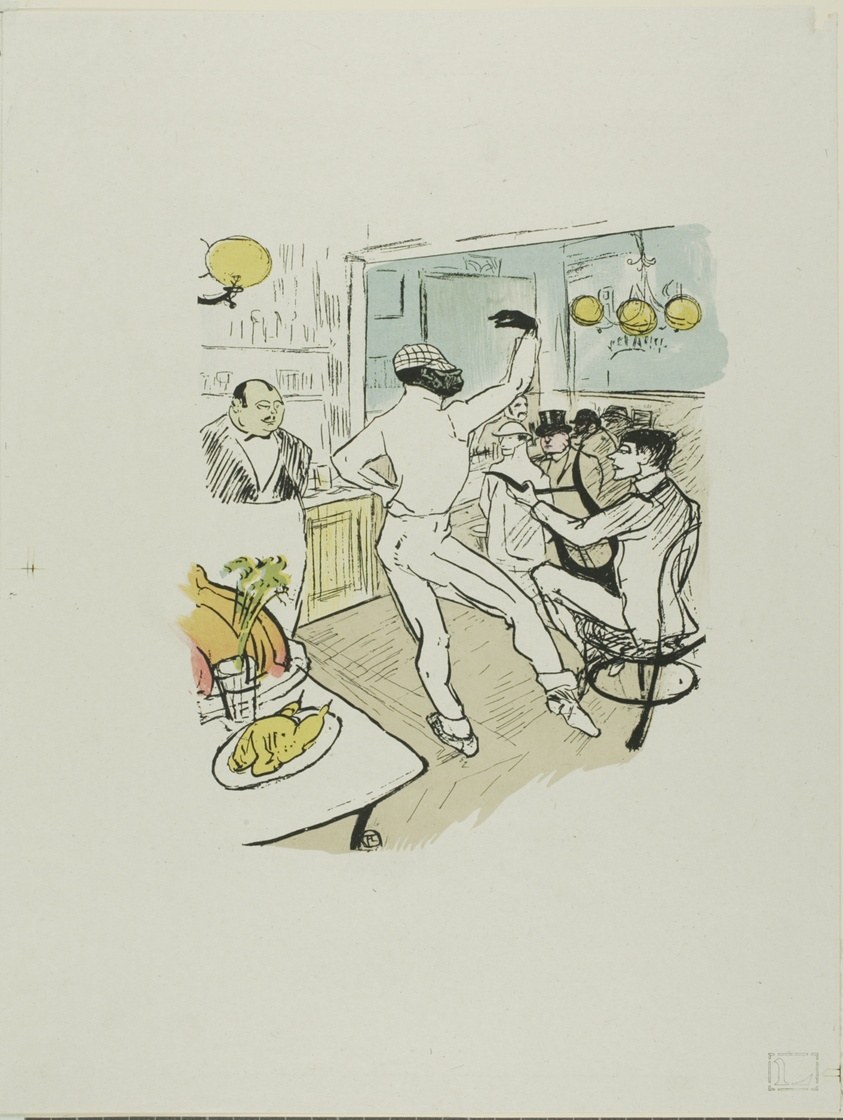
Chocolat Dancing
after Henri de Toulouse-Lautrec French, 1864-1901
- Medium:
- Color lithographic reproduction of a photorelief print on grayish wove chine
- Collection:
- Prints and Drawings
- Source:
- Art Institute of Chicago
- Rights:
- Public domain — free to use, share and adapt.
- Recorded as:
- CC0 (Public Domain)
Chocolat was a pioneering performer whose skill and presence helped establish Black vernacular dance as a legitimate and commercially successful form in European theater. This image is one of few contemporaneous artistic records of his performance, made by a major artist, and it captures the energy and social context that made his work significant.
What you are looking at
A lively cabaret or music hall interior filled with seated patrons watching a performer. A Black male dancer in light-colored clothes executes a dynamic step or kick in the center of the composition, his body twisted and animated. Around him sit well-dressed onlookers in hats and formal attire, their attention fixed on the performance. The setting is rendered in ink line with selective color washes—yellows and ochres for the lighting and furnishings, pale greens for the architectural background. Brass hanging lamps punctuate the upper portion of the room. The foreground includes a table with fruit and flowers, establishing the intimate, convivial atmosphere of a fin-de-siècle Parisian entertainment venue. The sketch style is gestural and economical, capturing the immediacy and informality of the moment.
The dancing
The central dancer is caught mid-movement, his legs extended and body angled dynamically off the vertical, suggesting rapid weight transfer and improvisational footwork rather than codified positions. His arms are gesturing expressively. The seated figures around him are rendered more summarily, their postures relaxed and social. The dancer's isolation in the center and the encircling gaze of the audience establish a clear performer-audience hierarchy. His body language conveys ease, energy, and a confident command of the space.
The dance depicted
This appears to depict a solo cabaret performance, likely the cake-walk or a related vernacular social dance adapted for theatrical exhibition in a Parisian venue. The dynamism of the pose, the informal setting, and the Black male performer all align with the late-nineteenth-century Parisian fascination with American vernacular and African-diasporic dance forms, which were presented as entertainment in cabarets and music halls. The work most likely documents or celebrates Chocolat (likely Rafael Padilla), a renowned Black performer who danced in Paris in the 1890s and was celebrated for his athleticism and charisma in exactly these venues.
How it was made
This is a color lithographic reproduction (or photorelief print reproduction) on chine paper, a technique that allowed for rapid, wide circulation of artistic images at the end of the nineteenth century. The combination of bold ink lines with selective watercolor or lithographic tinting creates strong graphic impact while keeping production costs and edition sizes accessible to the popular market. The gestural, sketch-like line style suggests a work drawn from life or immediate memory, lending authenticity and intimacy to the record.
About this work
This work documents the phenomenon of Black vernacular and cabaret performance in fin-de-siècle Paris, where American-influenced entertainment drew large, enthusiastic crowds. The image captures not just a dancer but an entire social ecology—the venue, the audience, the moment of spectatorship. For students of dance history, it provides rare visual evidence of how these performances were perceived and valued by contemporary artists and audiences. The work demonstrates how modernist artists like Toulouse-Lautrec documented emerging forms of popular dance and entertainment that would eventually reshape theatrical and concert dance.
How to look at it
Observe the dancer's pose: legs extended, torso twisted, weight clearly not centered—this is a moment of maximum extension and energy, frozen mid-action. Notice how the artist has subordinated the background and surrounding figures to emphasize the dancer's silhouette and gesture. The selective use of color—bright yellows for the lamps and warm tones for the setting—draws the eye to the figure while the surrounding scene remains relatively flat. The line quality varies from precise to sketchy, suggesting both a finished work and a record of observed movement.
The artist
Henri de Toulouse-Lautrec (1864–1901) was a Post-Impressionist painter and printmaker who made the cabarets, music halls, and dance venues of Montmartre his primary subject. He worked rapidly, often from life, and created lithographs and paintings that combined sharp observation with graphic sophistication. His interest in performance, gesture, and the margins of Parisian society led him to document singers, acrobats, can-can dancers, and cabaret performers with equal seriousness. His work established the dance and cabaret subject as worthy of fine-art attention.
The period
The 1890s saw a explosion of commercial entertainment in Paris, particularly in Montmartre, where cabarets like the Moulin Rouge (opened 1889) attracted diverse audiences. American vernacular dance forms—the cake-walk, the cakewalk-derived performances of Black entertainers—arrived in Paris during this period and generated enormous fascination. At the same time, artists and writers were turning toward popular and marginal subjects as subjects for serious artistic treatment, part of a broader modernist interest in authenticity, energy, and social realism. The appearance of Black performers in Parisian cabarets was both celebrated and rendered exotic; they were simultaneously admired and othered.
Where it lives
The work is held in the Prints and Drawings collection at the Art Institute of Chicago. It is catalogued as a color lithographic reproduction of a photorelief print, indicating it is a published print rather than a unique work, though the exact edition size and publication details are not recorded here.
Dance in this work
Questions about this work
Who was Chocolat and why did Toulouse-Lautrec paint him?
Chocolat (Rafael Padilla) was a renowned Black cabaret performer who appeared in Parisian music halls in the 1890s, known for his athletic dancing and comedic skill. Toulouse-Lautrec documented the performers and venues of Montmartre as his primary artistic subject, treating cabaret and music-hall entertainment as worthy of serious artistic attention. This work is part of his broader effort to record the energy, variety, and social texture of Parisian entertainment.
What dance is being performed here?
The exact style is difficult to name from a single frozen moment, but the dynamic, weight-shifted pose and the setting suggest either a cake-walk (an African American vernacular form that was hugely popular in Paris) or a related improvised cabaret step. The informality of the setting and the dancer's confident command of space suggest a form that valued personality and athletic skill over codified technique.
Why is this a lithograph and not a painting?
Lithography was the dominant medium for producing multiple copies of images in the late nineteenth century, allowing artists to reach a broad audience. This work is specifically a color lithographic reproduction of a photorelief print, a technique that combined photographic precision with lithographic tinting. It allowed rapid, affordable circulation of artistic images and made the work accessible to a popular market—appropriate for documenting popular entertainment.
What does the setting tell us about cabaret performance in this period?
The interior shows a crowded, informal venue with both performers and audience visible in a single space—there is no separated stage, no theatrical distance. This was typical of Parisian cabarets, which were social spaces where entertainment and socializing were simultaneous. The presence of food and wine, the relaxed postures of the audience, and the intimacy of the setting distinguish this from formal theatrical performance.
More dance artwork





