49 works in this view — arrow keys or swipe to move between them.
Dance in Art
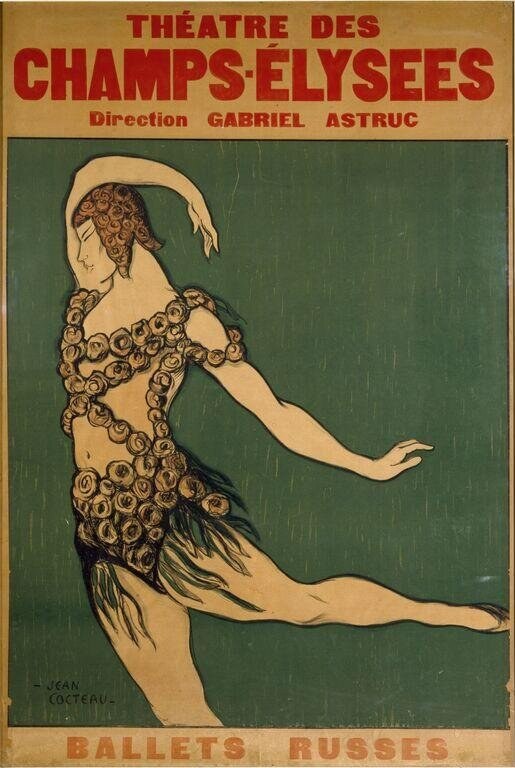
Poster advertiising Nijinsky with the Ballets Russes, Théâtre des Champs Élysées, Paris 1913
Cocteau, Jean
- Collection:
- Poster
- Source:
- Victoria and Albert Museum
- Rights:
- Rights vary by item — check the source record before reusing this image. Source record ↗
- Recorded as:
- V&A — check rights per item
This poster is essential to understanding both the visual culture of modernist dance and the role of graphic design in circulating avant-garde art in the early twentieth century. The Ballets Russes transformed European dance, and Cocteau's image captures the company's revolutionary aesthetic at the moment of its greatest cultural impact—the exotic, sensual, anti-academic vision that made ballet modern.
What you are looking at
This is a theatrical poster in the Art Deco style, rendered in warm tan and deep forest green. A single female dancer dominates the composition, her body twisted in a sinuous contrapposto pose against the green ground. She wears an ornate costume of patterned geometric circles—reminiscent of scales or coins—that covers her torso and drapes asymmetrically across her hips and one leg. The costume leaves her arms, shoulders, and much of her lower body bare, emphasizing the articulation of her limbs. Her right arm is raised and bent softly at the elbow; her left leg extends long and nearly horizontal in a suspended développé or similar extension. Her head is tilted back, her hair dark and pulled close to her skull. The pose suggests a moment of ecstatic abandon, the body weightless and floating. At the top of the poster, bold red letters announce "THÉÂTRE DES CHAMPS ÉLYSÉES" and below them "Direction GABRIEL ASTRUC." At the bottom, also in red, are the words "BALLETS RUSSES." The artist's signature—"JEAN COCTEAU"—appears in the lower left corner in smaller text.
The dancing
The single figure is rendered in simplified line and flat color typical of poster design. The dancer's weight appears suspended or lifted, with no contact with the ground suggested. Her right arm is relaxed and rounded; her left leg is extended fully in height, creating a diagonal line through the body. The torso twists away from the extended leg, opening the front of the body toward the viewer. The pose combines classical ballet vocabulary (the extended leg, the upright carriage of the torso) with an exaggerated, almost boneless flexibility in the spine and hips that is more characteristic of exotic or orientalizing dance vocabularies of the period.
The dance depicted
The costume and setting identify this as a publicity image for the Ballets Russes, the revolutionary company founded by Sergei Diaghilev that premiered in Paris in 1909. The ornate, geometric costume suggests roles from the company's most famous productions—most likely Nijinsky in *L'Après-midi d'un faune* (1912), which featured a jeweled, scaled costume designed by Léon Bakst, or possibly the title role in *Schéhérazade* (1910). The languorous, elongated pose and the emphasis on the body's malleability rather than its strength or control reflect the company's challenge to classical ballet aesthetics. The image captures the erotic, orientalizing aesthetic that made the Ballets Russes both celebrated and controversial.
How it was made
This is a color lithographic poster, a medium that allowed for flat areas of bold color, simplified forms, and broad graphic impact suited to street display and publicity. Lithography's capacity for fine linear detail—visible in the intricate geometric patterning of the costume—combined with large color fields made it the dominant poster technique of the period. The work's economy of means and reliance on elegant line and silhouette are typical of Art Deco design. As a poster, this object was created for mass circulation and public display, making it both a work of fine art and a commercial object designed to advertise theatrical performances.
About this work
This is a 1913 color lithographic poster by Jean Cocteau advertising the Ballets Russes at the Théâtre des Champs Élysées in Paris. The work captures in a single suspended moment the visual language that defined one of the most influential dance companies of the twentieth century: exotic beauty, orientalizing costume, physical virtuosity pushed toward extremity, and a deliberate challenge to academic ballet's conventions. Cocteau's design synthesizes the company's aesthetic into an image of pure, floating grace—a dancer seemingly weightless, captured mid-ecstasy, adorned in a jeweled costume that suggests both luxury and otherness.
The poster is both a historical document and a work of high design. It records what the Ballets Russes looked like to its audience and how the company chose to market itself. Cocteau's signature style—his gift for elegant, economical line and his eye for the essence of a moment—is evident in every element: the tilt of the head, the extension of the leg, the interplay of bare skin and ornament. The work belongs to a tradition of dance imagery that celebrates the dancer's body as a vehicle for artistic expression while also commodifying and exoticizing it.
How to look at it
Observe the pose: the dancer is suspended, not grounded. There is no sense of effort or transition—the image shows not a movement but a state of being, a moment of arrived-at grace. Notice how Cocteau uses the bare arm and leg to create diagonal lines that carry the eye through the composition; the costume's pattern draws the eye to the torso and hips. The simplification of the face and the tilt of the head suggest ecstasy or abstraction, as though the dancer is no longer present in her body but transformed by it. This technique of freezing a moment of apparent weightlessness was central to how the Ballets Russes was understood and represented to its public.
The artist
Jean Cocteau (1889–1963) was a French artist, writer, filmmaker, and designer of extraordinary range. In 1913, he was at the beginning of a long and productive relationship with the Ballets Russes; he would later design sets and costumes for several of its productions, including *Parade* (1917). His graphic style—spare, elegant, with an emphasis on expressive line and the distillation of form—made him an ideal designer for theatrical publicity. Cocteau was fascinated by dance, bodies, and performance throughout his career, and his work consistently explored the erotic and the decorative dimensions of movement.
The period
The Ballets Russes, which premiered in Paris in 1909, revolutionized dance and theatre by combining avant-garde visual design, exotic subject matter, and radical departures from classical ballet technique. The company's early years coincided with the emergence of Art Deco, a design movement that privileged simplicity, geometric form, and glamorous materials. This poster, created in 1913, comes at a moment of intense cultural ferment: the company had already premiered some of its most controversial works, including *L'Après-midi d'un faune* (1912), choreographed by Nijinsky, whose erotic vocabulary and relatively static poses scandalized and thrilled Paris. Cocteau's poster reflects this moment of aesthetic revolution—it shows a dancer whose body and costume are as much about visual spectacle and sensuality as about classical dance technique.
The theatrical poster itself was an art form in ascendancy in early-twentieth-century Paris. Artists of the highest standing—including painters and sculptors—designed posters for theatrical productions. The medium's combination of fine art and commercial purpose aligned with modernism's interest in breaking down hierarchies between 'high' and 'low' culture.
Where it lives
This is a printed poster, likely one of many produced for public distribution to advertise performances at the Théâtre des Champs Élysées in 1913. The holding collection and any surviving impressions are records of the company's self-presentation and of the role of graphic design in circulating modernist culture.
Dance in this work
Questions about this work
Is this Nijinsky?
The catalogue identifies the figure as Nijinsky, though the image does not include a name or identifying inscription visible in the poster itself. Given the costume's resemblance to designs from the Ballets Russes repertory and the date of 1913, this identification is plausible. However, the highly stylized, abstracted nature of Cocteau's design means the image represents an idea of the dancer and the role rather than a portrait.
What is the costume?
The geometric, scaled pattern suggests the jeweled, orientalizing costumes designed by Léon Bakst for the Ballets Russes. The specific role is difficult to determine from the poster alone, but the costume is consistent with designs for roles in *L'Après-midi d'un faune*, *Schéhérazade*, or other Bakst-costumed productions. The ornament emphasizes exoticism and luxury.
What does the pose tell us about the dance?
The suspension, the elongation of the line, and the apparent weightlessness reflect the Ballets Russes' departure from classical ballet's emphasis on control and virtuosity. The pose suggests a body that is malleable, sensual, and fully expressive—moved by emotion or transformation rather than by technique alone. This was both thrilling and scandalous to early-twentieth-century audiences.
Why did Cocteau design this poster?
Cocteau was a key figure in the artistic milieu of Paris in 1913 and had connections to the Ballets Russes. As a designer and man of letters, he was sought after for his ability to capture the essence of avant-garde art in visual form. His work for the company helped establish his reputation and reflected his lifelong fascination with theatre and the body.
More dance artwork





