49 works in this view — arrow keys or swipe to move between them.
Dance in Art
Nocturne
Fedorovitch, Sophie
- Collection:
- Costume design
- Source:
- Victoria and Albert Museum
- Rights:
- Rights vary by item — check the source record before reusing this image. Source record ↗
- Recorded as:
- V&A — check rights per item
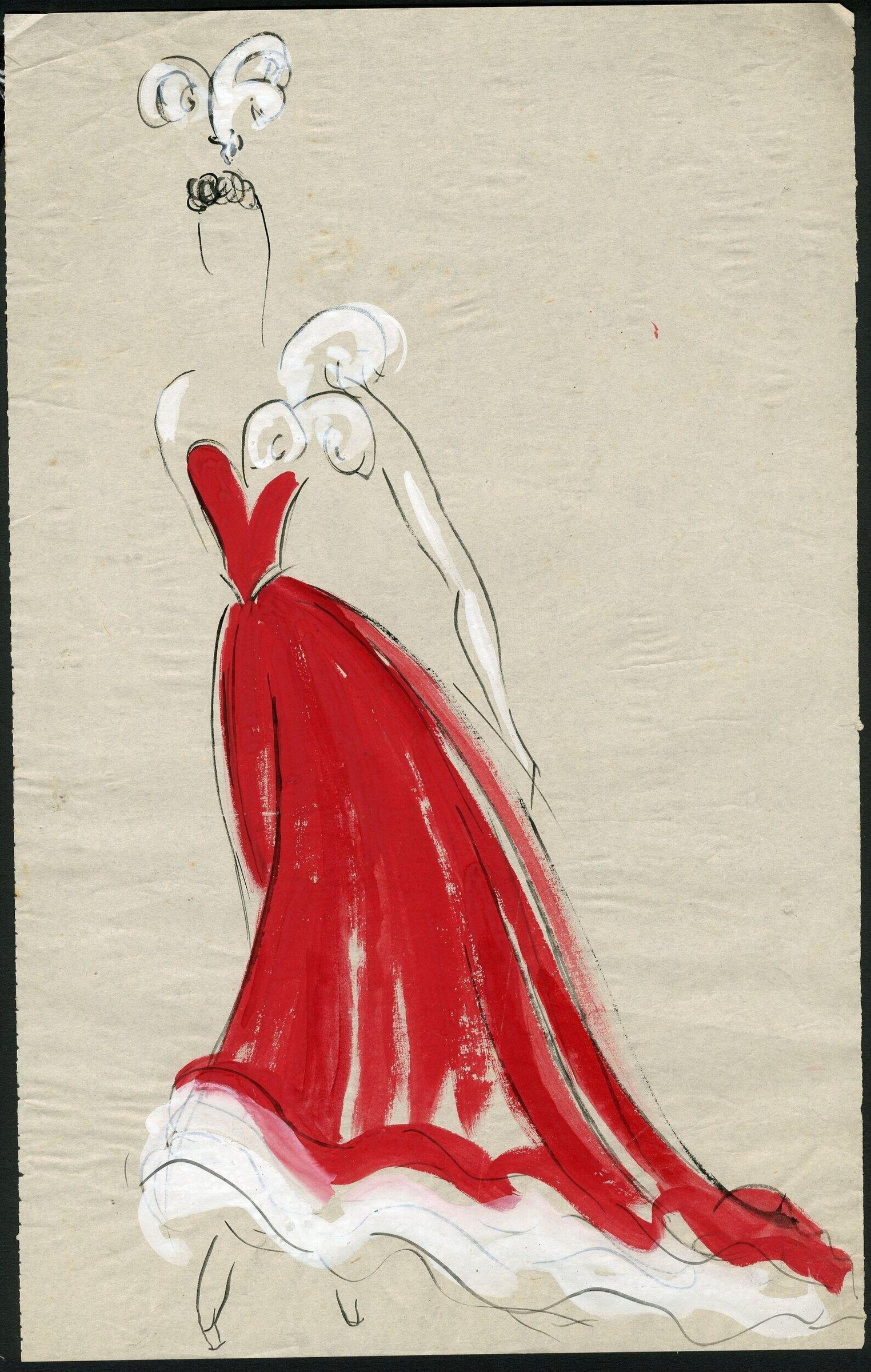
Fedorovitch's designs shaped the visual language of early twentieth-century European ballet. This sketch reveals how designers of that period used costume to define a dancer's role and the emotional tone of a piece—here, the severity and drama of the gown suggests a solo of introspection and beauty rather than virtuosity. For dance historians, such designs are documents of how bodies were meant to be seen on stage.
What you are looking at
A costume design sketch shows a dancer in a dramatic red evening gown with a sweeping train. The figure is drawn in profile, looking upward with an elongated neck and stylized features characteristic of 1930s fashion illustration. The gown features a sharp, angular white V-neckline that points dramatically upward, with voluminous fabric falling in deep folds to create a trailing silhouette. The skirt is rendered in rich red with highlights suggesting movement and dimensionality, while the train pools at the figure's feet in white. Two additional head studies appear at the top of the sheet, showing different angles of the dancer's face and hairstyle—one with curled waves, the other more profile. The drawing technique combines ink line work for the figure and minimal anatomical detail with watercolor or gouache for the fabric, creating a luxurious effect suited to theatrical design documentation.
The dancing
The single principal figure is depicted in a languid, almost stationary pose—upright but with an elongated, swanlike neck and tilted head gazing skyward. The posture suggests nobility or theatrical grandeur rather than active dancing movement. The arms are not visible, absorbed into or held behind the elaborate costume. The proportions are highly stylized, with an attenuated torso and small head typical of high-fashion illustration of the period. The body conveys stillness and presentation rather than kinetic energy.
The dance depicted
This is a costume design rather than a depiction of dance in action. The work documents theatrical dress for a solo performer—likely a prima ballerina or featured dancer in a classical evening piece. The title 'Nocturne' suggests a dreamy, romantic solo, a form common in early-twentieth-century ballet. The costume's severity and drama—the sharp angularity of the neckline contrasting with the fluid train—suggests a modernist approach to classical design, possibly European avant-garde theater of the 1930s. Without the actual performance context, the specific style cannot be confirmed, but the elegance and formal evening wear point toward classical or neoclassical ballet.
How it was made
This is a mixed-media costume design sketch, combining ink line drawing with watercolor or gouache. The technique is typical of theatrical design documentation of the 1930s, where designers presented concepts to directors, dancers, and production teams through such drawings. The immediacy of the ink line conveys the designer's hand and artistic decision-making, while the selective application of color—concentrated on the gown—focuses attention on the fabric and silhouette. This type of sketch served both as an artistic statement and a practical work document, circulated among production staff.
About this work
This is Sophie Fedorovitch's costume design for *Nocturne*, a solo dance created around 1936. Fedorovitch was a prominent designer for British and European ballet companies in the early twentieth century, and this work exemplifies her approach: a synthesis of modernist form and classical elegance. The sketch does not show a dancer in motion but rather presents an ideal image—the costume as a architectural frame for the performer's body. The red gown with its dramatic white trim and sweeping train embodies the romantic formality of pre-war theatrical design, a moment when ballet design was decisively influenced by Modernism and by Russian avant-garde practice.
The work belongs in a gallery about dance because it documents the material and visual culture of performance. Costume designs are primary sources for understanding how dancers were dressed, how bodies were framed and presented, and how designers collaborated with choreographers to create the total effect of a dance. Fedorovitch's precise, elegant line and her sensitivity to fabric and silhouette made her one of the most influential designers of her era.
How to look at it
Attend to the contrast between the sharp, angular white neckline and the soft, voluminous red fabric below. This tension—severity above, fluidity below—would create a striking silhouette on stage and guide how a dancer's movement would be perceived. The upward gaze and the elongated neck suggest a solitary, introspective moment. The two head studies at the top indicate Fedorovitch's process: she was solving the design problem of how the hairstyle and tilt of the head would complement the costume's drama. Notice also how minimally the face is rendered—detail is concentrated on the costume, making clear that this is a design for stage presentation, not a portrait.
The artist
Sophie Fedorovitch (1893–1953) was a Russian-born designer who became one of the most important costume and set designers for British ballet and theater in the twentieth century. She worked closely with the Ballets Russes, the Ballet Club, and the Royal Ballet, collaborating with choreographers including Frederick Ashton and Andrée Howard. Her style married modernist graphic clarity with an acute understanding of how costume moved with the dancer's body. She was known for elegant line, subtle color, and an ability to suggest both formality and fluidity—qualities evident in this *Nocturne* design.
The period
In 1936, European ballet was in ferment. The Ballets Russes, which had dominated the 1920s, was fragmenting, and new companies and choreographic voices were emerging in Britain, France, and other centers. Design was a crucial battleground: the influence of Russian avant-garde practice and Constructivism remained strong, but there was also a move toward a more restrained, classically grounded aesthetic. Fedorovitch's work of this period reflects that tension—modernist simplicity in service of romantic, lyrical dance. *Nocturne* as a title points to the Romantic era of ballet (Chopin nocturnes were beloved by dancers and audiences), and Fedorovitch's design respects that heritage while updating it for a contemporary stage.
Where it lives
This is a costume design held in the Victoria and Albert Museum's Theatre Collection. The sketch is documentation of a theatrical production and would have been created for reference and record, likely shared among the designer, choreographer, and production team. It represents the type of archival material that allows scholars to reconstruct the visual and material history of twentieth-century dance.
Dance in this work
Questions about this work
Who was Sophie Fedorovitch?
Fedorovitch (1893–1953) was a Russian-born designer who became one of the most influential costume and set designers for British ballet and theater. She worked with major companies and choreographers including the Ballets Russes, the Ballet Club, and Frederick Ashton. Her designs were known for elegance, clarity, and a sophisticated understanding of how costume interacted with the dancing body.
What is a 'nocturne' in dance?
Nocturne typically refers to a lyrical solo or small ensemble piece set to dreamy, introspective music—often a Chopin nocturne. These pieces are romantic and often emphasize fluidity and emotional expression over virtuosity. The form became especially popular in early twentieth-century ballet.
Why is this costume design important?
Costume designs are primary documents of how dance was created and staged. This sketch shows how Fedorovitch solved the problem of dressing a soloist—balancing formal elegance with the need for the dancer's body to be visible and free to move. It also reveals the modernist approach to classical ballet design in the 1930s.
How would this costume have moved on stage?
The sharp white V-neckline would frame the dancer's upper body and direct attention to the face and neck, while the flowing red skirt and train would emphasize the lower body and create dynamic lines as the dancer moved. The weight and length of the fabric would require careful management, becoming part of the choreography itself.
More dance artwork





