49 works in this view — arrow keys or swipe to move between them.
Dance in Art
Nocturne
Fedorovitch, Sophie
- Collection:
- Costume design
- Source:
- Victoria and Albert Museum
- Rights:
- Rights vary by item — check the source record before reusing this image. Source record ↗
- Recorded as:
- V&A — check rights per item
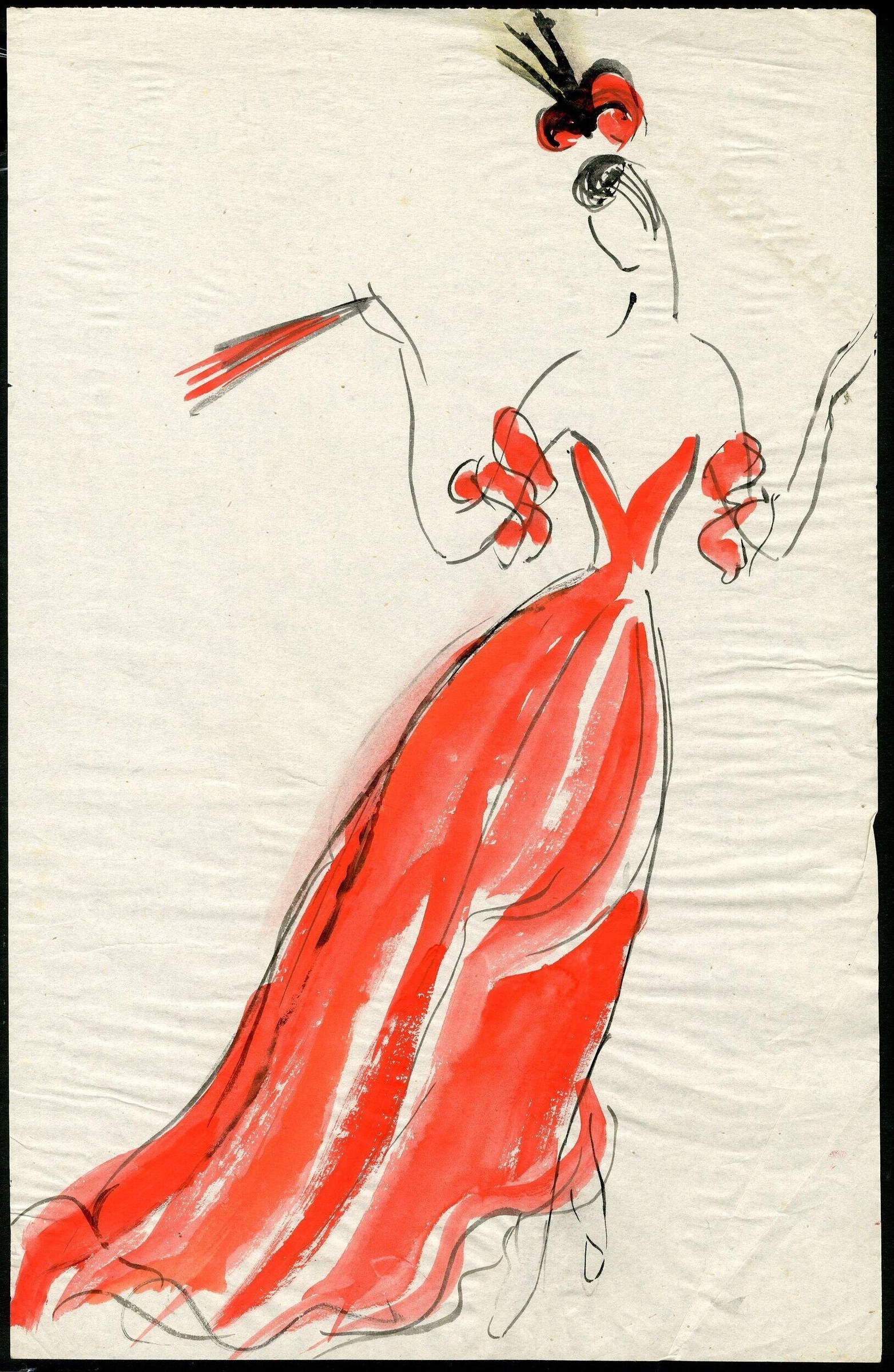
Fedorovitch was one of the most influential ballet designers of the interwar period, working with Ballets Russes choreographers and London-based companies; her drawings are primary documents of how Modernist theatre conceived the dancing body. This sketch shows the designer's process: how she thought through silhouette, fabric, and the body's line as a single aesthetic problem, collapsing the distinction between costume and dancer into a unified visual concept.
What you are looking at
A tall, sinuous figure in a flowing red gown dominates the composition, shown in three-quarter length against an off-white ground. The dancer is rendered in loose ink outline with the dress filled in bold red wash, the fabric depicted with fluid, gestural brushstrokes that suggest motion and volume. The figure's posture is languid and curved, the body weight shifted into a gentle S-bend. The head is tilted back, depicted in ink with dark hair swept upward, and the face is reduced to a few essential lines. The arms extend downward and away from the body in sinuous curves, hands rendered as delicate line-work at the ends of long, thin forearms. The dress falls in dramatic folds from a fitted bodice, suggesting both weight and lightness—the red pigment is layered and modulated, creating depth through areas of wash and reserved paper. Small sketch studies in red and ink appear in the margins: abstract floral or butterfly-like forms at top right, and what appear to be decorative flourishes or costume detail studies near the figure's hands. The overall effect is one of elegance and elongation, economy of line combined with sensuous colour.
The dancing
One figure, a tall dancer shown in a relaxed, asymmetrical stand with the body curved into a lateral arc. The weight appears settled into the hips; the legs are long and straight, while the upper body bends gracefully backward or sideways, creating an understated arabesque or similar extension. The arms hang or extend in soft, attenuated lines, not in any rigidly turned-out position but rather following the body's flow. The overall frame is open and informal—no closed hold, no sharp angles, no technical rigidity. This is a body at rest within a dance, or captured in a moment of languid transition.
The dance depicted
The work most likely depicts Romantic or early twentieth-century theatrical dance, most probably ballet given the elongated silhouette, the loose tutting of the skirt, and the lyrical extension of the limbs. The title *Nocturne* and the dreamlike quality of the pose suggest a work in the repertory of night or fantasy scenes—potentially influenced by Fokine's aesthetic reforms and the Ballets Russes, which valued elongation and naturalism over rigid classical form. The pose and costume do not suggest classical variation technique but rather the modern, expressionistic ballet that emerged in the early twentieth century. Fedorovitch's training and circle (she was a Russian-born designer working in London from the 1920s onward) makes a Soviet or London ballet context likely, though the work could also reflect continental European modernism.
How it was made
The work is a costume design drawing executed in ink line and red wash (watercolour or gouache) on paper. The technique reveals the sketch's purpose: ink defines structure and detail economically, while the bold red ground communicates the visual weight and silhouette of the garment at a glance. This is a presentation or working drawing intended for a stage designer, costume maker, or choreographer—not a finished artwork for exhibition. The marginalia (small studies of trims, flowers, or ornamental details) confirm it as a functional document. The media and approach (quick, confident, uninflected line with bold colour statement) are typical of interwar theatre design practice in European avant-garde circles.
About this work
This is a costume design study by Sophie Fedorovitch for a theatrical ballet, likely created in the 1930s for a London ballet company or the Ballets Russes circle. The figure wears an evening gown or stage costume rendered in sinuous line and red wash, depicted in a pose of languid grace that suggests the movement vocabulary of modern ballet. The work is a document of a specific production—titled *Nocturne*, implying a night scene or reverie—and demonstrates both Fedorovitch's fluent draughtsmanship and her sensitivity to the elongated, flowing silhouette that defined early twentieth-century dance modernism. It is a work of theatre design practice rather than independent art, but invaluable as evidence of how choreography, costume, and atmosphere were conceived as a unified whole.
How to look at it
Attend to the relationship between the red wash and the ink line: the wash establishes the silhouette and weight of the garment, while the line traces the body within and beneath it. The artist has chosen a moment of suspension or repose—not a leap or turn but a standing, turning, or swaying gesture in which the body's curves are fully revealed. Notice how the elongation of the limbs and the sinuous posture suggest movement without depicting a dramatic action; this is the vocabulary of Romantic ballet and its modern heirs. The small studies in the margins remind us that this is a working document: a costume designer thinking through proportion, ornament, and the overall visual effect as a unit.
The artist
Sophie Fedorovitch (1893–1977) was a Russian-born painter, theatre designer, and costume specialist who emigrated to Britain in the 1920s and became a central figure in British and Continental ballet design. She worked frequently with the Ballets Russes, choreographer Frederick Ashton, and the Sadler's Wells Ballet (now the Royal Ballet), creating designs for major productions including *Facade* (1931) and *Apparitions* (1936). Her drawing style—economical, elegant, and informed by modernist reduction—shaped how an entire generation of dancers and choreographers visualized movement. She was equally accomplished as a fine artist and theatre practitioner, and her sketches form an essential archive of mid-twentieth-century ballet aesthetics.
The period
The 1930s saw a decisive shift in ballet design away from the jewelled excess of the Ballets Russes Diaghilev era toward modernist restraint and emphasis on the dancing body itself. Designers like Fedorovitch, Pavel Tchelitchew, and Oliver Messel pioneered a visual language in which costume served the line and vocabulary of the choreography rather than overwhelming it. At the same time, Soviet ballet was being documented in photographs and published designs that circulated widely in London and Paris. The aesthetic of elongated, lyrical movement embodied in *Nocturne* reflects both the Fokine revolution—which valued expressive plasticity over classical rigidity—and the early work of Frederick Ashton, who favoured a modern, humanized ballet aesthetic. The sketch's date of 1936 places it at a moment when British ballet was establishing itself as a major cultural force, distinct from both Soviet and Parisian models.
Where it lives
The work is held as part of the Costume Design collection (likely the V&A Theatre Collection or a related archive), identified with the source 'va' in the record. It is a working design for a theatrical production, not an autonomous artwork; costume designs of this period typically remained in the possession of theatres, designers' estates, or institutional collections dedicated to theatre history.
Dance in this work
Questions about this work
Is this a sketch for a real ballet, or a study?
It is a costume design for a production titled *Nocturne*, likely created for a specific performance. Whether that production was realised, and by which company, would require archival research; the record does not specify. Such designs were typically created after the choreography was composed or in close collaboration with the choreographer, so it represents an actual production plan even if the final costume may have differed in execution.
Why is the figure so elongated and stylized?
The elongation is partly a matter of Fedorovitch's modernist aesthetic, which favoured elegant lines and reduction of detail. But it also reflects the aesthetic of ballet itself in this period: Fokine and Ashton sought to move away from the compact, turned-out classical body toward a longer, more languid silhouette. The elongation of the limbs in the sketch emphasizes the dancer's reach and fluidity.
Who danced this role?
The record does not identify the dancer or the company. Fedorovitch designed for multiple companies and choreographers in the 1930s; identifying the specific production would require consultation of theatre archives, programme notes, or Fedorovitch's own records.
What is the red garment—a dress, a robe, a stage costume?
It appears to be a full-length evening or stage gown, fitted at the bodice and falling into fluid folds from the waist. The style—refined, elegant, without overt theatricality—suggests either a romantic scene or a stylized modern costume that sought to blend theatrical effect with the illusion of everyday elegance. The fabric effect rendered in the wash suggests silk or another lustrous material.
More dance artwork





