49 works in this view — arrow keys or swipe to move between them.
Dance in Art
Nocturne
Fedorovitch, Sophie
- Collection:
- Costume design
- Source:
- Victoria and Albert Museum
- Rights:
- Rights vary by item — check the source record before reusing this image. Source record ↗
- Recorded as:
- V&A — check rights per item
Fedorovitch's designs were integral to the aesthetic of twentieth-century British and European ballet, influencing how dancers moved and how audiences saw the art form. This drawing demonstrates the designer's understanding of how fabric behaves in motion and how costume design shapes the dancer's silhouette and line—knowledge that only comes from watching dancers rehearse and perform. For anyone studying the relationship between design and choreography, or the evolution of ballet costume away from pantomime spectacle toward modernist simplicity, this work is essential.
What you are looking at
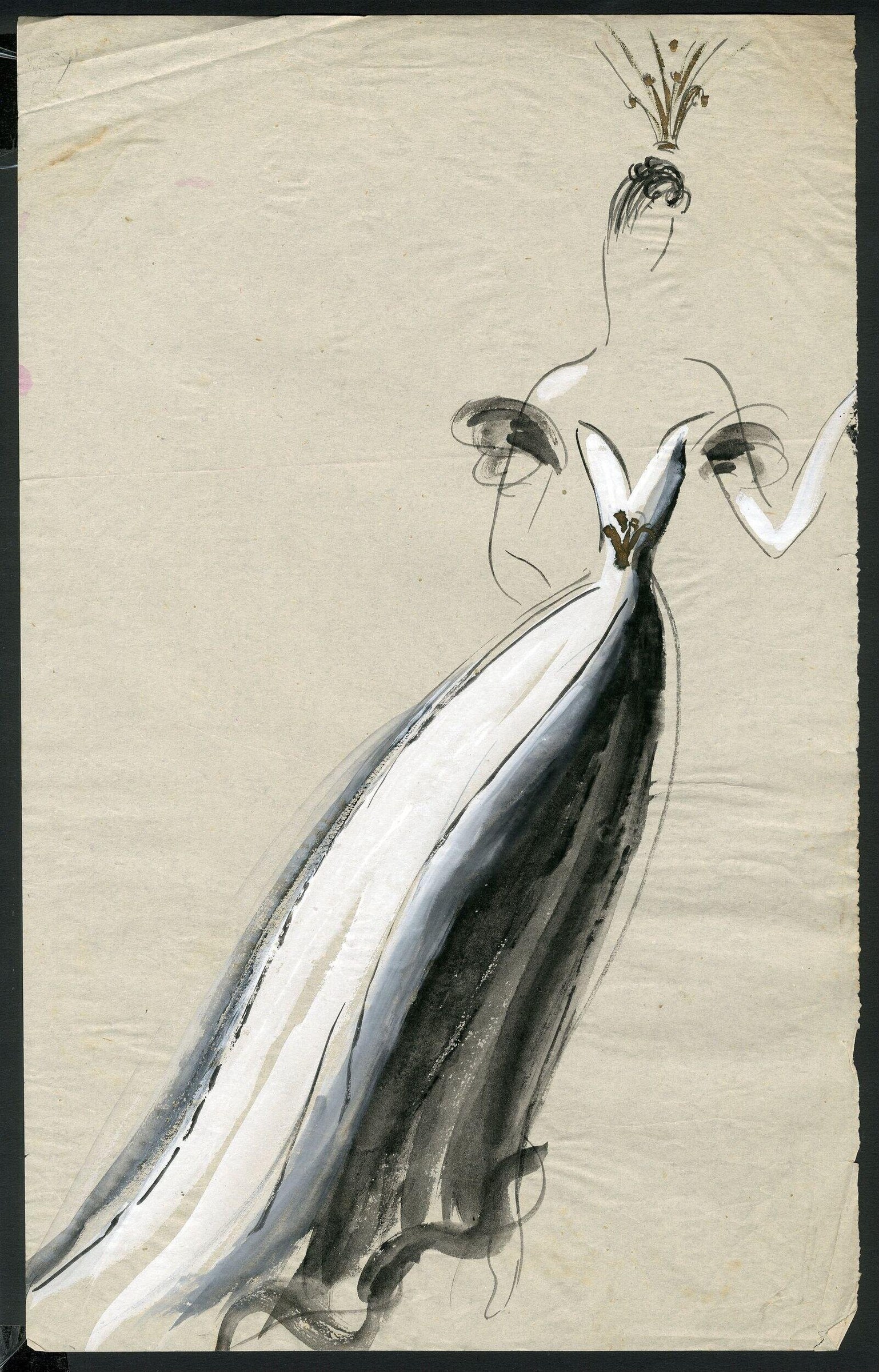
A single female figure dominates the composition, shown from approximately waist to head, posed in an elegant contrapposto stance. The dancer wears a flowing, bias-cut gown in white and deep charcoal or black, with the fabric arranged to create sweeping diagonal lines across the body. The skirt panels suggest movement—one appears to be mid-swirl or caught in motion, creating a sense of arrested momentum. Her long arms extend upward and outward with graceful, elongated lines; the upper arm curves away from the body while the forearm and hand gesture toward the upper right of the composition. Her head is held with chin slightly raised. The background is neutral cream or pale beige, allowing the figure's silhouette and the sculptural folds of the drapery to command attention. The drawing technique emphasizes contour and volume through confident, flowing lines and selective shading, particularly in the fabric's darker passages. The overall impression is one of poised elegance captured in a moment of potential motion.
The dancing
The single dancer is shown in a standing position with weight seemingly centered but with a subtle sway suggested by the drapery. Both arms are raised and extended, with the right arm higher and more fully extended than the left, creating an asymmetrical, balletic frame. The gesture is open and expansive rather than contained—the arms suggest an attitude or arabesque preparation rather than a closed, partnered hold. The elongated proportions of the limbs and the treatment of the hand at the top of the composition emphasize line and extension. The posture conveys aristocratic bearing and refined control.
The dance depicted
This appears to be a costume design for theatrical ballet, most likely from the Romantic or Neoclassical tradition given the flowing, ethereal quality of the gown and the idealized, elongated proportions of the figure. The dress itself—lightweight, high-waisted, with bias-cut panels that create movement even in stillness—suggests a ballerina's costume rather than character or character-adjacent dress. The extended arm positions and the overall aesthetic align with early-to-mid twentieth-century ballet design, when costumes became increasingly simplified and when the line of the body through the limbs became paramount. The title "Nocturne" suggests a lyrical, intimate ballet idiom—possibly a pas de deux or solo of introspective character rather than dramatic spectacle.
How it was made
The work appears to be a design drawing executed in ink and watercolor or gouache on paper. The medium is fluid and economical, using confident line work for the figure's contours and selective wash to establish volume and shadow, particularly in the darker fabric areas. This technique was standard for costume design in the early twentieth century, where the goal was to convey the essential character and drape of a garment while remaining quick enough for practical use in theater. The lightness of touch and the emphasis on line over detailed modeling suggest this was a working design rather than a finished presentation piece for a patron.
About this work
This is a costume design for a theatrical ballet role, created by Sophie Fedorovitch in 1936. Fedorovitch was a Russian-British designer of significant influence in mid-twentieth-century ballet, known for her refined, modernist approach to costume that prioritized the dancer's line and movement over ornamental detail. The drawing captures a single figure in an elegant, extended pose, wearing a flowing gown designed to move with the body while maintaining an aesthetic of lightness and grace. The work exemplifies the Neoclassical or Romantic ballet idiom of its period, when costume design became increasingly focused on supporting rather than dominating the dancer's form. As a design drawing, it represents the practical work of theater—a blueprint for execution by seamstresses and a communication tool between designer and dancer.
How to look at it
Notice how the artist has used line, not detail, to suggest the dancer's movement. The extended arms and the swirl of the skirt imply a moment of turning or traveling movement even though the figure is frozen. Observe how the white and dark fabrics are used to define the body's silhouette and the dress's volume—the contrast creates dimension without the need for shading. Pay attention to the proportions: the elongated limbs and the small, delicate hands are deliberate choices that reflect both the aesthetic ideals of 1930s ballet design and the actual physique of trained dancers. The pose itself—open, expansive, and asymmetrical—reflects the influence of classical ballet vocabulary while suggesting a modern, less rigid sensibility.
The artist
Sophie Fedorovitch (1893–1977) was a Russian-born painter and costume designer who became one of the most influential theatrical designers of mid-twentieth-century Europe. Based primarily in London, she worked extensively with British ballet companies, including the Vic-Wells Ballet (later the Royal Ballet), where she developed long collaborations with choreographers including Frederick Ashton. Her design philosophy rejected historical pastiche and heavy ornamentation in favor of simplified forms, modernist color palettes, and costumes that revealed rather than concealed the dancer's body. She was respected as much for her understanding of movement and dance technique as for her visual sensibility, and her influence on ballet aesthetics during the 1930s–1950s was profound.
The period
In 1936, ballet design in Britain and Europe was undergoing a significant modernization. The influence of the Ballets Russes (founded 1909) had established that costume design was not mere decoration but integral to choreographic meaning. By the 1930s, designers like Fedorovitch were moving away from the elaborate, orientalist, or narrative-driven costumes of earlier decades toward cleaner lines and more abstract aesthetics. At the same time, the rise of Neoclassical ballet under George Balanchine in America and the continued popularity of Romantic ballet revivals in Europe created demand for costumes that would not obscure the body's line. In painting and graphic art, modernism and art deco were the dominant visual languages, and Fedorovitch's designs reflect these currents—simplified form, elegant line, and an absence of superfluous ornament.
Where it lives
This work is held in the Victoria and Albert Museum's collection as a costume design, part of their holdings related to theatrical design and practice. It is a working design drawing rather than a fine art print or painting, reflecting its original purpose as a practical tool for theater production.
Dance in this work
Questions about this work
Who was Sophie Fedorovitch?
Fedorovitch was a Russian-born costume designer and painter (1893–1977) who became one of the most significant theatrical designers of early-to-mid twentieth-century ballet. She worked closely with British ballet companies and choreographers, particularly in London, and was known for her modernist approach to costume that emphasized the dancer's line and form. Her influence on ballet aesthetics was substantial and long-lasting.
What is a costume design drawing?
A costume design drawing is a working sketch created by a designer for a specific theatrical production. It communicates the character, proportions, fabrics, and movement of a costume to the director, choreographer, dancers, and costume makers. These drawings are practical tools rather than fine art, though they are often elegant and reveal the designer's understanding of both visual form and how cloth moves with the human body.
What does 'Nocturne' mean in the context of ballet?
A nocturne is a lyrical, often introspective ballet, typically set to music suggestive of nighttime, dreams, or intimate emotion. The term reflects the Romantic ballet tradition and suggests a work of subtle emotional content rather than narrative spectacle. The costume in this design—ethereal, elegant, and unornamented—supports such a reading.
How does Fedorovitch's design approach differ from earlier ballet costume design?
Earlier theatrical and ballet costumes, particularly in the nineteenth century, often prioritized spectacle, ornament, and narrative clarity. Fedorovitch's approach, shared with other early-twentieth-century designers, stripped away excess and focused on how a costume could enhance the dancer's line and support the choreography. Her designs are modern, economical with ornament, and reveal the body's form rather than concealing it.
More dance artwork





