49 works in this view — arrow keys or swipe to move between them.
Dance in Art
Nocturne
Fedorovitch, Sophie
- Collection:
- Costume design
- Source:
- Victoria and Albert Museum
- Rights:
- Rights vary by item — check the source record before reusing this image. Source record ↗
- Recorded as:
- V&A — check rights per item
Fedorovitch was a major costume and set designer for British and European ballet, and this sketch exemplifies her approach to modernist dance design: economy, elegance, and a keen understanding of how fabric and gesture interact on stage. The work shows how the designer's hand—the way she renders the skirt, the tilt of the head, the line of the arm—communicates character and mood more directly than elaborate detail ever could.
What you are looking at
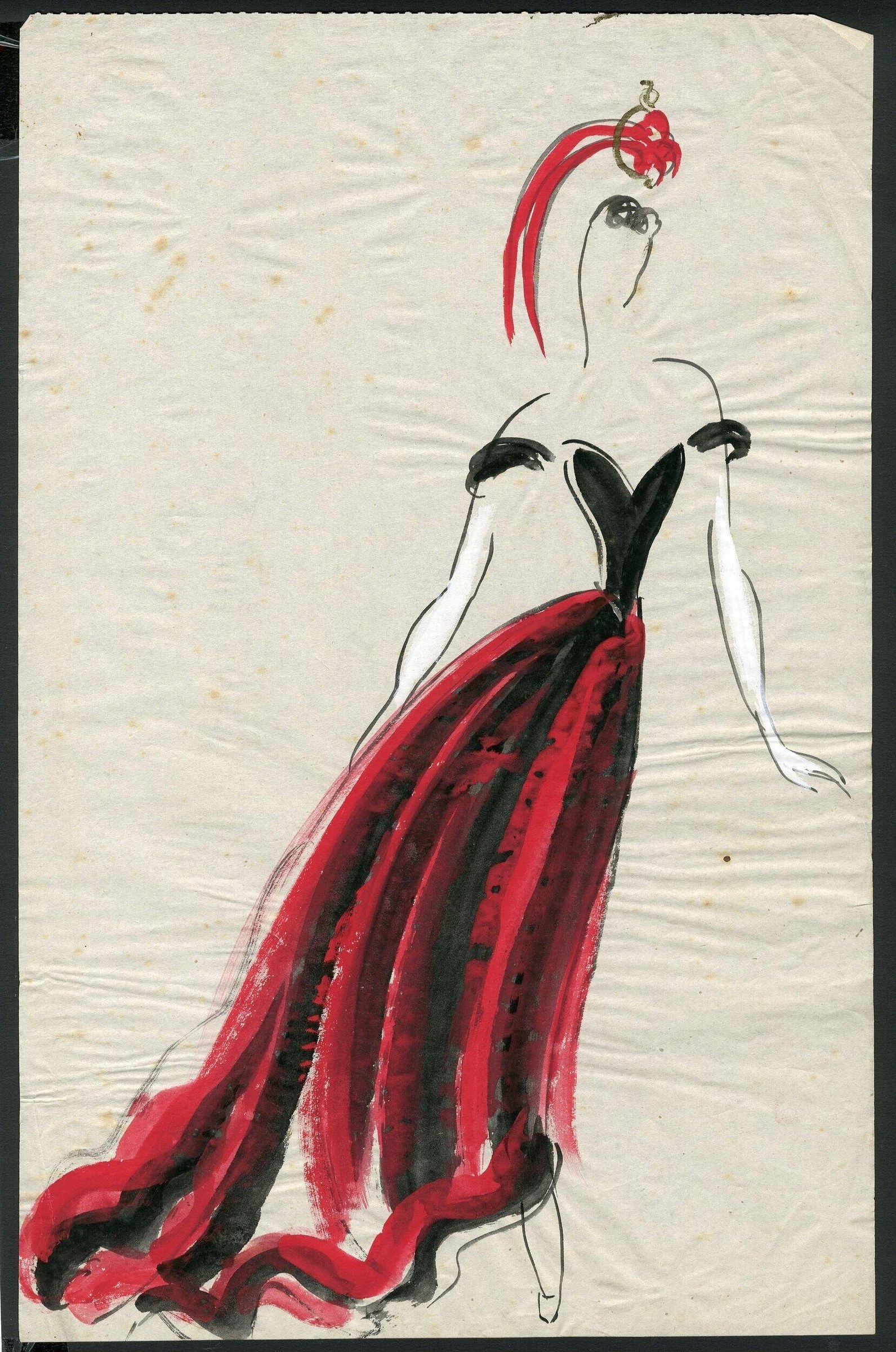
A single female figure dominates the composition, rendered in a minimalist style against cream paper. The dancer is shown from roughly waist-up, her body angled in a graceful contrapposto stance. She wears a dramatically voluminous skirt in deep red and black, rendered with bold, gestural brushstrokes that suggest movement and fabric weight; the skirt trails downward with sweeping folds. Her upper body is spare—white or bare skin, outlined in thin black lines—with arms extended downward and outward in an elegant, elongated line. Her head is tilted back, face indicated only by the barest suggestion of features in profile, crowned by a striking red ribbon or ornamental hair accessory that curls upward like a question mark or stylized feather. The composition is asymmetrical and focuses the viewer's attention on the interplay between the dancer's restrained upper half and the explosive volume of her skirt.
The dancing
A single standing dancer, weight shifted onto one leg in a relaxed but poised stance. Both arms extend downward and slightly away from the body, creating an open frame and suggesting ease and control. The head tilts back in an attitude of reverie or abandon. The line work is economical and confident—the artist understands how to suggest the dancer's weight and balance through minimal mark-making. The elongated proportions and attenuated limbs are characteristic of fashion illustration and modernist figure drawing rather than anatomical precision.
The dance depicted
The work is likely a costume design for theatrical ballet, possibly Romantic ballet, though the sparse aesthetic and the extreme stylization make definitive identification difficult. The voluminous skirt and the dancer's ethereal posture suggest the vocabulary of early-twentieth-century ballet modernism or the aesthetics of the Ballets Russes. The title *Nocturne*—a musical term implying dream, introspection, or night—supports a reading of romantic or lyrical dance. The red and black palette and the dramatic silhouette are consistent with avant-garde theatrical design of the 1930s rather than classical academic ballet.
How it was made
This appears to be a watercolor or gouache sketch on paper, with delicate pen or ink line-work defining the contours. The technique is swift and assured—the artist has left the paper largely bare, using color sparingly and strategically to guide the eye. The red and black are applied with broad, gestural strokes that suggest movement rather than detail. The approach is consistent with working costume designs or fashion sketches, made for practical theatrical use rather than as finished exhibition pieces, which would have allowed for rapid iteration and revision.
About this work
This is a costume design sketch for a female dancer in a theatrical work titled *Nocturne*, dated 1936 and attributed to Sophie Fedorovitch. The spare, modernist aesthetic and the Ballets Russes–influenced silhouette place it within early-twentieth-century avant-garde dance design. It captures a moment of lyrical ease: a dancer in repose, supported by a sumptuous skirt that anchors and balances her elongated frame. The work is a study in the economics of line and color—everything unnecessary has been stripped away, leaving only the essential gesture of a dancer in a red skirt, looking away. It belongs in a dance gallery as evidence of how designers understood and represented the dancer's body in the modernist period.
How to look at it
Attend to the artist's choice to leave most of the paper blank. The white space is not empty—it is part of the composition, suggesting air, lightness, and the dancer's isolation in space. Notice how the skirt is the only element rendered in full color and texture; everything else is line and suggestion. This hierarchy tells us what matters: the fabric, the volume, the visual drama of the costume. Observe the tilt of the head and the downcast gaze, which create a mood of introspection or longing that matches the musical title. Finally, look at the economy of the arm lines—how much the artist communicates about balance, grace, and the dancer's training with just a few marks.
The artist
Sophie Fedorovitch (1893–1953) was a Ukrainian-born Russian painter, designer, and sculptor who became one of the most influential costume and set designers for British ballet and modern dance. She worked extensively with the Ballets Russes, the Vic-Wells Ballet (later the Royal Ballet), and choreographers including Frederick Ashton and Michel Fokine. Her design aesthetic was modernist and restrained, favoring clean lines, bold color, and a sophisticated understanding of how fabric moves on a dancing body. She was equally skilled as a fine artist and as a theatrical craftsperson, and her sketches and finished designs are prized for their elegance and economy.
The period
In 1936, ballet was undergoing a decisive shift toward modernism. The Ballets Russes, which had dominated the 1920s, was fragmenting, but its influence on design remained absolute. Designers like Fedorovitch were working to liberate ballet from the naturalism and hyperrealism of the nineteenth century, creating costumes that were architecturally bold and psychologically direct. In painting and graphic art, the 1930s saw the rise of modernism across Europe—abstraction, expressionism, and a deliberate move away from academic representation. Fedorovitch's sketches sit at the intersection of these movements: they are working drawings for the theater, but they are also modern artworks in their own right, informed by contemporary visual culture.
Where it lives
The work is held in the V&A Museum's collection of costume designs. It is catalogued as a costume design (a work made for theatrical use or as a design study) rather than as an independent artwork, though the distinction is blurred for modernist designer-artists like Fedorovitch.
Dance in this work
Questions about this work
What does the title Nocturne mean?
A nocturne is a musical form associated with introspection, reverie, and night. The term suggests a lyrical, contemplative mood—the dancer may be dreaming, remembering, or lost in thought. The title does not necessarily indicate a specific narrative ballet; it is more a tonal and emotional marker.
Could this be a design for a real costume that was made and worn?
Very likely. Fedorovitch's sketches were working documents for theater production. This sketch shows enough clarity and decision to have served as a basis for a seamstress or costumier to construct the actual garment. However, the archive record does not confirm whether this particular design was realized on stage.
Why is the costume mostly red and black?
Red and black were powerful colors for modernist theater design: bold, legible from a distance, and emotionally charged. Red suggests passion, vitality, or night; black suggests drama and sophistication. The combination would have read dramatically on stage, and the contrast between the saturated skirt and the bare white upper body creates visual tension and focuses attention on the dancer's gesture.
Is this a specific character or ballet?
The catalogue record does not identify a specific ballet or character. It is possible that *Nocturne* refers to a piece created or planned for a specific choreographer or company, but without further documentation, the work stands as a study in character and mood rather than as documentation of a known production.
More dance artwork





