49 works in this view — arrow keys or swipe to move between them.
Dance in Art
Nocturne
Fedorovitch, Sophie
- Collection:
- Costume design
- Source:
- Victoria and Albert Museum
- Rights:
- Rights vary by item — check the source record before reusing this image. Source record ↗
- Recorded as:
- V&A — check rights per item
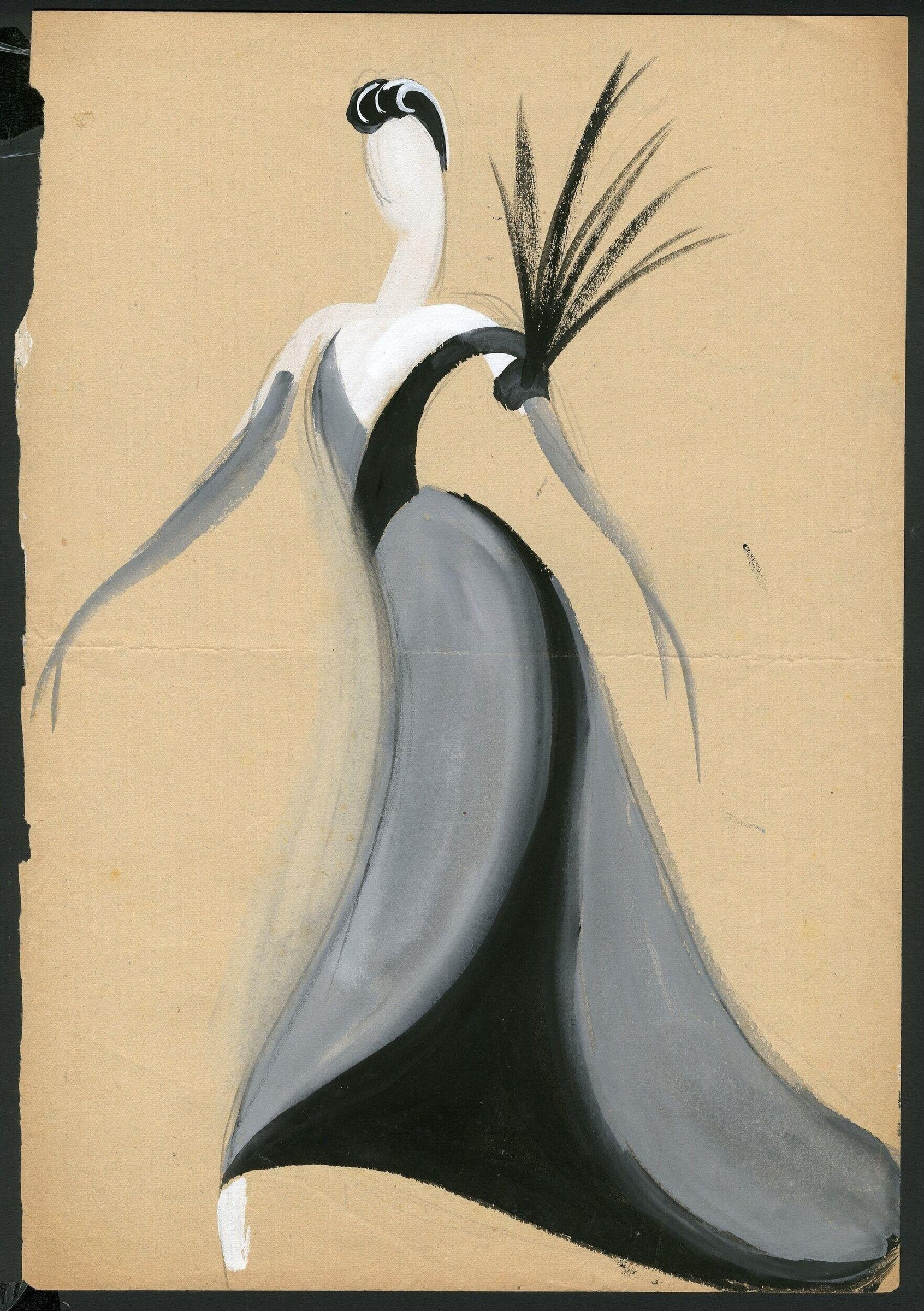
Fedorovitch's designs shaped the visual identity of British ballet at a transformative moment, influencing how dancers moved and how audiences saw ballet bodies. This drawing preserves a specific vision of dance spectacle from an artist who understood both classical technique and modernist visual language, demonstrating how costume and headdress design encode and enable particular kinds of movement.
What you are looking at
A single figure stands in elegant contrapposto against a warm cream background, the body elongated and sinuous. The dancer wears a white sleeveless garment across the shoulders and upper body, while the lower half is draped in charcoal gray fabric that curves and pools with sculptural weight. The head is turned sharply upward and back, the neck extended, crowned with a stylized black coiffure swept into sharp waves. The dancer's right arm extends outward with fingers splayed; the left arm curves downward. Most striking is the headdress—a tall sheaf of black-tipped feathers or plumes rises vertically from the crown, their lines sharp and geometric against the void. The figure is rendered in cool grays and whites against warm ground, creating a stark, almost ethereal presence. This is not a naturalistic pose but a deliberate moment of arabesque or attitude, the body a line of restraint punctuated by the explosive vertical accent of the feathered ornament.
The dancing
A single dancer in profile-front, weight gathered and lifted, the frame suggesting trained classical technique. The extended arm and backward head tilt compose an open, reaching line; the opposite arm drawn inward creates dynamic tension. The pose reads as sustained and controlled rather than momentary or earthbound—the body seems to hover despite the pooling drapery. The vertical lift through the spine and the precise hand positions suggest familiarity with balletic vocabulary, though the actual weight distribution and foot placement remain hidden by fabric.
The dance depicted
This is almost certainly a costume design for theatrical ballet or a related classical dance form, likely dating to the 1930s theatrical avant-garde. The stylization, the feathered headdress, and the sculptural treatment of the body suggest a production design rather than documentary record—possibly for a Surrealist or modernist ballet of the period. The pose itself is balletic (an attitude or arabesque held in the upper body), but the extreme artificiality of the presentation and the ornamental headdress suggest a figure from a court scene, a dream sequence, or an allegorical ballet. Without additional context, the specific choreography cannot be identified, but the design speaks to classical technique executed within an avant-garde aesthetic.
How it was made
This appears to be gouache or tempera on paper, with confident brushwork in the drapery and precise linear rendering of the feathered element. The white highlights on the gray fabric are laid in with opacity, and the black plumage is executed in a graphic, almost art-deco manner. The technique shows training in theatrical design—the economical palette and the emphasis on silhouette and line over naturalistic modeling are typical of 1930s stage costume and set drawing. The medium allowed rapid iteration and clear communication to seamstresses and craftspeople, making this a working drawing as much as a finished artwork.
About this work
This is a costume design by Sophie Fedorovitch for a work titled *Nocturne*, dated 1936. Fedorovitch was a Russian émigré designer who became a defining visual voice in British ballet during the 1930s and 1940s, creating designs for major choreographers including Frederick Ashton and Andrée Howard. The work shows her characteristic fusion of classical training with modernist aesthetics—the figure is balletically conceived but rendered in a style indebted to Surrealism and graphic art deco. The nocturne title suggests a night-world subject; the feathered ornament and the otherworldly color palette point toward a fantasy or dream scene. As a design drawing, it is a primary document of how mid-twentieth-century ballet conceived its visual world and how female dancers' bodies were decorated and framed for the stage.
How to look at it
Attend to the extreme verticality of the composition—the figure is compressed and elongated, the feathers shooting upward like a exclamation. The drapery, though sculptural, is secondary; the real action is in the architecture of the body and the crown. The white-on-cream of the upper body contrasts with the gray void of the lower half, which reads almost as the body dissolving into costume. The head thrown back and the extended arm suggest rapture or aspiration, but the overall mood is cool, controlled, almost architectural. This is not a snapshot of movement but a design for a sustained, presented image—a moment the dancer holds.
The artist
Sophie Fedorovitch (1893–1953) was a Russian-trained painter and designer who emigrated to London in the 1920s and became one of the most important costume and set designers for British ballet. She worked extensively with the Ballets Russes-influenced circles and created designs for the Vic-Wells Ballet (later the Royal Ballet), the Ballet Rambert, and independent choreographers. Her work is characterized by a synthesis of classical taste with modernist reduction; she understood the body and its movement in three dimensions and designed costumes that enhanced rather than obscured the dancer's line. She was as much a collaborator with choreographers as a subordinate artist, and her designs are inseparable from the works they inhabited.
The period
In 1936, British ballet was rapidly professionalized and artistically ambitious, drawing on the legacy of Diaghilev's Ballets Russes (which had closed in 1929) while developing indigenous choreographic voices. The mid-1930s saw a flourishing of modernist experimentation in dance design and choreography. The Surrealist movement was at its height, and its imagery of dreamscapes, strange juxtapositions, and liberated form influenced theatrical design across Europe. Fedorovitch's approach synthesized classical restraint with modernist artifice—her designs were often spare, graphically bold, and visually striking rather than historically ornate. *Nocturne* sits within this moment of high modernist ballet, when designers and choreographers were testing the boundaries between classical ballet and contemporary art.
Where it lives
The drawing is held in the Victoria and Albert Museum's Theatre Collection as a costume design. It is catalogued as a work on paper, likely in the holdings assembled to document twentieth-century British theatre and dance design.
Dance in this work
Questions about this work
Who was Sophie Fedorovitch?
A Russian-trained artist (1893–1953) who became one of the most influential costume and set designers for British ballet from the 1930s onward. She worked with choreographers including Frederick Ashton and Andrée Howard, and her designs shaped the visual language of mid-century ballet.
What is this design for?
A costume for a work called *Nocturne*, dated 1936. The specific choreography is not established from the record, but the design suggests a classical ballet with modernist or Surrealist visual sensibility, possibly a scene requiring a night-world or dream aesthetic.
What kind of dance would wear this?
Classical ballet or a related theatrical form. The pose is balletic, and the design assumes trained technique and classical bodily vocabulary. The extreme artificiality of the headdress and the sculptural approach to drapery suggest a stylized or allegorical role rather than a naturalistic character.
Is this a finished artwork or a working drawing?
Both. It is executed with enough finish and confidence to be exhibited or valued as a complete artwork, but it is also a costume design—a working drawing intended to communicate a visual idea to seamstresses, dancers, and production staff. The format and technique are typical of 1930s theatrical design practice.
More dance artwork





