49 works in this view — arrow keys or swipe to move between them.
Dance in Art
Nocturne
Fedorovitch, Sophie
- Collection:
- Costume design
- Source:
- Victoria and Albert Museum
- Rights:
- Rights vary by item — check the source record before reusing this image. Source record ↗
- Recorded as:
- V&A — check rights per item
Fedorovitch's designs shaped how classical ballet was seen for fifty years; this work shows her characteristic approach—the reduction of costume to pure line and volume, serving the dancer's body and the choreography. For historians, it documents a critical moment when ballet costume design shifted from pictorial ornament to architectural collaboration with the moving body.
What you are looking at
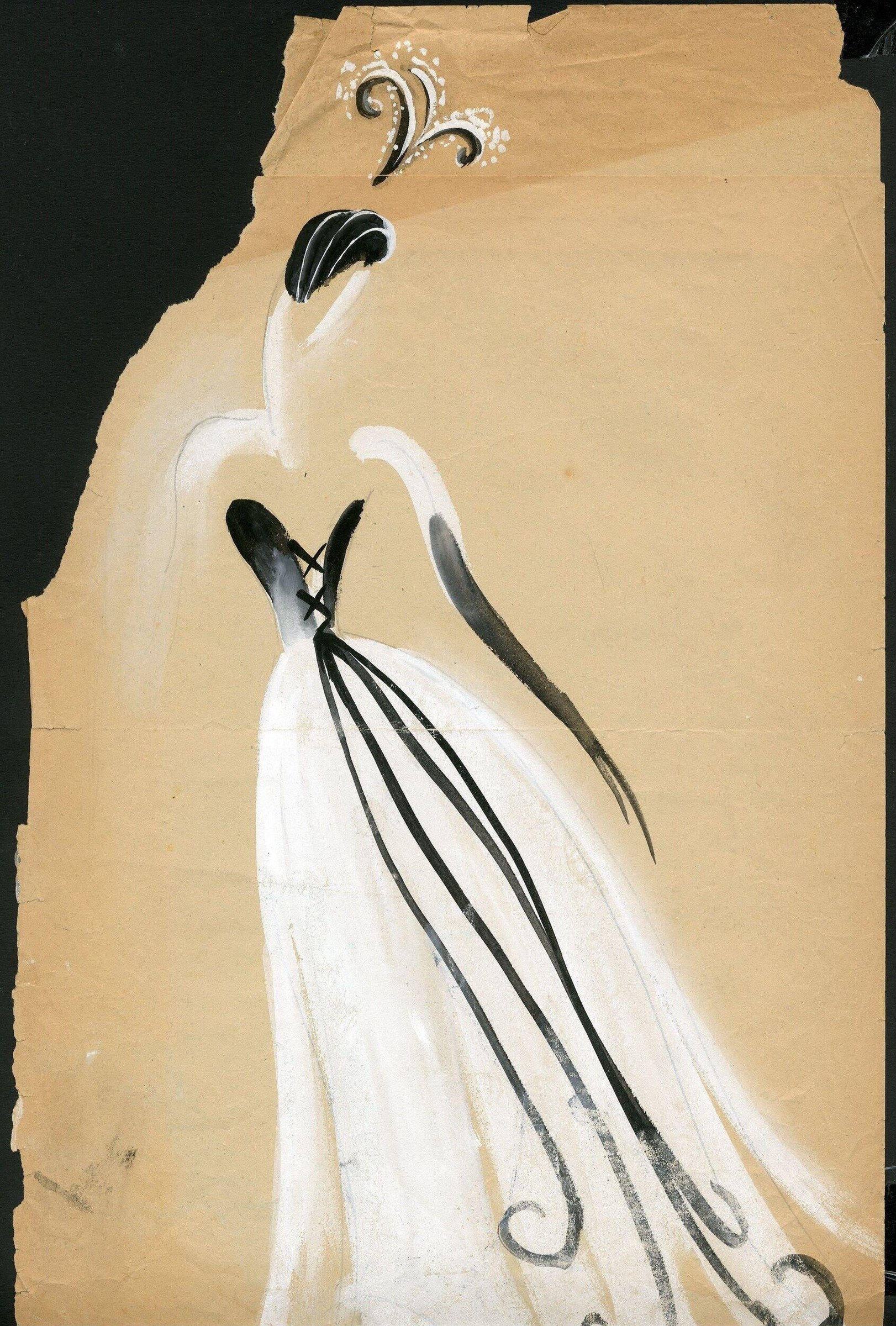
A single figure in an elegant white gown stands against a warm beige ground. The dancer is shown in a moment of poised stillness or suspension, the body angled gracefully with one arm raised and bent expressively. The gown features a fitted bodice with sharp, angular black linear elements that suggest either decorative beading or structural seaming, creating a striking contrast against the white fabric. The skirt flows downward in long, fluid lines, gathered or pleated to suggest motion even in stillness. At the top of the composition, two ornamental flourishes in grey and white—possibly a decorative monogram or design element—suggest this is a costume design rather than a scene. The figure's pose conveys refinement and elongation; the body appears almost suspended in a moment between movements.
The dancing
The dancer is isolated and frontal, viewed from roughly the knee up. The torso tilts slightly, with the visible arm lifted and gently curved, the hand appearing relaxed. The head is tilted back slightly, enhancing a sense of dreamy extension or aspiration. The weight appears gathered in the lower body and supported by the full, floor-length skirt. The linear black marks on the bodice emphasise the vertical, line-oriented aesthetic of 1930s modernist fashion design. There is no partner, no interaction—this is a study of a single body in formal, contemplative stillness.
The dance depicted
This is a costume design for theatrical ballet, most likely from the Romantic or Neoclassical tradition, executed during the high modernist era of 1930s stage design. The white tulle-like gown, the lifted arm position, and the ethereal elongation of the figure are consistent with classical ballet vocabulary and the aesthetic of mid-20th-century European ballet costume. Fedorovitch was a prominent Russian-born stage designer working in Paris and London, celebrated for her collaboration with the Ballets Russes and subsequent ballet companies. The title 'Nocturne'—evoking night, introspection, and lyricism—suggests a solo or principal role in a work emphasizing mood over spectacle. The modernist simplification of the design (flat colour, linear embellishment, absence of narrative detail) is characteristic of 1930s avant-garde ballet design.
How it was made
This is a gouache or tempera design study on paper or board, rendered with broad washes of beige and white, accented with black ink or paint applied with a fine instrument. The technique is rapid and selective—the artist has eliminated all but the essential silhouette and decorative gesture, prioritising the line of the body and the fall of the fabric over naturalistic detail. The worn edges and surface creasing visible in the photograph suggest this is an original working design rather than a finished presentation drawing, indicating this was a functional document for seamstresses and production staff rather than a gallery object. The fluid, confident application of paint and ink is characteristic of a designer trained to communicate movement and volume economically.
About this work
This is a costume design by Sophie Fedorovitch for a classical ballet role, likely created in the 1930s for a production of or in the style of a Romantic or Neoclassical work. Fedorovitch (1905–1977) was a Russian-born designer who became one of the most influential costume and set designers of European ballet in the mid-twentieth century, known for her collaboration with the Ballets Russes, the Royal Ballet, and other companies. Her work bridged Russian expressive tradition and Western modernist simplification; this design exemplifies her approach—stripping away ornament to emphasize the line of the body and the architecture of the costume itself.
The drawing belongs to a specific moment in ballet design: the period after the Ballets Russes' great era, when modernist principles were reshaping stage aesthetics. Where early 20th-century ballet design had been lavish and narrative, designers like Fedorovitch moved toward abstraction, geometric clarity, and the principle that costume should enhance, not compete with, the dancer's body. This design is at once highly finished as a practical instruction to production staff and wholly refined as an aesthetic object.
How to look at it
Study the relationship between the black linear marks on the bodice and the sculptural white form beneath: Fedorovitch is not decorating a dress, but emphasizing the skeletal structure of the costume itself, suggesting how it will sit on a moving body and how light will play across it. Notice the gesture of the raised arm—subtle, refined, not dramatic—and how the costume design supports that line without elaboration. The title 'Nocturne' invites a reading of the pose as introspective or suspended in a private moment; the modernist simplification of the design (no face, no narrative, no setting) enforces that reading. The artist has chosen a moment not of climactic movement but of repose or transition, asking the viewer to read emotion through posture and the fall of fabric alone.
The artist
Sophie Fedorovitch (1905–1977) was a Russian-born costume and set designer who became one of the most influential figures in European ballet and theatre design. She studied in Paris and worked with the Ballets Russes, designing costumes for works by Balanchine and others. After emigrating to London in the mid-1930s, she collaborated with Frederick Ashton and the Royal Ballet, designing costumes for major works including *Daphnis and Chloé*, *Ondine*, and *La Fille Mal Gardée*. Her practice was marked by a synthesis of Russian expressionism and Western modernist design principles; she favoured clean lines, sophisticated colour harmony, and an acute understanding of how fabric moves on the body. Her designs are held in major collections including the Victoria and Albert Museum.
The period
In the 1930s, ballet design was entering a new phase. The Ballets Russes, under Diaghilev's direction, had celebrated exotic spectacle and avant-garde collaboration between painters and choreographers; by the mid-1930s, as Diaghilev's company declined and state ballet companies grew in strength, design aesthetics shifted toward a more austere modernism. Simultaneously, stage lighting had improved, allowing designers to work with subtlety rather than baroque excess. Fedorovitch's generation of designers—including Karinska in costume and Pavel Tchelitchev in scenography—represented a maturation of modernist principle: the belief that costume should be 'honest,' revealing the body's architecture and supporting choreography rather than concealing or decorating. This design, made during the mid-1930s, sits at the threshold of that shift, showing a designer already committed to line, proportion, and functional elegance.
Where it lives
This is a working costume design held in the costume design collection of the Victoria and Albert Museum, London. It documents the practical work of a major designer, serving as both a historical record of a specific production or period and an artwork in its own right. Such designs were created for production staff and remain valuable evidence of how theatrical spectacle was conceived and realised.
Dance in this work
Questions about this work
Who was Sophie Fedorovitch and why does she matter?
Fedorovitch (1905–1977) was a Russian-born designer who became one of the twentieth century's most influential costume and set designers for ballet. She worked with the Ballets Russes and later the Royal Ballet, designing iconic productions including *Ondine* and *La Fille Mal Gardée*. Her approach—emphasizing line, proportion, and the dancer's body over ornamental spectacle—helped define the aesthetic of mid-century classical ballet.
What is 'Nocturne' and what ballet is this design for?
The title 'Nocturne' suggests a lyrical, introspective work, likely a solo or principal role. The catalogue record does not specify which production this design was created for, and the design itself contains no identifying marks or narrative clues. The style and approach are consistent with work Fedorovitch did in the 1930s for major ballet companies, but the specific work has not been definitively identified.
What do the black marks on the bodice represent?
The sharp, angular black lines likely represent either embroidered beading, sewn seaming, or strategic use of a contrasting fabric to emphasize the structure and movement of the bodice. In stage design, such marks serve multiple purposes: they clarify the silhouette under stage lighting, guide the eye, and indicate to the seamstress how the costume should be constructed. They are not merely decorative but functional, enhancing both the costume's appearance and its wearability.
Why is this a 'design' rather than a finished artwork?
This is a working design—a practical document created for production staff. The worn edges, creasing, and informal execution indicate this was a working drawing, handled and consulted during costume construction and fitting. It is not a presentation drawing made for display or sale, but rather a functional object that has value both as historical evidence and as art because it shows a master designer's process and aesthetic decisions in condensed form.
More dance artwork





