49 works in this view — arrow keys or swipe to move between them.
Dance in Art
Poster
Unknown
- Collection:
- Poster
- Source:
- Victoria and Albert Museum
- Rights:
- Rights vary by item — check the source record before reusing this image. Source record ↗
- Recorded as:
- V&A — check rights per item
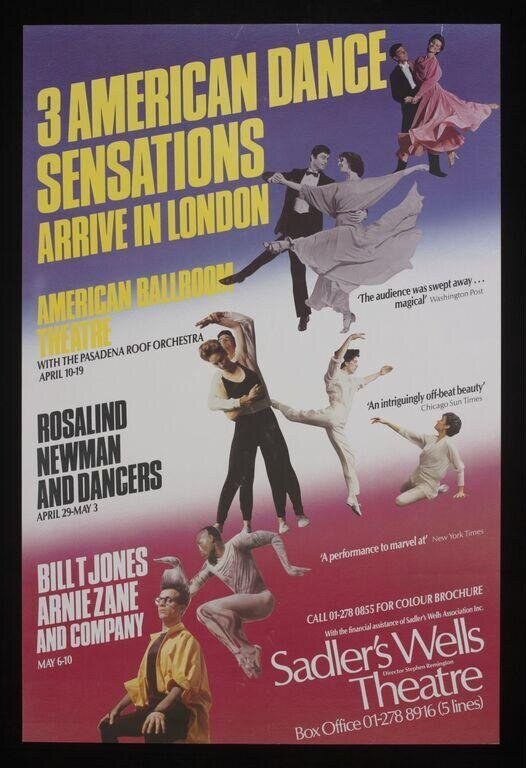
The poster documents the visibility and marketability of American contemporary dance in 1986, at a moment when Bill T. Jones/Arnie Zane and Company was beginning international prominence and when ballroom dance was still a distinct theatrical commodity. It is evidence of how promoters visualized and sold the diversity of American dance forms to European audiences, treating ballroom and avant-garde as equally worthy of prestige venue space.
What you are looking at
This is a theatrical poster advertising three American dance companies performing at London's Sadler's Wells Theatre in April 1986. The design is dominated by a striking gradient background that shifts from deep purple at the top to hot pink at the bottom, across which are arranged eight dancing figures in mid-movement. The largest and most prominent dancers occupy the upper portion: a man in a tuxedo and a woman in a flowing pink dress are shown in a dramatic lift or supported turn, their bodies extended and graceful. Below them are six more figures in various poses—some mid-leap, some in extended arabesques or contemporary floor-work positions—wearing an assortment of rehearsal and performance clothing in black, white, cream, and gold. The composition creates a sense of energy and upward momentum. At the bottom left sits a woman in a gold-yellow garment, grounded and observational, providing compositional balance. The typography is bold and urgent, with the headline "3 AMERICAN DANCE SENSATIONS ARRIVE IN LONDON" in large yellow letters, followed by the company names: American Ballroom (performing with the Pasadena Roof Orchestra, April 18–19), Rosalind Newman and Dancers (April 25–May 3), and Bill T. Jones/Arnie Zane and Company (April 8–10). A pull quote describes the experience as "magical" and "an intriguingly off-beat beauty."
The dancing
The poster shows eight dancers in markedly different styles. The two foreground figures in the upper center are in a classical ballroom frame—the man upright in evening dress, the woman in a sweeping gown with her body arched and supported. The surrounding figures adopt contemporary and modern-dance positions: one dancer in black performs a high vertical jump with extended limbs; another lies in a horizontal extension; a third is captured in what appears to be a release-based forward fold or contemporary floor phrase. The variety of body positions and dress suggests the three companies have distinct aesthetics, ranging from ballroom formality to experimental contemporary practice.
The dance depicted
The poster advertises three distinct American dance practices converging on London in April 1986. American Ballroom is identified explicitly and shown in the formal waltz or foxtrot frame of the two prominent figures. Rosalind Newman and Dancers and Bill T. Jones/Arnie Zane and Company (a pioneering queer experimental ensemble) are represented by the more sculptural and contemporary poses. The image does not attempt to unify these under a single dance vocabulary; instead, it celebrates their diversity as three separate "sensations," each with its own movement language. The ballroom couple suggests the classical American smooth dances; the other figures suggest 1980s contemporary and avant-garde practice.
How it was made
This is a lithographic poster, a medium that allowed for bold, saturated color gradients and large-scale typography ideal for street and venue promotion. The soft gradient background and the painterly rendering of the dancers' bodies suggest a hand-drawn or photo-based original that was then separated for lithographic printing. The clarity and flatness of the type, combined with the smooth color transitions, is characteristic of professional theatre poster production in the 1980s. Lithography's economy and color vibrancy made it the dominant medium for entertainment advertising of this period, allowing the design to command attention in public spaces.
About this work
This is a professional theatre poster for a season of three American dance companies at London's Sadler's Wells in April 1986. It advertises American Ballroom (performing with the Pasadena Roof Orchestra), Rosalind Newman and Dancers, and Bill T. Jones/Arnie Zane and Company—a lineup that spans ballroom, contemporary, and avant-garde practice. The poster's visual strategy is to showcase aesthetic diversity: the classical ballroom couple in the foreground contrasts sharply with the experimental floor-work and contemporary movement of the surrounding figures, signaling that audiences should expect range and innovation. As a document of 1980s dance promotion and transatlantic cultural exchange, it captures a moment when American experimental and ballroom traditions were being actively exported and celebrated in Britain.
How to look at it
Notice the stark compositional separation between the ballroom couple at the top, rendered in classical frame and dress, and the six contemporary figures surrounding them. The designer has not attempted to blend these vocabularies visually; instead, the contrast is the message. Observe the bodies: the ballroom dancers are symmetrical, supported, and formally aligned; the others are asymmetrical, extended, fallen, or suspended in states that would be unstable in classical dance. The color coding also helps—the pink-clad ballroom woman reads as romantic tradition, while the black-clad contemporary dancers read as modern experiment. This is a poster that celebrates plurality, not synthesis.
The period
In 1986, American dance was in a period of significant international expansion. Bill T. Jones and Arnie Zane had co-founded their company in 1982 and were building a reputation for formally innovative, emotionally direct work that engaged with race, sexuality, and social urgency—pushing against both classical ballet and mainstream modern dance. Ballroom dancing, meanwhile, was experiencing a modest cultural resurgence in the 1980s, with exhibitions and performances that positioned it as a legitimate theatrical and social form, distinct from its competitive ballroom-sport context. London's Sadler's Wells was a major venue for touring dance, and programming three American companies in a single month suggests strong commercial interest in and cultural appetite for American dance in Britain.
Where it lives
This poster is held in the V&A collection as a promotional object from the 1986 London theatre season. It is a commercial print, produced for display at Sadler's Wells Theatre and on London streets and transport to advertise the season of performances.
Dance in this work
Questions about this work
Who were these three dance companies?
American Ballroom was a ballroom dance ensemble that performed with the Pasadena Roof Orchestra, a swing and jazz group. Rosalind Newman and Dancers performed contemporary and jazz-influenced work. Bill T. Jones/Arnie Zane and Company was a groundbreaking experimental ensemble founded by the choreographer Bill T. Jones and his partner Arnie Zane, known for formally innovative, socially engaged work. All three brought different American dance traditions to London in April 1986.
Why did London theatres present American ballroom and avant-garde together?
In the 1980s, there was significant interest in American cultural forms in Britain, and dance venues like Sadler's Wells programmed diverse work to attract broad audiences. The pairing reflects both ballroom's theatrical legitimacy at the time and the emerging international reputation of American experimental choreography. The poster's visual strategy—contrasting the two aesthetics—suggests they were being marketed as complementary expressions of American dance innovation.
What does the poster's design tell us about dance marketing in 1986?
The bold color gradient, dramatic poses, and use of pull quotes from reviews shows that dance was being sold to the public as visually exciting and emotionally powerful, not as specialized or elite. The decision to show multiple bodies in different styles suggests marketing that emphasized diversity and choice. The prominence of the ballroom couple indicates that ballroom still carried romantic and theatrical appeal for general audiences.
More dance artwork





