49 works in this view — arrow keys or swipe to move between them.
Dance in Art
Theatre costume
Georgiadis, Nicholas
- Collection:
- Theatre costume
- Source:
- Victoria and Albert Museum
- Rights:
- Rights vary by item — check the source record before reusing this image. Source record ↗
- Recorded as:
- V&A — check rights per item
For a dancer or historian, this costume is primary visual evidence of how Romantic ballet looked in three dimensions: the weight, the construction, the placement of ornament, the permitted ranges of motion. It bridges design intent and historical practice in a way that paintings and engravings cannot. Georgiadis was a significant figure in twentieth-century dance and theater design; understanding his approach to costume reconstruction or historical homage illuminates both his own practice and the mid-century reassessment of Romantic ballet as a foundational modern tradition.
What you are looking at
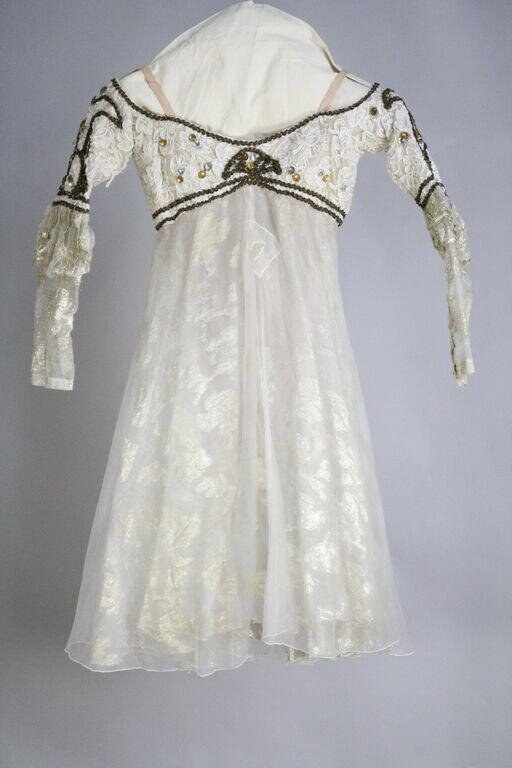
A sleeveless dress of cream or pale ivory silk or linen hangs against a neutral ground, displayed flat as a museum piece rather than on a body. The garment is high-waisted in the neoclassical manner, with a fitted bodice and a skirt that falls in loose, columnar folds to mid-calf. The most striking feature is the decorative upper bodice and sleeve band: a richly embroidered or beaded crossover design in gold, bronze, and dark thread forms an X-pattern across the shoulders and upper chest, with additional ornamental trim running down the outer edges of short, draped sleeves. The embroidery is dense and geometric, suggesting either Regency-era beadwork or a classical revival idiom. The contrast between the severe simplicity of the skirt and the jeweled complexity of the yoke and sleeves speaks to a theatrical costume designed to catch stage light and read from a distance.
The dancing
There is no dancer visible; this is a costume object photographed for archival documentation. The dress is presented without the moving body that would animate it. The cut and construction suggest a dancer of small to medium build — the high waistline, narrow shoulders, and shortened sleeves indicate a woman's form, likely of the early nineteenth century or a later historical revival. The lack of a fitted bodice and the fluid drape of the skirt would have permitted free leg movement and the balletic turnout expected of theatrical dancers of the Romantic era.
The dance depicted
This is unmistakably a theatrical dance costume, most likely for Romantic ballet of the mid-nineteenth century or a twentieth-century production that revived or referenced that aesthetic. The neoclassical silhouette—high waist, columnar skirt, minimal bodice structure—is characteristic of Romantic-era ballet costume, when dancers performed in lightweight muslin gowns that permitted the illusion of effortless flight and ethereal weight. The embroidered shoulder piece and cross-body ornamentation suggest a named role rather than corps costume; such jeweled detail was reserved for featured dancers and character parts. The costume may have been worn in a ballet drawing on classical mythology or a historical reverie. Without a documented provenance or inscription, the specific role and production remain uncertain, but the style places it firmly in the Romantic ballet tradition or a twentieth-century homage to it.
How it was made
This is a textile costume, constructed of silk or linen with hand or machine embroidery in metallic and dark thread. It survives as a three-dimensional object in a museum collection, photographed here in a conserved flat-lay format typical of costume and textile documentation. The embroidery technique—whether needle and thread or applied beading—would have created a substantial weight in the upper bodice, throwing light in performance and anchoring the dancer's frame visually. The garment shows no visible wear or staining in this image, suggesting either careful historical preservation or recent conservation; the photograph itself is modern archival documentation, likely from a museum accession or research record.
About this work
This is a Romantic-era or Romantic-revival theatrical dance costume, a sleeveless high-waisted dress of cream silk or linen with ornamental embroidered or beaded shoulder and sleeve trim. Designed for performance rather than everyday wear, it exemplifies the aesthetic and construction of nineteenth-century ballet costume: light, permissive of movement, and ornamented at points of visual focus. The garment preserves the silhouette of an era when dance costume was undergoing profound change—away from the restricting corsetry and weight of earlier court dance, toward the spare, floating line that Romantic ballet demanded.
As a museum object, it documents not only the dance of its own period but also the later twentieth-century interest in preserving and studying theatrical history through costume. The work of Nicholas Georgiadis, a major twentieth-century designer, suggests this piece may be a scholarly reconstruction or a design for a historical revival production, part of the mid-twentieth-century wave of renewed attention to Romantic ballet and its visual idiom.
How to look at it
Attend to the construction details: the way the embroidery is massed at the shoulders and upper bodice, creating visual weight and drama at the point from which arms extend and the spine rises. Notice how the skirt itself is entirely plain, unornamented, falling in simple folds—the ornament is strategic, not applied overall. In Romantic ballet, costume was designed to read from the back of a theater; this concentration of jeweled detail in the upper bodice would have caught stage light and framed the dancer's face and upper body without impeding movement. The high waistline is the mark of the Romantic era and its effort to elongate the leg and suggest weightlessness. A viewer familiar with photographs of nineteenth-century dancers will recognize the silhouette immediately.
The artist
Nicholas Georgiadis (1923–2001) was a Greek-born British stage and costume designer of international reputation. He worked extensively with major ballet companies, including the Royal Ballet and American Ballet Theatre, and was also a painter and sculptor. Georgiadis was known for designs that married classical restraint with rich ornamental detail, and for a scholarly engagement with historical costume and its possibilities. His work across ballet, opera, and theater made him one of the defining designers of mid-to-late twentieth-century performance.
The period
In 1965, when this costume was designed or documented, the rediscovery and reconstruction of Romantic ballet was in full momentum. The 1950s and 1960s saw major companies worldwide reviving or newly staging foundational works of the Romantic era—*La Sylphide*, *Giselle*—with renewed scholarly attention to historical sources. Simultaneously, designers like Georgiadis were interrogating whether historical authenticity or creative interpretation should guide costume and staging. The neoclassical aesthetic of Romantic-era ballet costume, with its emphasis on lightness and line, held deep appeal for modernist designers and choreographers, who saw in it an ancestor of their own aesthetics. This costume sits at the intersection of that scholarly interest and creative practice.
Where it lives
This costume is held in a theater collection or museum of performance, catalogued by Georgiadis's name and the date 1965. The source code 'va' suggests a museum or archive focused on visual and performing arts, most likely in Britain or Europe. The work is documented here as a museum accession or research object, preserved for its value as a design artifact and historical evidence.
Dance in this work
Questions about this work
Who would have worn this costume?
A soloist or featured dancer in a Romantic ballet or a twentieth-century production evoking that aesthetic. The refined embroidery and custom tailoring indicate a named role rather than a corps part. Without archival documentation linking the costume to a specific production and dancer, the original wearer cannot be identified.
Why is the costume so simple in the skirt?
Romantic ballet demanded the visual impression of lightness and ethereal flight. A heavy, ornate skirt would have read as weight and substance from a distance; the plain, flowing skirt created an illusion of effortlessness. Ornament was concentrated at the shoulders and bodice, where it framed the dancer and caught light without hindering the legs and feet.
Is this an original historical costume or a modern reconstruction?
The 1965 date suggests Georgiadis designed or supervised this costume for a mid-twentieth-century production, likely a revival or scholarly reconstruction of a Romantic ballet. It may be modeled on surviving nineteenth-century examples or archival drawings, but it is a twentieth-century object, not an original.
What is the embroidery made of?
The exact material is not documented in the catalogue record. From the photograph, it appears to be gold or bronze metallic thread, possibly with darker silk or glass beads, applied by hand or machine embroidery to the silk or linen base. The technique was standard for theatrical costume of the nineteenth and twentieth centuries.
More dance artwork





