49 works in this view — arrow keys or swipe to move between them.
Dance in Art
All's Well That Ends Well
Moo-Young, Ginni
- Collection:
- Poster
- Source:
- Victoria and Albert Museum
- Rights:
- Rights vary by item — check the source record before reusing this image. Source record ↗
- Recorded as:
- V&A — check rights per item
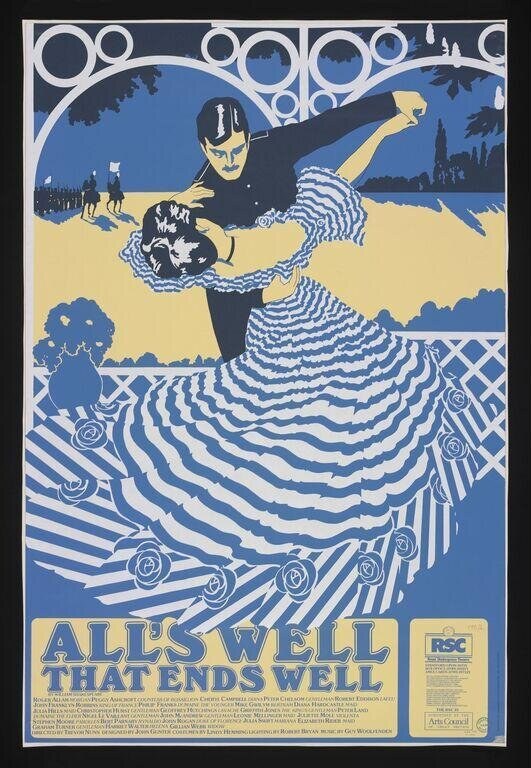
This poster documents the integration of choreographed dance into RSC stage productions and demonstrates how graphic design shaped audience perception of theatrical dance in the 1980s. The figure's ballroom-inspired posture and classical frame reveal the choreographer's or designer's understanding of formal ballroom and ballet vocabulary, and the poster's visual strategy—reducing the dancer to a single, graceful silhouette—exemplifies how theatrical dance was marketed to the public during this period.
What you are looking at
A stylized poster depicts a female dancer in an elegant, flowing gown composed of horizontal striped bands in blue and white. The dancer is shown mid-movement, her body arched backward in a graceful extension, with one leg lifted and arms positioned expressively—one reaching forward, the other supporting the dramatic curve of her torso. Her dress dominates the composition, its billowing skirt rendered as concentric waves of stripes that create a sense of movement and volume even in the static image. She wears a dark-colored bodice or corseted top. The background is divided: the upper half shows a moonlit landscape in blue with silhouettes of cypress trees and distant architecture suggesting an Italian or Mediterranean setting, while the lower portion transitions to a sandy or golden tone. Decorative circular motifs and geometric patterns frame the composition at the top and bottom, characteristic of Art Nouveau design. The figure's pose and costume suggest ballroom elegance rather than theatrical spectacle, with an emphasis on grace and romantic idealization. At the base, yellow text reads 'ALL'S WELL THAT ENDS WELL,' and an RSC (Royal Shakespeare Company) logo appears in the lower right corner.
The dancing
The single female figure occupies the entire composition vertically, her body in a pronounced backbend or lunge position that displays classical ballroom frame and extension. Her supporting leg remains relatively straight while her free leg extends upward and away from her body. The arms are positioned to frame and emphasize the curve of the torso and the sweep of the skirt—one reaches outward at approximately shoulder height, the other curves across or near the body. The posture conveys control and partnership even in a solo figure; the arch of the back and the leg extension are characteristic of waltz or foxtrot frame, suggesting a moment captured mid-turn or mid-sway.
The dance depicted
The costume, setting, pose, and the theatrical context of the Royal Shakespeare Company suggest this is a theatrical or stage dance, most likely from a ballet or classical dance interpretation. The striped gown, the ballroom-like frame, and the romantic landscape evoke Romantic-era ballet aesthetics. The poster's title, 'All's Well That Ends Well,' refers to Shakespeare's play, and the RSC logo indicates this is promotional material for a theatrical production—likely an RSC stage adaptation with choreographed dance sequences. The figure's posture and the formality of the costume and setting point toward classical or Romantic ballet vocabulary, though the horizontal-stripe treatment of the skirt is modernist in its abstraction. The work does not depict social ballroom dance but rather the stylized, theatrical presentation of ballroom-inspired movement on a stage.
How it was made
This is a lithographic poster, a technique that allows bold areas of flat color and strong linear work, as evidenced by the crisp division of blues, whites, yellows, and blacks, and the precise rendering of the striped pattern across the skirt. Lithography was the dominant medium for theatrical and commercial posters in the early 20th century, allowing for efficient reproduction and distribution to advertise performances. The technique's capacity for both detailed line work (visible in the figure's anatomical contours and facial features) and large, bold areas of color (the sky, the stripes) is fully exploited here. The medium was ideal for reaching a broad audience and establishing a strong visual identity for the production.
About this work
This is a lithographic poster from 1981 by Ginni Moo-Young, created to advertise a Royal Shakespeare Company stage production of Shakespeare's 'All's Well That Ends Well.' The poster centers on a single female dancer in an elegant, striped gown, captured mid-movement in a pose that evokes classical ballroom and Romantic ballet aesthetics. The composition combines Art Nouveau decorative framing with modernist abstraction in the treatment of the skirt, creating a striking image that emphasizes theatrical elegance and romantic idealization. The work sits at the intersection of theatrical dance promotion, graphic design, and the history of RSC visual culture in the late 20th century.
How to look at it
Attend to the pose: the figure is caught in mid-movement, her body in a pronounced backbend that suggests either a pivoting turn or a sustained extension of the kind found in waltz or in classical ballet. Notice how the artist has rendered the skirt as pure pattern—concentric waves of stripes that suggest motion and volume without realistic fabric rendering. The decorative framing at the top and bottom grounds the figure in Art Nouveau tradition while the stark division between the moonlit landscape above and the sandy ground below creates an almost dreamlike or theatrical staging. The overall effect is one of frozen grace, emphasizing the dancer's control and elegance rather than dynamic energy.
The artist
Ginni Moo-Young is credited as the artist for this 1981 poster. Limited information is currently available regarding Moo-Young's broader artistic practice or career in theatrical poster design, but the execution and style suggest professional familiarity with lithographic design and theatrical promotion. The work is housed in the va (Victoria and Albert Museum) collection, which holds extensive materials related to theatrical design and stage costume.
The period
In 1981, the RSC was actively commissioning poster designs for productions, often drawing on modernist and graphic design approaches to attract audiences. The 1980s saw increasing interest in combining classical literary texts with contemporary visual design and choreography. The Art Nouveau decorative vocabulary visible in the framing motifs reflects an ongoing aesthetic dialogue with early 20th-century design traditions, even as the figure itself and the overall composition employ modernist principles of abstraction and simplification. Theatrical dance in Britain during this period was expanding beyond strictly narrative ballet into more experimental and integrated forms.
Where it lives
The work is held in the Victoria and Albert Museum (va) collection, which archives theatrical posters, designs, and related materials. The RSC logo and the 1981 date indicate this was official promotional material for a Royal Shakespeare Company production.
Dance in this work
Questions about this work
Is this a real dancer or an idealized figure?
The figure is a stylized, idealized representation created for a poster rather than a portrait of a specific dancer. The design prioritizes grace and theatrical elegance over anatomical precision or individual likeness. Posters from this era typically presented dancers as iconic, generalized forms rather than as specific performers.
What dance style is depicted?
The posture and frame—the backbend, the leg extension, the arm positioning—evoke classical ballet and ballroom dance vocabulary, particularly the Romantic era tradition. However, the context (a Shakespeare play) suggests this is theatrical stage dance rather than competitive ballroom or concert ballet. The costume and setting are theatrical rather than ballroom-specific.
Why is the skirt rendered as stripes rather than realistic fabric?
The striped pattern is a modernist design choice that serves multiple purposes: it creates visual rhythm and dynamism, reduces the figure to bold graphic shapes suitable for poster reproduction, and suggests movement through repetitive pattern rather than through realistic rendering. This abstraction was typical of graphic design in the 1970s-80s.
What is the RSC logo and why is it on the poster?
The RSC (Royal Shakespeare Company) is Britain's most prominent theatrical institution. The logo indicates this poster was official promotional material for an RSC production of 'All's Well That Ends Well.' The presence of the logo and the Shakespeare text confirm the work is theatrical advertising rather than fine art.
More dance artwork





