49 works in this view — arrow keys or swipe to move between them.
Dance in Art
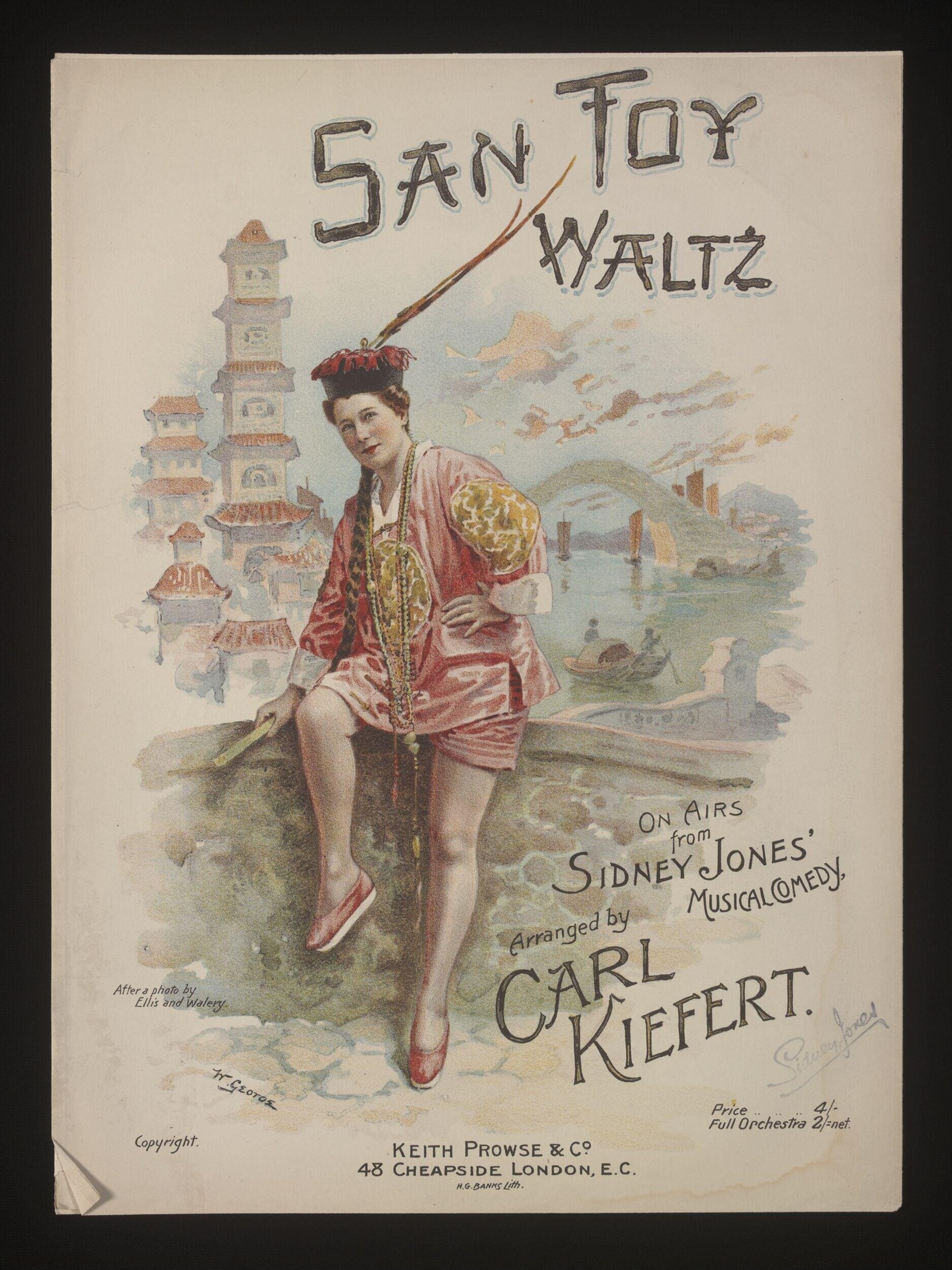
San Toy Waltz
Jones, Sidney
- Collection:
- Sheet Music
- Source:
- Victoria and Albert Museum
- Rights:
- Rights vary by item — check the source record before reusing this image. Source record ↗
- Recorded as:
- V&A — check rights per item
Sheet music covers are often overlooked as historical documents, but they are direct evidence of what the theater industry chose to advertise and how dancers and choreography were marketed to paying audiences. This image reveals the conventions of Edwardian musical theater—the emphasis on a single glamorous female figure, the Orientalist fantasy, the balletic posture—and shows how theatrical dance was communicated visually to the public. For anyone studying the history of musical theater, popular taste in dance, or the material culture of early 20th-century theater, this is a primary source.
What you are looking at
A woman in an elaborate crimson silk robe stands in a three-quarter pose against a misty landscape of Chinese pagodas and waterways. She wears a jeweled headdress with upswept red plumage, and her robe is richly embroidered with gold brocade depicting chrysanthemums or peony blossoms. Her left leg extends in a high kick, the foot pointed, revealing red silk slippers. The setting is Orientalist and fantastical—the pagoda in the background has multiple tiers with upturned eaves, and the middle distance shows boats on water and a bridge, all rendered in soft watercolor washes. The composition places her weight on her right leg while the left is thrust upward in an energetic, balletic line. The figure dominates the foreground while the architecture recedes into atmospheric perspective, emphasizing the dancer as the subject.
The dancing
A single female dancer in profile-three-quarter view. Her weight is planted on the right leg in a slight demi-plié; the left leg is raised high and extended in a straight line, pointed foot, in a posture suggesting either a high kick or a développé. The upper body is erect and facing forward, with the dancer's gaze directed toward the viewer. The arm position is not fully clear but appears to be raised or held back, consistent with late 19th-century theatrical dance carriage. The pose suggests a trained performer with control and extension; the line of the body reads as balletic rather than naturalistic.
The dance depicted
This is sheet music for a waltz associated with Sidney Jones's musical comedy *San Toy*, which premiered in London in 1899. The cover depicts a moment from the musical's dances, likely one of the ensemble pieces or a characteristic solo. The high leg extension and balletic posture place this within the theatrical-musical-theater tradition of the Edwardian stage. The pose is not a strict waltz position—it reads as a theatrical moment of display rather than partnered ballroom movement—suggesting this may be promotional imagery that captures the spirit of the musical's choreography rather than a specific dance hold. The Orientalist costume and setting reflect the musical's East Asian setting.
How it was made
A chromolithograph, printed in color by G. H. Barris Ltd. The technique allowed full-color reproduction at low cost, making it ideal for sheet music distribution to home pianists and theater patrons. The soft watercolor style of the landscape and the rich detail of the costume embroidery show the capabilities of chromolithography for fine rendering. This is a commercial object intended for wide circulation; the copyright notice and publisher information indicate it was produced by Keith Prowse & Co., a major London music publisher. The price—listed as 4/- for full orchestra and 2/6d for piano arrangement—indicates it was an affordable commodity for middle-class households.
About this work
This is the cover illustration of a waltz from Sidney Jones's hit musical comedy *San Toy*, published by Keith Prowse & Co. in London around 1899–1900. The image shows a female performer in an ornate Orientalist costume, posed in a high kick against a fantastical Chinese landscape. As a theatrical musical number of the Edwardian era, it captures the aesthetics and movement vocabulary of West End musical theater at the turn of the 20th century. Sheet music covers of this period are crucial historical documents: they are commercial art objects that reached thousands of homes and theaters, shaping what the middle-class public understood dance and the theater to look like.
How to look at it
Notice the pose: this is not a waltz position but a moment of display—a high kick or extension that breaks the closed hold of ballroom dancing. This reflects how early 20th-century musical theater borrowed from ballet and acrobatics, mixing forms. The Orientalist costume—the robe, headdress, embroidery—is theatrical fantasy, not ethnographic documentation. The landscape behind her serves as a stage set rendered in perspective. The composition places the entire focus on the female figure; she is the commodity being sold. Compare this to ballet chromos from the same period to see how musical-theater imagery differs: the pose is less classical, the setting more narrative, the overall effect more about spectacle than line.
The artist
The cover is credited to a photographer named Ella and Waltery (a London photographic firm), whose image was then processed into a chromolithograph. Sidney Jones (1858–1941) was the composer and conductor; the choreography is not attributed, though it would have been created by a choreographer of the West End musical theater tradition. The musical's popularity—it ran for three years in London and was performed internationally—made the sheet music a significant commercial product, and the cover illustration would have been a professional commission designed to appeal to amateur musicians and theater enthusiasts.
The period
In 1899–1900, musical comedy was at the height of its popularity in London, following the successes of *The Geisha* (1896) and other comic operas. *San Toy* was one of the decade's biggest hits, running 768 performances. The Edwardian musical theater was characterized by strong melodies, comic librettos set in exotic locations, and elaborate dance numbers—though these dances were typically ensemble pieces rather than solo virtuosity. The choreography drew on balletic vocabulary but was designed for actors who could dance rather than professional dancers. The Orientalist setting was fashionable in European theater, reflecting both imperial enthusiasm and the escapist fantasy the musical stage offered middle-class audiences. Sheet music covers from this era are valuable sources for understanding the visual identity of musical theater and how women performers were marketed.
Where it lives
This is a cover of published sheet music by Keith Prowse & Co., 48 Cheapside, London, E.C. The object is held as sheet music in the collection listed as 'va' (Virginia source, specific holding unclear from the catalogue record). Sheet music covers were mass-produced commodities; thousands of copies would have been printed and distributed to music shops, homes, and theaters.
Dance in this work
Questions about this work
What musical was this from?
*San Toy* was a musical comedy by Sidney Jones with a libretto by Edward Morton. It premiered at the Garrick Theatre in London in October 1899 and was a major commercial success, running for three years. The plot involved a British naval officer and a Siamese princess, hence the Orientalist costumes and setting.
Did women actually dance like this in 1899?
Not in a waltz—this is a theatrical moment, not a ballroom dance. The high kick and pointing of the foot show balletic influence, which was increasingly incorporated into musical theater choreography. Professional chorus girls and principals in West End musicals received training in ballet and acrobatics, so high leg extensions and turned-out positions were part of the vocabulary.
Why is the costume so elaborate if this is a waltz?
The costume is theatrical fantasy, designed for visual impact on stage. Even pieces titled as waltzes or other ballroom dances in musical theater were often staged as showpieces with elaborate costumes, scenery, and choreography that went far beyond the ballroom. The sheet music cover advertises the whole theatrical experience, not just the dance form.
Is this a photograph or a painting?
It is a chromolithograph based on a photograph by Ella and Waltery. The photographic image was converted into a color-separated lithograph for mass production. This was the standard process for colored sheet music covers in this era.
More dance artwork





