49 works in this view — arrow keys or swipe to move between them.
Dance in Art
The Silesien Waltz, no 3
Brandard, John
- Collection:
- Source:
- Victoria and Albert Museum
- Rights:
- Rights vary by item — check the source record before reusing this image. Source record ↗
- Recorded as:
- V&A — check rights per item
This work documents a pivotal moment in dance history—the waltz's transformation from scandalous novelty to respectable theatrical subject, and its deployment in Romantic ballet as a vehicle for character and narrative. It also shows how dance was marketed and circulated to audiences through prints: what people who attended theaters actually saw and remembered was often mediated through images like this one, making theatrical lithographs essential evidence for how dance was staged, interpreted, and imagined in the nineteenth century.
What you are looking at
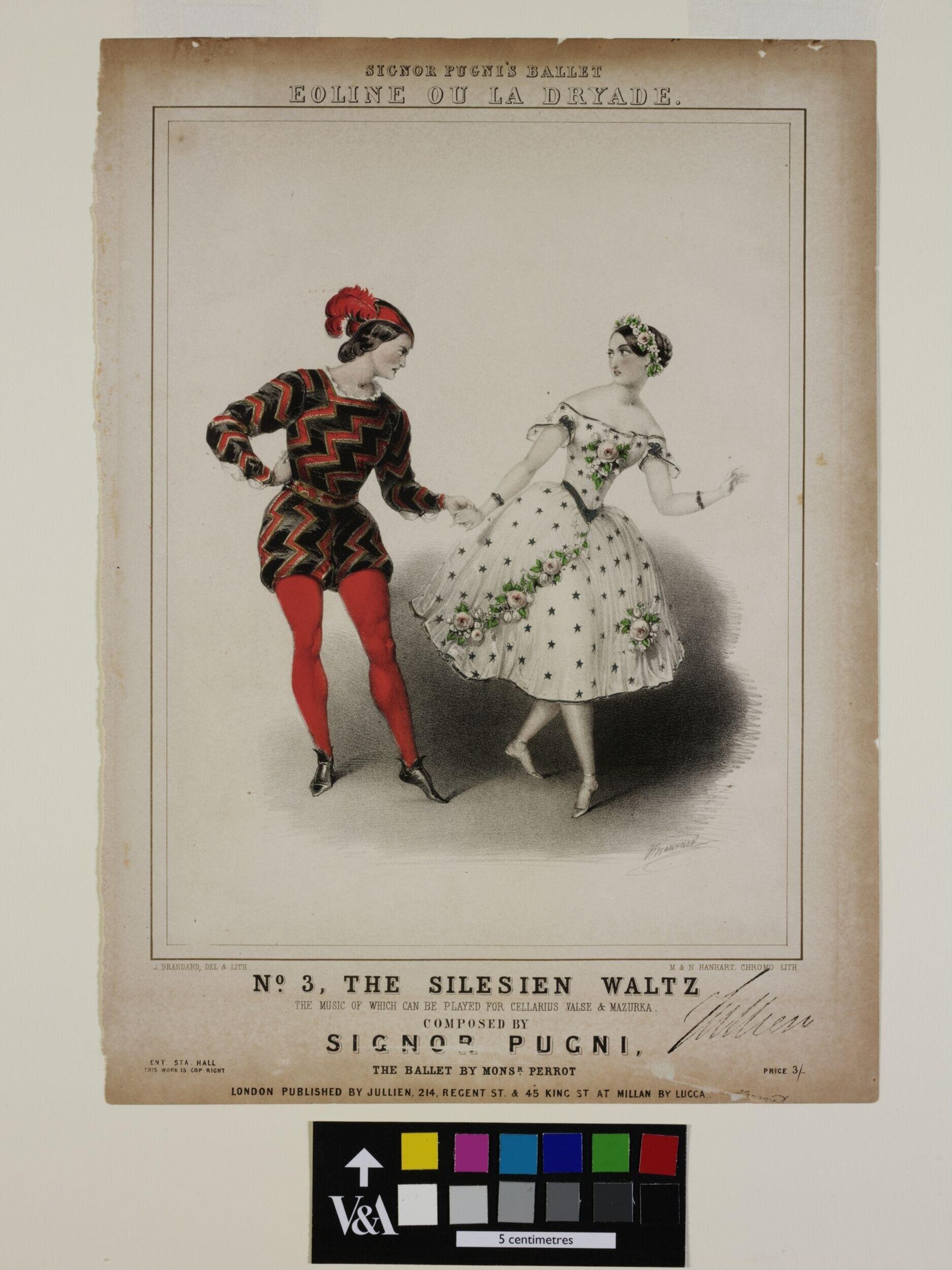
Two dancers occupy a pale studio space against a neutral background, caught in a moment of playful social interaction. On the left, a figure in a striking red and black zigzag-patterned tunic with red tights and black shoes, topped with a red feathered headdress, strikes a confident pose with one hand on hip and the other extended in gesture. On the right, a figure in a white ball gown scattered with black stars and trailing green ivy or floral garlands, wearing a wreath of flowers in their hair, turns toward their companion with arm raised. The composition uses soft charcoal shading to model the bodies against the white ground, creating depth through shadow beneath the figures. The dresses are rendered in fine detail—the geometric patterning of the left figure's costume contrasts sharply with the delicate scatter of stars across the gauzy skirt on the right. The moment captures not a formal dance position but an intimate, flirtatious exchange between the two, suggesting narrative or character rather than technical display.
The dancing
Both figures are upright and relaxed, positioned at an angle to one another rather than in a closed ballroom hold. The left figure leans forward slightly with weight on one leg, the gesture of hand-on-hip and extended arm suggesting confidence, display, or perhaps mocking address. The right figure is in three-quarter view, one arm raised to shoulder height with hand turning outward in a responsive gesture; the body sways slightly, the skirt caught mid-turn or curtsey, suggesting lightness and compliance. Neither adopts the rigid frame or precise positioning of formal ballroom dance; instead they embody the social ease of salon or stage comedy, with the bodies communicating personality rather than technique.
The dance depicted
The title identifies this as a waltz, and the costume of the right figure—white gown, flowers, lightweight fabric—is consistent with the Romantic-era waltz costume. However, the zigzag tunic and feathered headdress on the left suggest theatrical or comedic dress, possibly pantomime or ballet character costume rather than ballroom wear. The composition reads as a scene from a ballet with narrative content, likely from the Romantic period when the waltz featured prominently in theatrical storytelling. The relaxed, angled positioning and the evident character play suggest this depicts not the ballroom dance itself but a theatrical representation of waltzing, where two characters interact through dance as part of a larger narrative—possibly a scene of seduction, mockery, or courtship embedded in a ballet plot.
How it was made
This is a hand-colored lithograph, evidenced by the soft tonal modeling in charcoal or crayon, the precision of the linear border, and the technique of color laid over a lithographic base. The printing allows fine detail in the patterning of both costumes while the hand-coloring achieves subtle variation in flesh tones and the creamy white of the ball gown. This medium and its cost position the work as a commercial print for a middle-class audience—a keepsake or promotional image for a theatrical production, likely circulated as sheet music cover or print portfolio. The inscription at the foot identifies it as published in London by Jullien in the mid-nineteenth century, indicating it was meant for wide distribution among those who attended or followed fashionable theater and dance.
About this work
This is a scene from Signor Pucini's ballet *Éoline ou la Dryade*, captured in a theatrical moment of waltzing interaction between two characters: one in colorful pantomime dress, the other in the ethereal white gown of Romantic ballet convention. The work documents not ballroom practice but theatrical representation—how waltz steps and partnering were translated into narrative ballet for the Victorian stage. Published as a lithographic print with hand coloring, it served both as advertisement for the production and as a souvenir for audiences, making it a window into how dance was consumed visually in mid-nineteenth-century theater. The image reveals the tight relationship between social dance and theatrical dance in the Romantic period: the waltz was fashionable in drawing rooms and on stage simultaneously, and this print captures that doubling.
How to look at it
Notice how the artist has chosen a moment of social ease rather than technical spectacle: the dancers are not mid-leap or in a perfect closed position, but rather engaged with one another as characters. The contrast between the two costumes—geometric and pantomimic on the left, ethereal and Romantic on the right—suggests comic or dramatic relationship rather than social equality. The feathered headdress, the theatrical pose, and the playful gesture of the left figure all point toward character work and narrative theater rather than pure dance display. This was a common strategy in Victorian theatrical prints: they captured the 'story' moment rather than the 'show' moment, because those were the scenes audiences remembered and wanted to own.
The artist
John Brandard was a London-based lithographic artist specializing in theatrical and musical subjects. He produced numerous prints documenting popular stage productions and musical performances of the 1830s–1850s, often capturing scenes from ballets, operas, and musical comedies. His work was published primarily by Jullien and distributed as both sheet music covers and stand-alone theatrical prints, making him a prolific visual documentarian of nineteenth-century popular entertainment.
The period
The 1840s were the height of the Romantic ballet in Europe. Ballets like *La Sylphide* and *Giselle* had already established the genre's conventions: the ethereal heroine in white tulle, the supernatural or pastoral setting, and the integration of popular social dances—especially the waltz—as expressions of character and emotion. The waltz itself had recently been domesticated in polite society; once condemned as too close and sensual for respectable ballrooms, by the 1840s it was the dominant fashionable dance across Europe and a standard feature of theatrical entertainment. Pucini's *Éoline* was part of a flourishing commercial ballet industry in London, where Romantic ballet had been adapted to local taste and frequently updated with topical references, comedy, and spectacular scenery.
Where it lives
Published by Jullien, 214 Regent Street, 45 King Street, Piccadilly, London. The print appears as no. 3 in a series documenting Pucini's ballet *Éoline ou la Dryade*. It is held in the Victoria and Albert Museum's collection as a theatrical print and souvenir of mid-nineteenth-century London commercial entertainment.
Dance in this work
Questions about this work
Why is one dancer dressed so differently from the other?
They are characters in a ballet narrative, not a ballroom couple. The colorful tunic and feathered headdress indicate a comedic, pantomimic, or non-human character (possibly a mythological being or comic servant), while the white gown marks the heroine of Romantic ballet convention. The contrast in costume tells the story before you read the title.
Is this showing how people actually waltzed in 1845?
Not exactly. This is a theatrical version of the waltz, staged for entertainment. Actual ballroom waltzers held each other in a closed frame and maintained vertical alignment; here the dancers are relaxed and angled, using the waltz as a vehicle for character interaction rather than displaying technique. The print shows how the waltz was adapted for theater, not how it was danced in drawing rooms.
What was Pucini's ballet about?
Based on the title and the costume of the right figure (ethereal, flower-crowned), *Éoline* likely drew on the popular Romantic ballet theme of the supernatural heroine—either a nymph, spirit, or nature spirit. The narrative probably involved the encounter between this character and a mortal or comic figure, as suggested by the interaction in this print. Specific plot details would require access to the ballet libretto or contemporary reviews.
More dance artwork





