49 works in this view — arrow keys or swipe to move between them.
Dance in Art
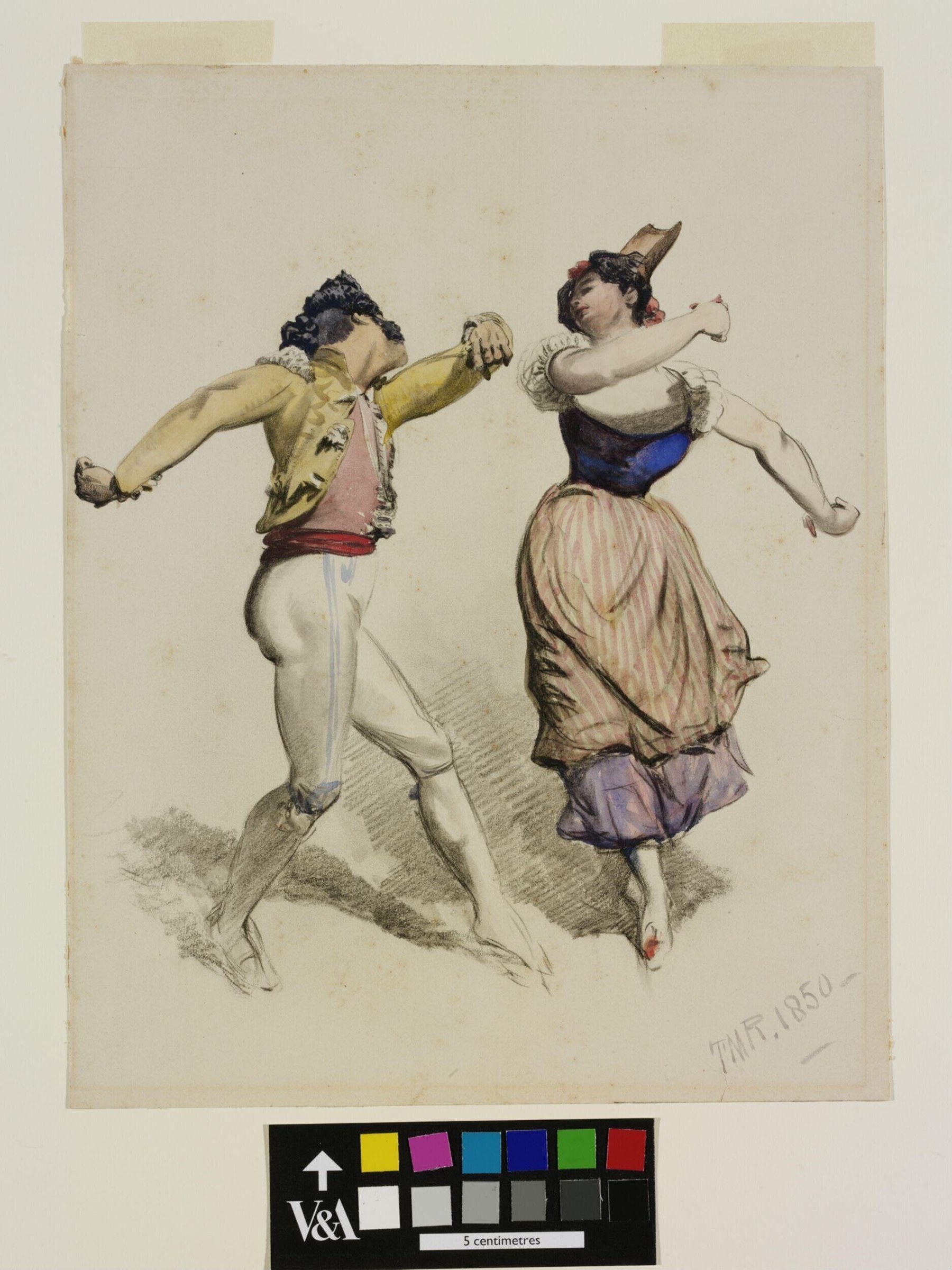
A Spanish Dance
Richardson, Thomas Miles the younger, RWS
- Collection:
- Source:
- Victoria and Albert Museum
- Rights:
- Rights vary by item — check the source record before reusing this image. Source record ↗
- Recorded as:
- V&A — check rights per item
This print documents the crucial 19th-century traffic between authentic folk and national traditions and the theatrical fantasies they inspired—the moment when Spanish dance entered European consciousness through the stage rather than direct cultural encounter. For historians of theatrical dance and exoticism, it reveals how Romantic ballet and theatrical entertainment constructed 'Spain' and 'Spanish' through movement, costume, and the dancing body, a process that shaped European attitudes toward Spanish and broader Latin American culture.
What you are looking at
Two figures in energetic motion dominate a plain cream ground. On the left, a male dancer in a yellow jacket with pink lining leaps with legs splayed in a vigorous jump, his upper body arched backwards and arms outstretched. He wears white breeches and has dark curled hair topped with what appears to be a plumed hat or decorative headpiece. On the right, a female dancer in a striped pink skirt with a blue bodice and white chemise extends her right arm outward in a corresponding gesture, her arm bent at the elbow in a reciprocal pose. She too wears a tall plumed hat or headdress, tilted at a jaunty angle. Her left arm reaches up and back, and her posture suggests a moment of turning or lifting. The figures appear to be partners in a duet, captured mid-leap or mid-turn, with their extended limbs and opposing arm angles suggesting a coordinated moment of display rather than a formal closed-position dance. The composition is buoyant and theatrical, the figures isolated against an unmodulated background that emphasizes their silhouettes and movement.
The dancing
Both dancers are airborne or at the moment of leaving the ground, suggesting a highly technical jump or elevation central to the choreography. The male dancer's legs are flung wide apart in a split leap (possibly a jeté or grand battement in a jump), while the female dancer's position is less clear but equally dynamic and elevated. Their arm positions are emphatic and extended rather than held in any formal ballroom frame—open, assertive gestures that suggest either display choreography or the folk-inflected exuberance of a nationalistic or theatrical style. The woman's extended arm and upward reach contrast with the man's backward arch, creating a sense of complementary opposition. Neither figure displays the upright carriage or closed partnership holds of ballroom or court dance.
The dance depicted
The title 'A Spanish Dance' and the theatrical dress suggest this is a theatrical or stage interpretation of Spanish dance, most likely a dance with strong flamenco or bolero associations given the era (1850) and the theatrical context. The vigorous elevation, split legs, and emphatic arm positions do not correspond precisely to authentic flamenco footwork or the contained upper-body movement characteristic of actual flamenco, but rather represent a Romantic-era theatrical fantasy of Spain—the kind of exoticized Spanish character dance that appeared in European ballet and popular theatre. The female dancer's costume and the male's jaunty hat with plume suggest stage dress rather than folk costume. This is likely a theatrical duet created for the stage rather than a representation of vernacular Spanish dance, choreographed for European audiences seeking visual spectacle and the thrill of exotic difference.
How it was made
This is a hand-colored engraving or lithograph, likely a theatrical print from the mid-19th century. The precise line work, the subtle cross-hatching in the background, and the restrained but deliberate color application (the yellow, pink, and blue are selective rather than covering) suggest the working method of theatrical costume or character print production—the kind of image circulated to advertise performers, dances, or fashionable theatrical moments to a broad urban audience. The print's moderate size and its appearance in a holding collection as a catalogued work indicates it was a print sold separately or collected in theatrical annuals, reaching audiences who could not attend the stage but wanted visual access to fashionable dance and spectacle.
About this work
This hand-colored mid-19th-century theatrical print depicts two dancers in exuberant motion, identified as performing 'A Spanish Dance.' The work represents the Romantic period's embrace of exotic and nationalistic themes in theatrical dance, when Spanish identity—real and imagined—became a source of choreographic fascination for European audiences and choreographers. The image is not a document of vernacular Spanish dance, but rather a window into how that tradition was translated, theatricalized, and consumed by the concert stage and the expanding market for theatrical prints.
The print belongs to a rich tradition of character and national dance imagery in 19th-century theatre, when dances labeled as Spanish, Italian, Hungarian, or Swiss appeared regularly in ballets and variety performances. Such images served multiple purposes: advertising performers, documenting ephemeral stage works that left no other trace, and circulating images of fashionable dance to a print-buying public. This work exemplifies that circulation and speaks to the profound connection between stage dance, graphic art, and the formation of popular taste in the 19th century.
How to look at it
Note the moment the artist chose to freeze: the apex of the leap, when both dancers are suspended and their extended limbs create the widest, most visually dramatic silhouette. This is not a moment of grounded technique or rhythmic footwork, but of aerial display—the choice tells us that elevation and spectacle mattered more than the intricate footwork flamenco is known for. Observe the contrast between the two bodies: the male's backward arch and splayed legs versus the female's forward extension and upward reach. This opposition suggests a coordinated theatrical moment rather than a folk partnership, and the emphasis on openness, display, and the extension of the limbs outward into space reflects the balletic and theatrical values of the stage for which it was created.
The artist
Thomas Miles Richardson the Younger (1813–1890) was a British engraver, watercolorist, and artist known for theatrical subjects, architectural views, and landscape work. He was active in an era when theatrical prints were a significant commercial and artistic enterprise, circulating images of celebrated performances, dancers, and fashionable entertainments to urban audiences. His engagement with theatrical subjects suggests he moved in circles connected to London's theatrical world and the market for visual culture surrounding it.
The period
The 1850s were a peak moment for exotic national and character dances in European theatre. The Romantic ballet had already established the convention of the character dance as a vehicle for representing cultural 'otherness' and nationalist fantasy within the framework of dramatic ballet—think of the Spanish and Italian dances in many 5-act Romantic ballets. At the same time, variety theatres, music halls, and even concert rooms featured individual dancers performing national character dances as specialty acts. Spanish dance held particular fascination, fed by broader Romanticism's attraction to Iberian exoticism, the legacy of Spanish guitar and folk music in European consciousness, and the physical virtuosity associated with Spanish movement. The 1850s were also a moment of print proliferation—theatrical prints were a major commercial product, feeding the appetite of middle-class theatre-goers for images of their favorite performers and fashionable stage moments.
Where it lives
The work is held in the V&A collection as a print. The catalogue record identifies it as by Richardson, the Younger, and dates it to 1850, suggesting it was produced in that year or shortly after, likely for sale as a theatrical print or in a theatrical annual or magazine.
Dance in this work
Questions about this work
Is this Spanish flamenco dance?
No. While the title claims it is Spanish, the movement is theatrical and balletic—the vigorous leg splits, backward arches, and emphatic arm extensions are not characteristic of authentic flamenco, which centers on intricate footwork, rhythmic hand clapping, and a contained upper body. This is a theatrical fantasy of Spain, created for European stage audiences, not a representation of vernacular Spanish dance.
Why are both dancers in the air?
The choice to capture the leap—the moment of greatest suspension and visual drama—reflects 19th-century theatrical values. Elevation, spectacle, and the extension of the body through space mattered more to the stage choreographer and the print audience than the intricate rhythmic footwork characteristic of actual folk dance. The leap makes the dance visually exciting and easily recognizable as 'dance' to viewers unfamiliar with Spanish tradition.
What was this print for?
Theatrical prints like this were sold to theatre-goers who wanted images of celebrated dancers and fashionable stage moments they had seen or heard about. They were also collected in theatrical annuals and periodicals. This print advertised the dance, the performers, and the visual spectacle of the moment to a broad urban audience, extending the reach of the theatre beyond the playhouse itself.
Who danced this dance?
The catalogue record does not identify the performers, and the print itself does not name them. Such theatrical prints often remained anonymous in this way, emphasizing the dance and the character rather than individual performers, though they would have been immediately recognizable to audiences of the time.
More dance artwork





