49 works in this view — arrow keys or swipe to move between them.
Dance in Art
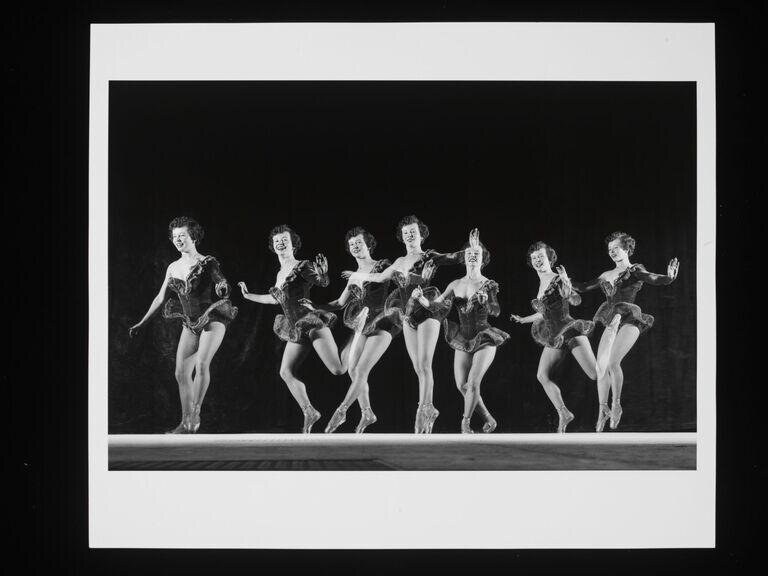
Photograph of a Ballet dancer
Edgerton, Harold
- Collection:
- Photograph
- Source:
- Victoria and Albert Museum
- Rights:
- Rights vary by item — check the source record before reusing this image. Source record ↗
- Recorded as:
- V&A — check rights per item
This image is a direct record of how American theatrical dance looked at the moment when musical theatre and revue were at their commercial and cultural peak. It shows the aesthetic values of the period—precision, uniformity, visual spectacle, and the subordination of individual expression to ensemble effect—in a single crystalline image. For historians and dancers, it is material evidence of a now-historical dance practice and the performance values that shaped American popular dance.
What you are looking at
Seven female dancers stand in a precise line across a dark stage, evenly spaced and facing forward in a unified formation. Each wears an identical sequined or beaded costume—a dark short-sleeved tunic or leotard with ornamental detail that catches the light—and dark stockings. They are lit from the front by stark theatrical lighting that models their bodies and creates sharp shadows, a hallmark of 1940s theatrical photography. All seven have their arms raised and bent at the elbow in a synchronized gesture, with hands positioned at mid-height and visible. Their posture is upright and controlled, weight distributed evenly on both feet. The composition emphasizes geometric precision and perfect unison: each figure is a mirror of the others, and the line itself becomes the subject—a demonstration of disciplined ensemble work rather than individual expression. The dark background isolates the dancers completely, focusing attention entirely on their formation and synchronization.
The dancing
Seven dancers arranged in a single line, all identically costumed and posed. Each holds the same arm position—elbows bent, arms raised to approximately shoulder height, hands visible and held with precision. Their bodies are fully frontal to the camera, weight evenly balanced, legs straight and together or in a neutral stance. The uniformity of posture and gesture across all seven figures suggests this is a professional ensemble trained to move as a single unit. No variation in line or arm position is visible; this is disciplined, uniform movement rather than expressive or interpretive gesture.
The dance depicted
This is a chorus line or precision ensemble dance, likely from a Broadway musical, revue, or theatrical production of the 1940s. The seven dancers moving in perfect unison with identical costumes and synchronized arm positions are the essence of the American chorus tradition that flourished in musical theatre and vaudeville during this era. The geometric precision, the emphasis on synchronized movement, and the theatrical costume all point to a professional stage production. The specific arm gesture and formation cannot be identified as a named classical or vernacular dance form; instead, this represents the conventions of commercial theatrical dance and ensemble work typical of the period.
How it was made
This is a black-and-white photograph, and the sharp focus, careful lighting, and studio-quality composition suggest this is a professional theatrical photograph taken during a performance or a formal documentation session. The stark front lighting and dark background are characteristic of 1940s theatrical photography, which used controlled studio conditions to document stage work. The photographer's attribution to Harold Edgerton—known for pioneering high-speed flash photography—suggests this may have been taken using experimental lighting techniques, though the image shows conventional theatrical lighting rather than Edgerton's typical stop-motion work. The photograph was likely produced for publicity, documentation, or archival purposes and represents a moment frozen in the controlled conditions of studio photography rather than a candid stage capture.
About this work
This photograph documents a moment of American theatrical dance at mid-20th century: seven identically costumed dancers moving in perfect unison on a dark stage, their bodies and gestures frozen in a single synchronized moment. It is an image of the ensemble aesthetic that defined musical theatre and revue dancing of the 1940s—a dance form built not on the expression of individual dancers but on the creation of visual spectacle through multiplication, precision, and unanimous movement. The photograph shows the ideal of the chorus line as a unified visual and kinetic entity, where each body is interchangeable with the others and the power of the image lies in perfect repetition.
The work belongs to a documentation tradition that valued theatrical photography as a record of commercial entertainment and a tool for publicity. It represents a moment before the modernist reforms of the 1950s and 1960s began to challenge the conventions of musical theatre dance, and before television and film began to reshape how dancers and audiences understood performance.
How to look at it
Look first at the uniformity: every dancer wears the same costume, holds the same pose, maintains the same spatial relationship to the others. Notice that there is no variation, no sense of individual personality or expression—the power of the image lies in perfect repetition. Then attend to the lighting: the sharp front light that defines each body, the dark background that isolates the figures, the way light catches the sequined costumes. This is the vocabulary of 1940s theatrical photography, designed to maximize visibility and visual impact. Finally, consider what moment the photographer chose: not a moment of leap or turn, but a moment of stillness and unison—the dancers held in a gesture that emphasizes their coordination and synchronized control.
The artist
Harold Edgerton (1903–1990) was an MIT electrical engineer and inventor known for pioneering high-speed flash photography and stroboscopic imaging. His photographs of motion—water drops, bullets in flight, dancers—were revolutionary in capturing phenomena invisible to the human eye. Though this image does not appear to use his signature stop-motion technique, it may represent work from his documentary engagement with dance and performance in the 1940s, a period when he was expanding beyond purely technical experimentation into artistic and commercial photography.
The period
This photograph was made in 1940, at the height of the Broadway musical and theatrical revue era in the United States. The 1930s and 1940s were the golden age of the chorus line, perfected by choreographers like Busby Berkeley (in film) and John Tiller and others on stage. The aesthetic of unified, precision-drilled ensemble movement was the dominant form of commercial dance entertainment. Simultaneously, modern dance was developing as a serious artistic form under figures like Martha Graham and Doris Humphrey, but the theatrical revue and musical comedy remained the primary venues for professional dancers and the primary form of dance that most Americans witnessed.
Where it lives
The photograph is held by the Victoria and Albert Museum (VA), one of the world's largest collections of theatre and performance documentation. It is catalogued as a theatrical photograph, likely acquired as documentation of a Broadway or London stage production.
Dance in this work
Questions about this work
Is this the Rockettes or another famous chorus line?
The catalogue record does not identify the specific production, dancers, or venue. The image shows the visual hallmarks of 1940s chorus line work—identical costumes, synchronized movement, theatrical lighting—but without additional documentation it cannot be attributed to a specific troupe. The Radio City Rockettes were the most famous precision ensemble of the era, but many Broadway productions and revues maintained similar standards.
What is Harold Edgerton doing photographing dancers?
Edgerton was known primarily for high-speed flash photography of motion, but in the 1940s he also documented performance and dance for artistic and commercial purposes. This photograph may represent a commissioned documentation of a theatrical production, or it may be part of his broader exploration of how photography could capture human movement.
Why is the photograph so precisely composed?
This is a studio or theatrical photograph, not a candid stage capture. The controlled lighting, dark background, and careful framing are intentional choices designed to document the dancers clearly and produce a publishable image for publicity or archival purposes. The precision reflects both the photographer's skill and the theatrical values of the period, which prized clarity and visual order.
More dance artwork





