49 works in this view — arrow keys or swipe to move between them.
Dance in Art
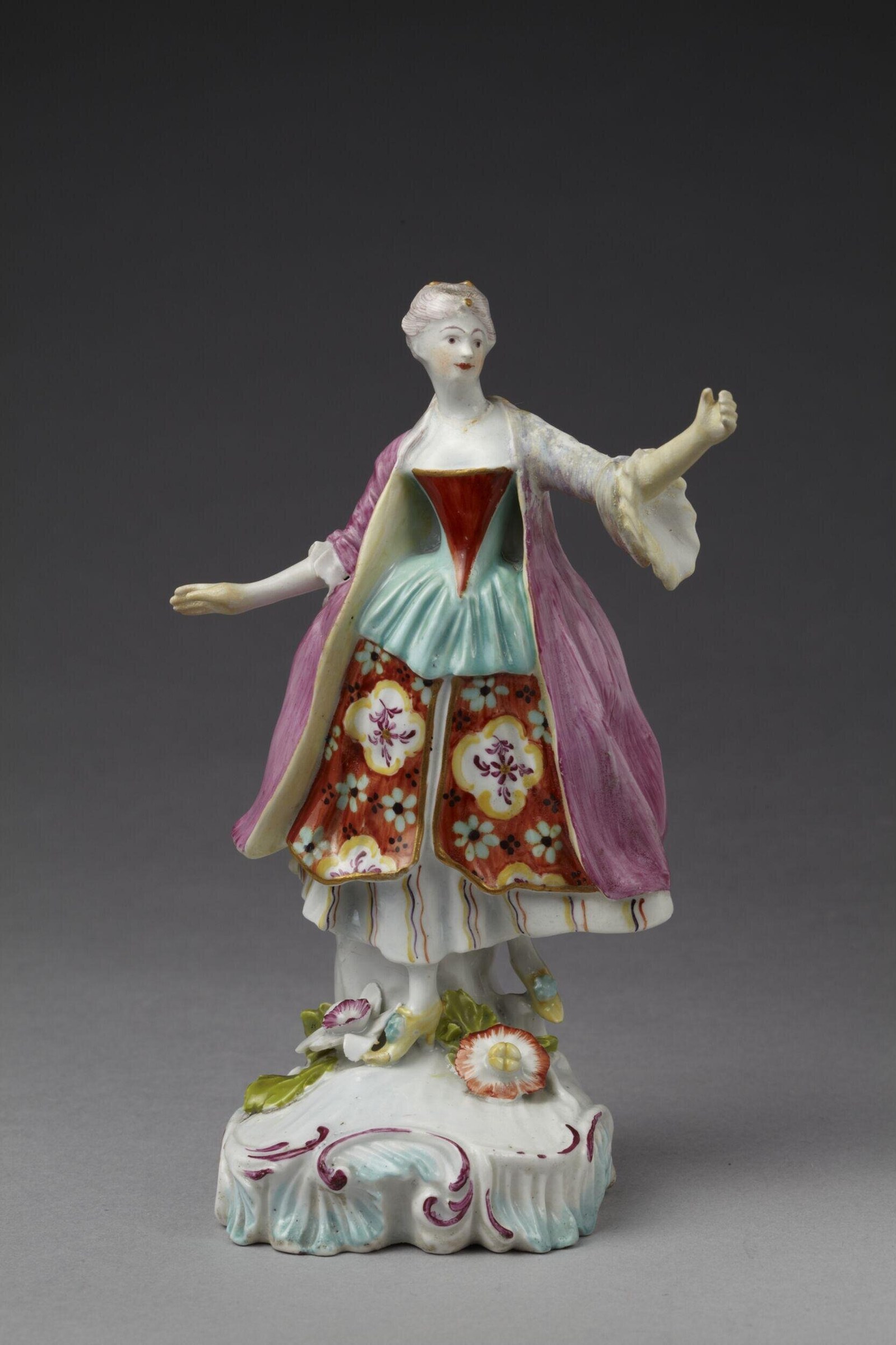
Female Turkish dancer
William Duesbury & Co.
- Collection:
- Figure
- Source:
- Victoria and Albert Museum
- Rights:
- Rights vary by item — check the source record before reusing this image. Source record ↗
- Recorded as:
- V&A — check rights per item
This object reveals how 18th-century European consumers understood and consumed ideas about non-European dance and culture—through theatrical fantasy, not ethnographic accuracy. It demonstrates that porcelain figurines were serious subjects in the art world of the period, chosen to represent not just beauty but entertainment, performance, and the exoticism that fascinated educated elites. For dance historians, it is evidence of how 'Turkish' or 'exotic' dance was imagined, staged, and commodified in English drawing rooms.
What you are looking at
A porcelain figurine depicts a woman in fashionable 18th-century dress, posed in an elegant, animated stance against a neutral ground. She stands on a rococo-scrolled base decorated in pale blue and mauve. Her pale complexion and white hair are rendered in unglazed porcelain; her body is draped in layered costume: a fitted red bodice with a pale blue underskirt, topped by an ornate red overskirt with yellow and floral motifs in the Chinoiserie manner, and finished with a flowing mauve-pink wrap or shawl draped from her shoulders and across one outstretched arm. Her posture is one of animated salutation or greeting—both arms extended, one raised higher than the other, weight distributed evenly, as if mid-gesture in conversation or performance. The figure is entirely painted in enamel colours characteristic of Chelsea or Derby porcelain: reds, blues, yellows, and greens with gilt accents. The scale suggests a cabinet piece intended for display on a shelf or mantelpiece.
The dancing
The single figure occupies the entire composition. Her stance is upright and balanced, with one leg bearing weight and the other free, allowing for a natural, conversational posture rather than a formal dance position. Both arms are raised at varying heights, extended outward in a gesture of greeting or welcome—not the codified frame of a ballroom dance, but the open, expressive gesture of a performer or entertainer. Her torso is upright and unsupported; her neck is long and elegant, her gaze forward and engaging. The extended arms and open posture suggest ease and animation rather than technical dance movement.
The dance depicted
The catalogue identifies this as a 'Female Turkish dancer,' but the costume and pose suggest a theatrical representation of Orientalism as understood in 1760s Europe rather than documentation of Turkish dance practice. The animated gesture and theatrical dress align with 18th-century European balletic or theatrical interpretations of 'exotic' characters—the kind of entertainment that blended dance, pantomime, and dramatic pose. The wrapped and patterned overskirt, Chinoiserie florals, and flowing shawl reflect contemporary European fantasy about the East rather than historical accuracy. What we see is a performer adopting an attitude of welcome or salutation, the kind of gestural vocabulary that would appear in court ballet or theatrical entertainment of the period.
How it was made
This is a glazed and enamelled porcelain figurine, recognisable as English soft-paste porcelain from the Chelsea or Derby factories. The figure was hand-modelled, the separate arms and wrapping affixed, and the whole piece decorated with painted enamel colours applied over the glaze in multiple firings. The technique allowed fine detail in the face and elaborate patterning in the dress, but the small scale and fragile material meant the figure served as a display piece in a cabinet, drawing room, or collection—an object of aesthetic appreciation and conversation, not a documentary record. The rococo base is integral to the design and characteristic of fashionable taste in 1760s England.
About this work
This Chelsea or Derby porcelain figurine from 1760 represents a moment when European audiences were intensely curious about and romantically fascinated by the East—particularly Turkey and China. The maker, William Duesbury & Co., produced luxury porcelain figures for the English gentry, treating dance and theatrical performance as subjects worthy of collectors' attention. The 'Turkish dancer' is not a record of actual Turkish dance practice, but a theatrical character: a performer in European dress fantasy, captured in a gesture of animated greeting or welcome. The figure belongs to a tradition of porcelain 'dancers' and exotic characters that served as fashionable salon objects, mixing performance, costume, and artistic ambition.
How to look at it
Attend to the posture and the arm gesture: this is not a technical dancer's hold, but a performer's attitude of greeting or salutation. The artist has chosen to show personality and engagement rather than skilled movement—the figure turns toward the viewer, arms open, as if welcoming you into her world. Note how the rococo base and the swirling folds of the overskirt create a sense of movement and ease, even though the figure is static. The bright enamel colours and the contrast between the pale porcelain skin and the vivid dress create the impression of a theatrical character stepping forward onto a stage.
The artist
William Duesbury founded the Chelsea porcelain factory around 1745 and later acquired the Derby factory (Derby porcelain works). He was a master of the English soft-paste porcelain tradition and established a practice of producing luxury figurines for the aristocratic and merchant-class market. Chelsea figures—particularly dancers, musicians, and characters from commedia dell'arte—were highly sought and expensive. Duesbury's workshops employed skilled modellers and painters, and his output established the English porcelain figurine as a distinct and prestigious form. By 1760, Chelsea was among the most fashionable porcelain makers in Europe.
The period
The 1760s were the height of European fascination with 'Orientalism'—a romantic, largely inaccurate vision of Turkey, China, India, and Persia filtered through European taste and fantasy. In dance, this fascination had already produced a tradition of theatrical 'Turkish,' 'Chinese,' and 'Indian' characters in court ballet and opera. Simultaneously, English porcelain manufacturing was establishing itself as a rival to continental Sèvres and Meissen, and figurines depicting dancers, actors, and exotic characters were among the most fashionable subjects. The porcelain figure allowed the aristocracy to own a permanent cabinet of theatrical characters—dancers, musicians, Harlequins—capturing a moment of performance in miniature and luxury.
Where it lives
This is a porcelain figurine from the Chelsea porcelain factory or one of William Duesbury's operations, dated to 1760 on stylistic grounds. It is catalogued in the Victoria and Albert Museum collections as a figure type—a portable, collectible object made for the display cabinet or drawing-room shelf of English and European aristocrats.
Dance in this work
Questions about this work
Is this based on an actual Turkish dancer?
No. This is a theatrical fantasy based on 18th-century European ideas about the East. The costume mixes Chinoiserie motifs (the floral patterns) with generic 'exotic' wrapping, and the gesture is that of a European stage performer rather than a Turkish dancer. It tells us what Europeans imagined, not what Turkish dancers actually wore or did.
Why was this figurine made?
Chelsea porcelain figurines were luxury goods for aristocratic and wealthy merchant households. They served as conversation pieces, status objects, and collected displays of fashionable taste. A cabinet full of dancers, musicians, and exotic characters showed that the owner was cultured and interested in theatre and performance.
What does the arm gesture mean?
The extended arms and raised posture suggest a moment of theatrical greeting or welcome—possibly a salutation in a pantomime or court ballet. It is gestural and expressive rather than technical dance vocabulary, capturing a moment of personality and engagement with the viewer.
How common were porcelain dancers?
Extremely common among English and European porcelain makers of the period. Chelsea, Derby, Meissen, and Sèvres all produced extensive ranges of theatrical characters, dancers, and musicians. They were among the most popular figurine subjects because they combined luxury, art, and entertainment in one collectible object.
More dance artwork





