49 works in this view — arrow keys or swipe to move between them.
Dance in Art
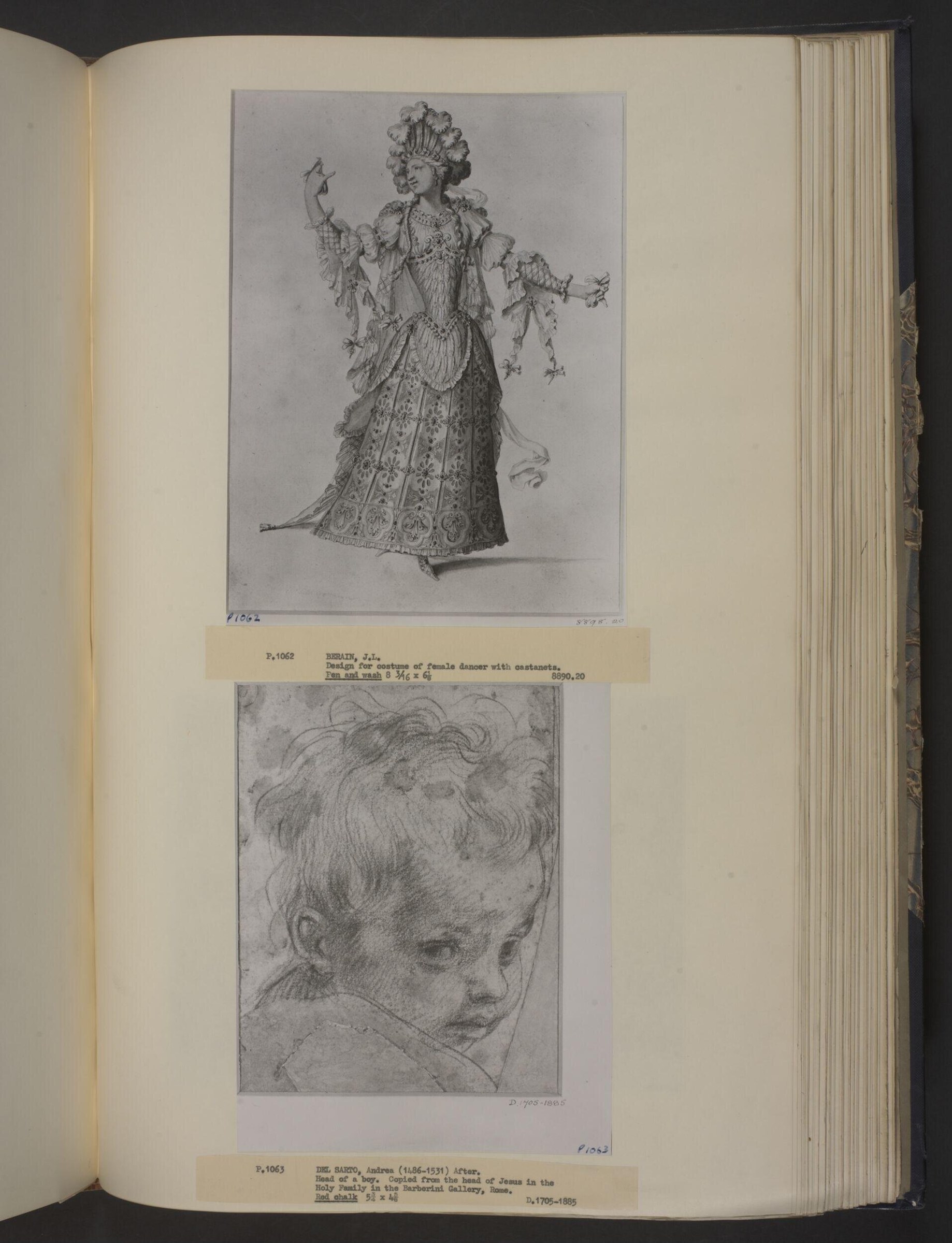
design for female dancer with castanets
Jean Berain the elder
- Collection:
- Costume design
- Source:
- Victoria and Albert Museum
- Rights:
- Rights vary by item — check the source record before reusing this image. Source record ↗
- Recorded as:
- V&A — check rights per item
This drawing documents the costume and presentation of a specific dance tradition—castanet-accompanied entertainment—within the formal court system. For historians, it shows how dance was integrated with dress design and court spectacle, and how Spanish cultural elements were absorbed into court culture. The drawing itself is a working design document, revealing the professional infrastructure of dance production in this period.
What you are looking at
This is a costume design study for a female dancer holding castanets, drawn in pen and ink on pale paper. The figure stands in a three-quarter pose, her body angled to show the silhouette of an elaborate costume. She wears a towering headdress of curled ostrich plumes or similar material, rising significantly above her head. Her gown is ornately decorated with embroidered or appliquéd patterning across the bodice and skirt; the skirt itself is voluminous and trails at the hem. Her arms are raised and extended, the right arm lifted higher, each hand holding a castanet. The drawing captures the decorative richness of courtly dress through fine hatching and line work, with particular attention to the texture and weight of the fabric. The figure casts a delicate shadow beneath her feet. The overall composition presents not a moment of active dancing but rather a display figure—the kind used in court spectacles or theatrical productions to showcase costume design and the dancer's formal presence.
The dancing
A single female figure stands in contrapposto, her weight slightly shifted, arms raised asymmetrically with the right arm higher and more extended than the left. Her posture is upright and formal, the body arranged for display rather than captured mid-movement. The hands hold castanets, but the pose is static and presentational—there is no suggestion of the rapid wrist or arm action that actual castanets playing demands. The arms are fully extended and relatively rigid, consistent with court dance etiquette where movement is controlled and geometric.
The dance depicted
This is most likely a design for a court ballet or theatrical dance spectacle of the French or Italian court in the late 17th or early 18th century. The castanet-holding suggests Spanish or Spanish-inflected dance of the period, which was fashionable in European courts as an exotic entertainment. The castanets themselves were percussion instruments that marked rhythm, and their presence indicates this dancer was expected to provide both visual spectacle and rhythmic accompaniment. The static pose and elaborate dress suggest this figure was designed for a formal court entertainment where costume and presentation outweighed virtuosity of footwork.
How it was made
This is a pen and ink drawing, likely executed with a fine nib or quill, using line work and light hatching to create tonal variation and suggest fabric texture. The technique is economical—the artist has conveyed rich material detail through precise observation and selective shading rather than heavy modeling. The clarity and finish of the drawing suggests it was a working design document intended for manufacture or reference, not a sketch for private study. Such drawings circulated among craftspeople and were instrumental in costume production.
About this work
This is a formal costume design drawing from the court ballet tradition, presenting a female dancer in castanets dress for a court spectacle. The work belongs to the workshop practice of court entertainment design, where drawings of this type served as blueprints for the costume makers and gave the choreographer or impresario a record of the visual effect intended. The figure stands as a type—the exotic, richly dressed female performer—rather than a portrait of an individual dancer. It represents the intersection of fashion, theatre design, and dance spectacle in the early modern European court. The castanets identify this as a moment when Spanish and Mediterranean movement vocabulary entered the formal dance vocabulary of the French and Italian courts, through both direct contact and the circulation of printed designs like this one.
How to look at it
Look first at the pose: this is not a dancer caught mid-movement but a formal presentation figure, designed to be seen from a single viewpoint and to display the costume as a whole. The raised arms and castanets are attributes—symbols of the dance style—rather than evidence of active playing. Notice the care taken with the headdress: the plumes are rendered with fine parallel lines that suggest their softness and movement, in contrast to the more heavily modeled bodice. The hem of the skirt trails behind, suggesting the figure is shown in profile or three-quarter view. This is a costume design, not a representation of dance movement; the document tells us what the dancer will wear, not what the dancer will do.
The artist
Jean Bérain the Elder (1640–1711) was a leading designer of court spectacles, ballets, and theatrical productions for the French court under Louis XIV. He held the position of *dessinateur des ballets* and later *designer of the King's chamber and cabinet*. Bérain was the master of a highly influential workshop that produced costume and set designs in pen and wash, and his style—elegant, economical, and theatrically assured—became the model for court design across Europe. His drawings circulated in print and through copies, making his visual vocabulary widely influential. This work is consistent with his mature style and the range of courtly entertainments he designed.
The period
This drawing dates from a period when court ballet was undergoing change. The formal court ballet (*ballet de cour*) of the mid-17th century, in which nobility participated in highly codified geometric formations, was giving way to professional theatrical ballet. At the same time, Spanish and Mediterranean dance forms—including those accompanied by castanets—were entering court entertainment as exotic spectacles. The late 17th and early 18th centuries saw increasing traffic in images of dance costumes through printed designs and drawings, as court spectacles became more visually elaborate and the demand for design documentation increased. Bérain's designs were widely circulated and copied, establishing visual conventions for court dance that persisted well into the 18th century.
Where it lives
This drawing is held in the Victoria and Albert Museum's collection of costume designs. It is one of numerous designs by Bérain and his workshop now in major institutional collections, part of the Museum's broader holdings in theatrical design and court spectacle documentation.
Dance in this work
Questions about this work
Who were castanets for in court dance?
Castanets in European court entertainment were associated with Spanish and Mediterranean dance traditions. They were not part of the formal court ballet vocabulary but appeared in divertissements and exotic entertainment within court spectacles. The dancer holding castanets was typically presenting an entertainment derived from or inspired by Spanish dance, which was fashionable in courts as an exotic entertainment.
What was a costume design drawing used for?
Drawings like this served multiple purposes: they were records of what the costume designer intended, references for costume makers to work from, and documents that could be filed or circulated to other courts. In a court system, such drawings established visual standards and allowed designs to be reproduced or adapted. They were also sometimes reproduced as prints or circulated in manuscript form.
How much of court dance was actually about movement?
By the late 17th century, court ballet had become increasingly visual and spectatorial. While earlier court ballets relied on geometric group formations and symbolic movement, later court entertainments prioritized costume, scenic display, and the exotic or novel. This design suggests that the dancer's primary function was to present a richly dressed figure—the movement may have been secondary to the visual effect.
Why is the figure so formal and static?
This is a design document, not a narrative scene. The formal, static pose allows every detail of the costume to be visible and clearly rendered. The figure is presented as a template, ready to be translated into actual fabric and worn. The pose is chosen for clarity and completeness, not to capture a moment of dance.
More dance artwork





