49 works in this view — arrow keys or swipe to move between them.
Dance in Art
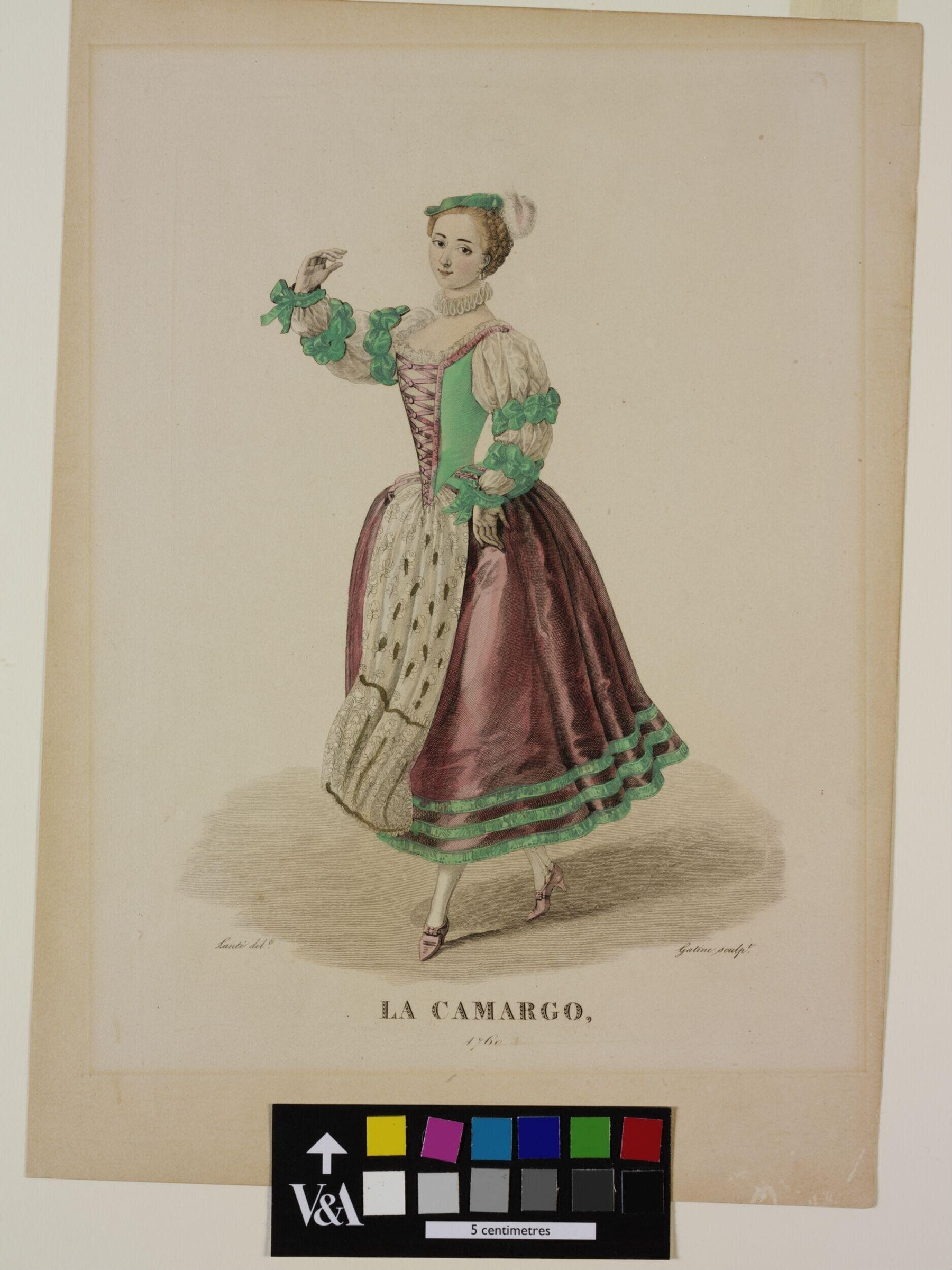
La Camargo, 1760
Lanté, Louis-Marie
- Collection:
- Source:
- Victoria and Albert Museum
- Rights:
- Rights vary by item — check the source record before reusing this image. Source record ↗
- Recorded as:
- V&A — check rights per item
Camargo revolutionised ballet by her example—her athleticism, her technical command of jumps and turns, and her willingness to abandon the mask and the French heel redefined what was possible for women in dance. This engraving, distributed to admirers and theatre-goers, was part of the machinery that made her a celebrity and kept her memory alive after her death. For historians of dance and of women's physical agency in the eighteenth century, the Camargo portraits are primary documents.
What you are looking at
A young woman in eighteenth-century dress stands alone against a plain background, turning toward the viewer with a graceful contrapposto stance. She wears an elaborate costume: a green silk bodice laced tightly at the front over a pink underbodice, cream-colored sleeves gathered at the elbow with green silk trim, and a voluminous skirt of deep mauve-pink silk with green trim at the hem. A white fichu drapes her shoulders and neck. Green ribbons or silk adorn her hair, which is swept up in the fashion of the 1750s–60s, and she holds a small flowering plant—possibly representing youth or spring—in her raised left hand. Her right arm hangs naturally at her side. She stands on the balls of her feet in heeled shoes, her weight forward and her body poised as if between steps. The coloring is soft and refined, applied with delicate hand-tinting to what is clearly an engraved print; the figure casts a gentle shadow on the ground beneath her.
The dancing
The dancer stands in a single, carefully composed figure. Her posture is upright and elongated, with the weight shifted onto the balls of her feet in a way that suggests turnout at the hip. The arms are held with one raised in a curved, open position and the other positioned naturally—a classical frame. The head is tilted slightly, with a serene expression. There is no indication of movement through space or of a partner; this is a portrait of a dancer in a characteristic pose, not a scene of action.
The dance depicted
This is a portrait of Marie Camargo, the celebrated dancer who performed in Paris from the 1720s to the 1740s. Camargo was renowned for her technical virtuosity—especially for her elevation and speed in beats and jumps—and for her willingness to shorten her skirts and abandon mask and heeled shoes for ease of movement, reforms that influenced ballet for generations. The pose shown here, despite being static, captures the essential qualities of the Camargo style: upright carriage, a sense of effortless grace, and the poised readiness that characterised the French noble dance of her era. The dress itself—with its shortened skirt and fitted bodice—references the theatrical costume associated with her name.
How it was made
This is a hand-coloured engraving. The composition has been engraved using fine parallel lines (visible as tonality in the shading), and then individually coloured by hand using watercolour or gouache, a common and economical method for producing multiple copies of a fashionable portrait. The signatures at the lower left ('Lancet del') and lower right ('Gallien sculp') indicate the artist (Lancet) and the engraver (Gallien). The technique allowed wide circulation of idealised images of celebrated performers, making them accessible to a theatre-going public and helping to establish celebrity in the modern sense.
About this work
This is a portrait engraving of the legendary dancer Marie-Anne de Cupis de Camargo, one of the most influential figures in the history of ballet. The image captures her in the formal language of eighteenth-century theatrical portraiture: a single figure, posed with studied elegance, wearing the costume by which she was known. The work belongs to a large genre of celebrity portraits produced for the Paris theatre public in the middle decades of the eighteenth century. It is both a historical record of a dancer's physical presence and a document of how dancers were imagined and marketed at the height of the Old Regime.
How to look at it
Attend to the pose and the carriage: notice how the artist has chosen to show the dancer poised on the balls of her feet, the body lifted, the arms arranged in curves that suggest training and control. The costume—especially the shortened skirt—is historically specific and signals modernity and reform. The plant in her hand is a convention of feminine allegory from court ballet but here serves also to establish her as an individual and a personality. The engraving technique itself is worth noticing: the delicate cross-hatching that builds the folds of the skirt and the texture of the fabric is labour-intensive, suggesting that this image was created for a cultivated audience willing to pay for finely finished prints.
The artist
Lancet (full name unknown) and the engraver Gallien were commercial printmakers working in Paris. The division of labour between artist and engraver was standard in the eighteenth-century print trade. Gallien was known for theatrical portraiture and produced a number of prints of celebrated performers. Nothing is known of Lancet beyond this signature. The pair's work circulated among the Paris theatregoing public and collectors of theatrical imagery.
The period
Marie Camargo danced in Paris from approximately 1726 until her retirement in 1751. The 1730s and 1740s were the height of her fame and influence. During this period, ballet was undergoing rapid technical evolution: dancers of both sexes were beginning to move higher and faster, to use the full stage, and to abandon the strict etiquette of the court dances from which stage ballet had originated. Camargo was central to this shift. The fashion for theatrical celebrity portraits—engravings and paintings of dancers and actors—was itself a new phenomenon of the mid-eighteenth century, reflecting the rise of commercial theatre and of celebrity as a social force. This engraving dates stylistically to the 1750s or 1760s, sometime after Camargo's retirement, indicating that her image retained marketable power even after she had left the stage.
Where it lives
The holding institution is listed as 'va' (Victoria and Albert Museum, London). The print is undated in the catalogue record, but stylistic evidence suggests it was made in the 1750s or 1760s, well after Camargo's retirement. It belongs to a large group of similar celebrity portrait engravings in the Museum's collection.
Dance in this work
Questions about this work
Who was Marie Camargo?
Camargo (1710–1770) was a Paris-born dancer who performed at the Opéra and the Comédie-Italienne from 1726 until 1751. She was celebrated for her speed, elevation, and technical brilliance—qualities that seemed almost superhuman to her contemporaries. She was also a reformer: she shortened her skirts (to just below the knee), abandoned the mask, and wore heeled slippers rather than the flat-heeled shoes of court dance, all to improve her ability to move.
Why do so many portraits of Camargo exist?
She was a celebrity—the most famous dancer in Europe during her era. Portrait engravings were cheap to produce once the plate was made, and they circulated widely among theatre-goers and collectors. Making and owning a portrait of a beloved performer was a form of fandom. This portrait was likely produced after her retirement, when the market for her image was still strong.
What dance style is shown here?
The pose is too static to identify a specific dance. However, it represents the French noble dance (danse noble) tradition, as performed at the Opéra. The upright carriage, the turnout, the curved arms, and the lifted weight are all hallmarks of this style. The costume—especially the shortened skirt—is the 'Camargo costume,' the theatrical dress associated with her name.
Is this an original artwork?
No—this is an engraving, a print made from an incised metal plate. The signature indicates that Lancet drew the design and Gallien engraved it (cut it into the copper plate). The hand-colouring was applied afterwards. Multiple impressions could be printed from the same plate, so many copies of this image exist in different collections.
More dance artwork





