49 works in this view — arrow keys or swipe to move between them.
Dance in Art
A nymph dancing
Unknown
- Collection:
- Drawing
- Source:
- Victoria and Albert Museum
- Rights:
- Rights vary by item — check the source record before reusing this image. Source record ↗
- Recorded as:
- V&A — check rights per item
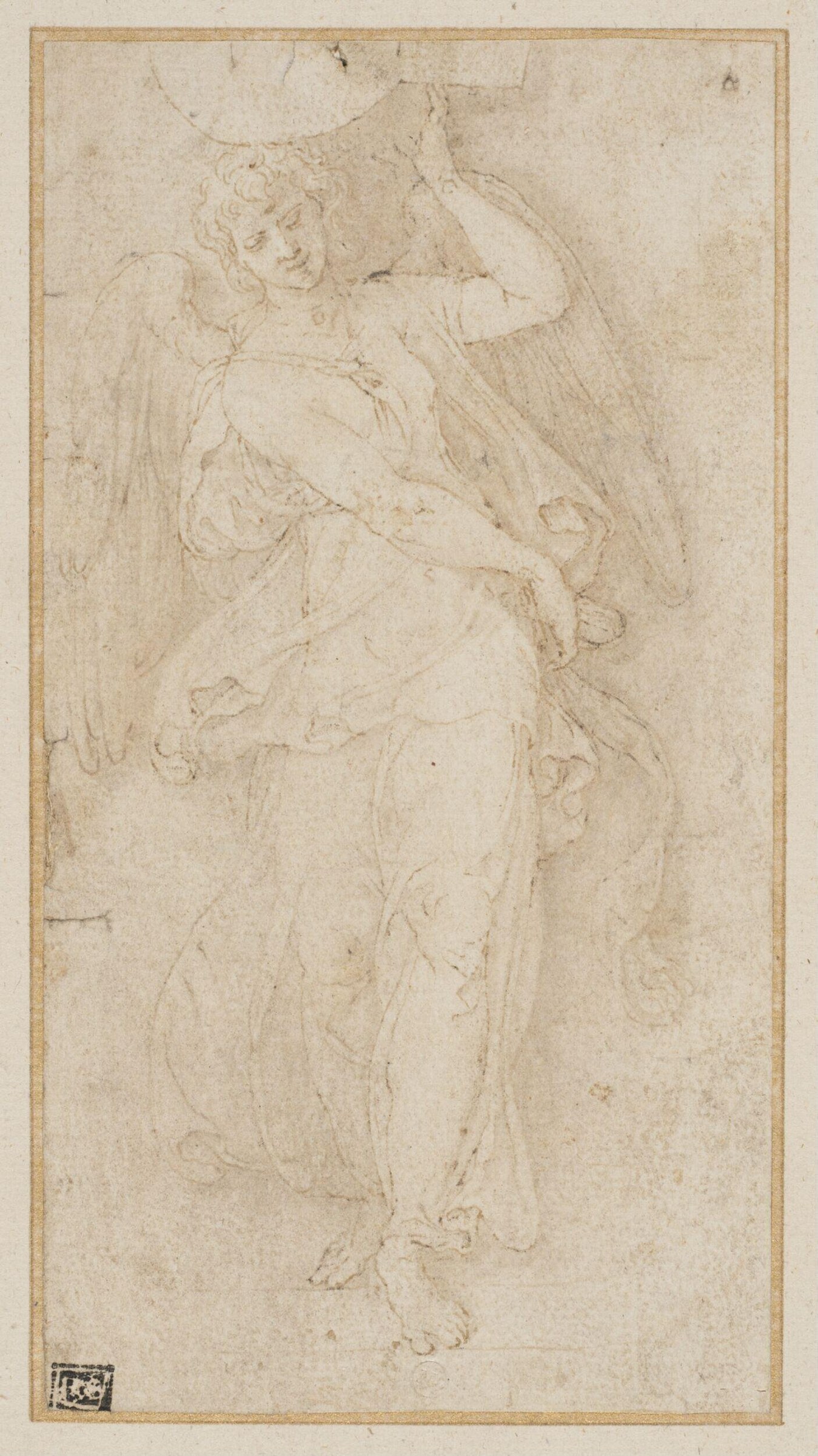
This drawing captures the aesthetics of early European theatrical dance before the codification of ballet technique—a moment when dance was seen as a form of graceful, weightless movement closer to flight than to the grounded athleticism of later centuries. For dancers and historians, it offers visual evidence of the arm positions, carriage, and expressive vocabulary valued in Renaissance and early Baroque spectacle, and of how artists understood and translated movement into visual form.
What you are looking at
A single winged female figure—a nymph or allegorical spirit—dominates this delicate pen drawing. She is shown in three-quarter view, her body tilted in a graceful contrapposto stance with her weight shifted to one leg. Her drapery swirls around her in elegant folds, suggesting movement; the fabric of her skirts and upper garment flows away from her body as though caught mid-turn or suspended in air. Her arms are raised and extended, one higher than the other, in a gesture that opens the upper body and emphasizes lift. Her head is turned in profile or three-quarter view, gazing downward with a serene expression. Large wings extend from her back, rendered with careful parallel hatching to suggest feathering. The drawing is executed entirely in brown ink on off-white paper, with no background setting beyond a simple rectangular border frame. The line work is assured and confident, with subtle shading used to model form and suggest the texture of fabrics and flesh.
The dancing
The single dancer (or allegorical figure) exhibits an open, uplifted frame with the weight grounded on one leg while the other appears nearly weightless. Both arms are raised and extended away from the body—not in a closed ballroom hold but in an expansive, lyrical gesture that suggests buoyancy. The torso is elongated and arched backward slightly, with the rib cage lifted. The drapery clings and flows in ways that suggest the figure is in motion rather than static—the skirts appear to lag behind the body's movement, which is a hallmark of how fabric behaves in turning or traveling steps.
The dance depicted
This appears to be a study or finished drawing of an allegorical or mythological dancer, almost certainly from a Renaissance or early Baroque tradition of theatrical or court performance. The winged figure, graceful contrapposto pose, and flowing drapery are consistent with depictions of nymphs, muses, or similar supernatural beings as they appear in court ballet (ballet de cour), intermedi, or similar court spectacle from the sixteenth through early eighteenth centuries. The emphasis on lift, open arm positions, and swirling drapery suggests a dance vocabulary emphasizing elevation, turning, and decorative line rather than weight or grounding—qualities associated with early ballet technique before the codification of classical form. The figure's serene expression and downward gaze, combined with the uplifted arms, suggests a moment of transcendence or spiritual exultation rather than social courtship dance.
How it was made
This is a pen and brown ink drawing on laid or wove paper, executed with fine linework and subtle parallel hatching for shading. The technique is economical—the artist uses line primarily for contour and structure, reserving shading for modeling form in the fabrics and suggesting volume in the limbs and torso. The delicate, assured quality of the line work and the refinement of the figure suggest a studio drawing by a trained hand, likely a study for a larger work or a record of a designed figure (possibly a costume or stage design). The durability of ink on paper meant these drawings could circulate among artists and patrons as models or references, making them valuable for understanding period performance practices.
About this work
This is a studio drawing of a dancing nymph or allegorical female figure, executed in pen and brown ink in a style consistent with Renaissance or early Baroque artistic practice. The figure embodies the qualities prized in courtly spectacle and early theatrical dance: grace, elevation, fluidity of line, and a dreamlike serenity. The winged form and mythological subject matter indicate this was not a record of everyday social dance, but rather of the elevated, allegorical performances that took place at courts and in intermedi—the spectacular interludes that punctuated theatrical events. The drawing is both a work of art in its own right and a historical document of how dancers were trained to move and how their movement was understood by visual artists.
How to look at it
Attend to the moment captured: the artist has chosen to freeze the dancer in an instant of suspended, uplifted movement rather than a grounded position. Notice how the drapery lags behind the implied movement of the body—this is not a static pose but a snapshot of motion. The raised and extended arms are not held symmetrically or in a closed frame, but rather open and offered outward, which conveys a sense of spiritual or joyful expression rather than partnered ballroom dancing. The downward gaze combined with the uplifted body creates a tension between earthly modesty and celestial aspiration, which is typical of how allegorical figures were understood in this period.
The period
This drawing dates from a period in which dance was a central element of courtly culture and theatrical spectacle across Europe, particularly in Italy and France. Nymphs and allegorical female figures were stock characters in court ballet (ballet de cour) and intermedi, embodying grace, supernatural beauty, and often representing classical or mythological virtue. The Renaissance recovery of classical texts and visual culture led artists and choreographers to reimagine how antique figures—satyrs, nymphs, muses—ought to move. The rise of professional stage design in this period meant that dancers' appearances and gestures were increasingly documented through drawings and prints, which circulated among courts and studios as records and models. By the early Baroque, the vocabulary of 'noble' dance—characterized by open positions, turned-out limbs, and uplifted carriage—was beginning to crystallize, though it had not yet been formalized into a systematic technique.
Where it lives
The collection source is recorded as 'va,' likely the Victoria & Albert Museum in London, one of the major repositories of Renaissance and Baroque drawings. This is a historical study or design drawing, the kind that would have been kept in an artist's studio or a noble collector's cabinet of curios and technical references.
Dance in this work
Questions about this work
Was this figure meant to be danced on stage?
Almost certainly yes. The careful attention to graceful pose, the decorative wings, and the mythological subject matter all suggest this was a design or record connected to courtly spectacle—either a study for a costume, a record of a choreographed moment, or a model for other artists. Whether it depicts an actual performance or an idealized vision of how such a figure should move is difficult to say from the drawing alone.
What technique did dancers use for this kind of movement?
The vocabulary was not yet systematized into a formal technique the way classical ballet would be. However, the emphasis on turned-out limbs, uplifted carriage, and open arm positions visible here are early markers of what would become the 'noble' or 'courtly' style of dance. Dancers trained through imitation and description rather than from written notation or codified positions.
Why does the figure have wings?
Wings marked the figure as supernatural or allegorical—a nymph, muse, or divine messenger rather than a mortal woman. In court spectacle, such beings were meant to represent abstract virtues, classical mythology, or poetic concepts, and their appearance in dance was understood as a kind of magical or transcendent event.
More dance artwork





