49 works in this view — arrow keys or swipe to move between them.
Dance in Art
Polovtsian Dances
Choumoff, Pierre
- Collection:
- Photograph
- Source:
- Victoria and Albert Museum
- Rights:
- Rights vary by item — check the source record before reusing this image. Source record ↗
- Recorded as:
- V&A — check rights per item
The photograph documents the Polovtsian Dances at a moment when this choreography was one of the most celebrated and widely performed pieces of theatrical dance, and when male acrobatic virtuosity in ballet was reaching new heights of visibility. The image is also evidence of how Orientalist fantasy—coded through body decoration and exotic styling—shaped the choreographic imagination of 1920s concert dance, a dynamic that historians of dance and visual culture continue to examine.
What you are looking at
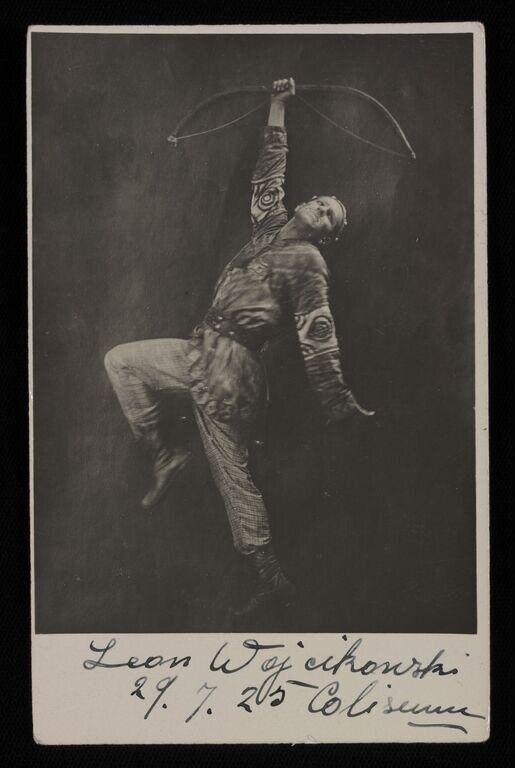
A male dancer is photographed in dramatic mid-leap against a dark background, captured in a moment of explosive upward movement. His body is fully extended vertically, one arm thrust overhead while the other is positioned at his side, creating a dynamic asymmetrical line. He wears heavily patterned or tattooed coverage on his torso and arms—geometric designs in white or light pigment that read as ritualistic or tribal body decoration. His lower half is clothed in light-colored (possibly white or cream) fitted trousers that contrast sharply with the dark upper body. The composition isolates the dancer against an almost black void, emphasizing the height and power of the leap and the sculptural quality of his suspended form. The photograph appears to be a studio portrait, carefully lit to define musculature and movement.
The dancing
A single male dancer occupies the frame. His weight is entirely airborne, legs extended downward with pointed feet in a configuration suggesting balletic training or folk technique. The upper body arches slightly backward, creating a strong vertical axis from the raised overhead hand through the extended legs. The posture suggests controlled, balletic elevation rather than purely acrobatic jump. His body demonstrates considerable extension and flexibility; the positioning shows disciplined technique rather than raw athleticism.
The dance depicted
The title *Polovtsian Dances* and the inscription on the photograph attribute this to Choumoff (possibly Pierre Choumoff or related to Alexei Kosloff's company), dating to 1925. The Polovtsian Dances are from Borodin's opera *Prince Igor*, a wildly popular theatrical showpiece depicting the military dances of a Caucasian people. The choreography became a vehicle for male virtuosity in early 20th-century ballet and concert dance. This image shows a male soloist in the acrobatic, high-flying style that made the piece famous in theatrical contexts. The heavy body decoration suggests stylization of 'oriental' or 'savage' otherness typical of Orientalist ballet of the period, deployed here to spectacular effect in the leap.
How it was made
This is a gelatin silver photograph, printed in the 1920s. The crisp detail, controlled studio lighting, and fine tonal range suggest professional theatrical or dance photography—likely made for promotion or documentation of a performance or dancer's technique. The photograph was inscribed by hand after printing, with the title and attribution in cursive script at the lower edge. Such photographs were distributed to promote performances and circulate images of celebrated dancers and choreography to audiences beyond the theatre.
About this work
This is a theatrical dance photograph from 1925 documenting a male soloist in the Polovtsian Dances, the celebrated oriental spectacle from Borodin's *Prince Igor*. The image freezes a moment of acrobatic flight—a high, controlled leap with the body fully extended and dramatically posed. It represents the intersection of early 20th-century ballet virtuosity, Orientalist theatrical fantasy, and photographic documentation of dance technique. The photograph preserves the explosive athleticism and exotic styling that made this choreography a staple of concert and operatic dance in the 1920s.
The work is part of a documentary tradition in which photographs of dancers were made, signed, and distributed to establish and circulate the performer's reputation and the choreography's visual spectacle. It belongs in a dance gallery because it captures not just an instant of movement but also the theatrical and cultural logic of how early modern dance audiences consumed the body, otherness, and technique on stage.
How to look at it
Attend to the moment of peak elevation in the leap—the dancer is held suspended, not caught in motion toward or away from the ground. The positioning of the arms creates an asymmetry that reads as controlled theatrical pose rather than the symmetry typical of classical ballet. The body decoration and costuming code the dance as 'exotic' in the Orientalist visual language of the 1920s. The studio lighting emphasizes the isolation and sculptural quality of the body, making the photograph more a portrait of technique than a record of theatrical context.
The artist
Pierre Choumoff (or variants of the transliteration: Chumoff, Choumov) was a dancer and choreographer working in the Russian and European dance world in the early 20th century. He was active in concert and theatrical dance contexts in the 1920s and associated with productions that revived or reinterpreted Russian Imperial ballet repertory and orientalist spectacles. The inscription attributes the photograph to him either as the dancer or as a credited source; Alexei Kosloff's company performed the Polovtsian Dances extensively in the 1920s in Paris and New York, and Choumoff may have been affiliated with that circle.
The period
The Polovtsian Dances, choreographed by Michel Fokine in 1909 for the Ballets Russes, became a sensation and one of the most frequently revived pieces of early 20th-century choreography. By the 1920s, when this photograph was made, the work had achieved canonical status and was being performed by multiple companies and dancers. Male ballet had become increasingly acrobatic and virtuosic in this period, partly due to the influence of Russian Imperial training and partly in response to competition from other forms of spectacular dance. The photograph dates to a moment when dance was being extensively documented through photography, and when theatrical imagery circulated widely through postcards, programs, and promotional materials.
Where it lives
The photograph is held in the Virginia collection and was likely acquired as a historical document of early 20th-century dance and theatrical practice. It is inscribed and dated, suggesting it was a professional or semi-professional circulation photograph—the kind distributed to dancers, promoters, and archives to document and publicize performances.
Dance in this work
Questions about this work
Who were the Polovtsian Dances and why were they so famous?
The Polovtsian Dances are a choreographed act from Borodin's opera *Prince Igor*, depicting the military dances of a Caucasian people. Michel Fokine created the most celebrated version for the Ballets Russes in 1909. It became one of the most revived and performed pieces of early 20th-century dance, celebrated for its acrobatic male solo work and spectacular visual staging. The dances were central to defining the male virtuoso style of Russian ballet and concert dance.
What is the body decoration visible in the photograph?
The geometric patterns appear to be body paint or costume application coded as 'tribal' or 'oriental' styling—part of the Orientalist visual language through which 1920s theatrical dance represented non-European cultures. This was a standard element of the choreography's appeal and theatrical packaging, reflecting the racial and colonial aesthetics of early 20th-century entertainment.
What does the photograph tell us about how this dance was performed?
The leap captured here shows a technique combining balletic training (pointed feet, controlled extension, lifted posture) with acrobatic height and explosive power. The asymmetrical arm positioning and the arched torso suggest a theatrical, gestural vocabulary rather than pure classical ballet line. The photograph preserves evidence of how virtuosity, exoticism, and theatrical spectacle were synthesized in the performance of this canonical work.
More dance artwork





