49 works in this view — arrow keys or swipe to move between them.
Dance in Art
Petrushka
Valentine Gross
- Collection:
- Drawing
- Source:
- Victoria and Albert Museum
- Rights:
- Rights vary by item — check the source record before reusing this image. Source record ↗
- Recorded as:
- V&A — check rights per item
This drawing documents one of the most important theatrical innovations of the early 20th century—the introduction of character and folk-rooted movement into high ballet. Petrushka was revolutionary in centering a comic, earthy character role, and Gross's sketch captures something the stage photograph cannot: the informal physicality and gestural ease that made the character vital. For historians of Russian dance and the Ballets Russes, and for dancers interested in character technique, this sketch is evidence of how the role was actually embodied.
What you are looking at
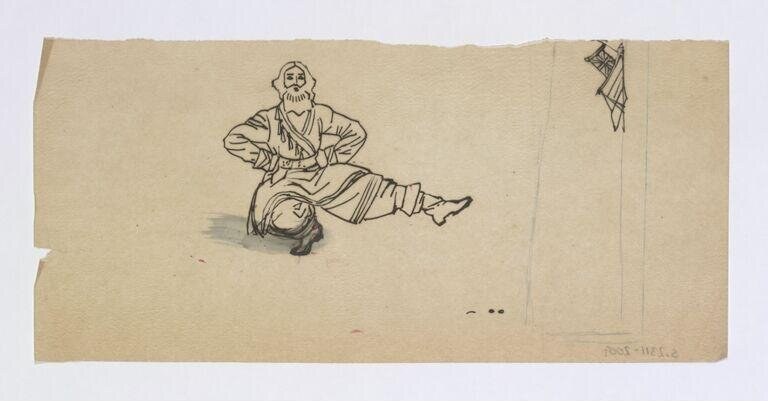
A single male figure is drawn in ink on cream paper, seated or reclining with his body at ease against what appears to be a round object, possibly a drum or cushion. He wears early 20th-century dress: a tunic or jacket with ornamental fastenings, baggy trousers, and what looks like a tall hat or headdress with a decorative element. His posture is relaxed and informal, with one leg extended and his upper body leaning back, supported by his arms. The figure's beard and facial features suggest character or age. The drawing is loose and gestural, executed in quick pen lines that capture movement and weight rather than detail. In the upper right corner, there is a small sketch of what appears to be a flag or banner. The paper shows age and wear at the edges.
The dancing
A single male figure dominates the composition, with weight settled backward and to one side, supported on his hands. His posture suggests ease and informality—the body is open, the limbs relaxed, without the turnout or formal frame of classical dance. The gesture is one of repose or a moment of character acting rather than technical movement. His extended leg and the tilt of his torso suggest a performer at rest or in a moment of comedic pause.
The dance depicted
This drawing is identified by the catalogue as Petrushka, the famous commedia dell'arte-derived character from Russian folklore and Stravinsky's 1911 ballet. The figure's dress—the tunic, baggy trousers, and tall hat—matches the costume of Petrushka as danced in the Ballets Russes production. The posture and informal gesture suggest a moment between scenes or a comedic rest, rather than a fixed dance position. Petrushka is a character role within theatrical-ballet tradition, performed with physical comedy and pantomime as much as formal technique.
How it was made
This is a pen drawing on paper, executed with rapid, confident line work that prioritizes silhouette and gesture over anatomical detail. The artist has used wash or light shadow to suggest volume on the figure's clothing and the round form he leans against. The loose, sketchy execution—typical of rehearsal drawings or preparatory studies—suggests this may be a working study from live observation or close familiarity with the performer or choreography. The paper's age and foxing indicate this is a historical document, not a modern reproduction.
About this work
This is a pen sketch of Petrushka, the comic character-role from the 1911 Ballets Russes production. The drawing captures a moment of relaxed, gestural repose rather than a virtuosic movement phrase, showing the performer in costume between scenes or in a moment of pantomime. Petrushka was a landmark work in bringing Russian folk character and commedia dell'arte tradition into the modernist ballet repertoire. The sketch is attributed to Valentine Gross, a significant documenter of early Ballets Russes productions, and records not just the costume but the quality of embodiment—the character's irreverent, earthbound physicality that made Petrushka distinct from the ethereal classical dancers of the period.
How to look at it
Notice the relaxation in this figure's frame. There is no rigid turnout, no upward lift; instead, the body settles into the seat with a kind of slouch. The extended leg and the tilt backward suggest weight and gravity, not the defiance of gravity that classical ballet pursued. The costume is specific and detailed—tunic, baggy trousers, tall hat—which grounds the figure in a particular character and place rather than the abstract space of classical ballet. This is how Gross captures the Petrushka innovation: not through technical virtuosity but through character, informality, and the body at rest.
The artist
Valentine Gross (1884–1968) was a French painter, illustrator, and documenter who was embedded within the Ballets Russes circle from its early years. She attended rehearsals and performances, made numerous sketches and studies of dancers and scenes, and published illustrations in contemporary periodicals. Her drawings are valued as intimate records of how major roles were physically realized, capturing the choreography and performance style at a moment before film documentation was routine. She was close to the company and worked with Diaghilev; her sketches are often the only surviving visual record of early twentieth-century choreography in motion.
The period
In 1911, when Petrushka premiered at the Ballets Russes in Paris, European ballet was in the midst of a radical transformation. The dominance of classical technique and ethereal femininity was being challenged by Fokine's reforms, which valued naturalism, characterization, and integration with music and design. Petrushka, with music by Stravinsky and choreography by Fokine, set a Russian folk fairground scene and centered a male comedic character—a deliberate move away from the prima ballerina focus of 19th-century ballet. Gross was documenting this moment in real time, capturing the new aesthetic before it became historical.
Where it lives
The drawing is held in the collection noted in the catalogue as 'va' (likely a Vassar or similar institutional code). It is a study or sketch, likely made during or shortly after rehearsals for the Ballets Russes production, and represents the kind of working documentation that Gross produced throughout her career with the company.
Dance in this work
Questions about this work
Who was Petrushka and why does he matter?
Petrushka is a Russian folk character from fairground puppet theater, brought into high ballet by the Ballets Russes in 1911. The role was revolutionary because it centered a comic male character instead of a prima ballerina, and it called for naturalistic, earthy movement instead of classical technique. The ballet is still performed today and is considered a masterpiece of early modernism.
Why would a dancer want to see this drawing?
Dancers learning the role of Petrushka have little to go on besides the choreography as reconstructed from later versions. This sketch shows how the role was embodied in the original production—the specific posture, the quality of ease and informality, the physical personality. It is evidence of performance style at a moment when such evidence is otherwise scarce.
What is Valentine Gross doing in this sketch?
Gross was an embedded observer of the Ballets Russes, attending rehearsals and performances and making rapid pen studies of dancers and choreography. Her sketches served multiple purposes: they were illustrations for publication, personal studies, and a form of dance documentation at a time before film was standard. This sketch of Petrushka is one of many such records she left of early Ballets Russes productions.
More dance artwork





