49 works in this view — arrow keys or swipe to move between them.
Dance in Art
New London Ballet
Unknown
- Collection:
- Poster
- Source:
- Victoria and Albert Museum
- Rights:
- Rights vary by item — check the source record before reusing this image. Source record ↗
- Recorded as:
- V&A — check rights per item
Galina Samsova was one of the first Soviet prima ballerinas to perform regularly in the West after the Cold War thaw, and her appearance on London stages represented a significant moment of artistic diplomacy. The poster is a direct record of how classical ballet was marketed to the public in the 1970s—the choice of a single, suspended moment of technical perfection as the image most likely to sell tickets tells us what audiences expected from ballet and how the art form wished to be seen.
What you are looking at
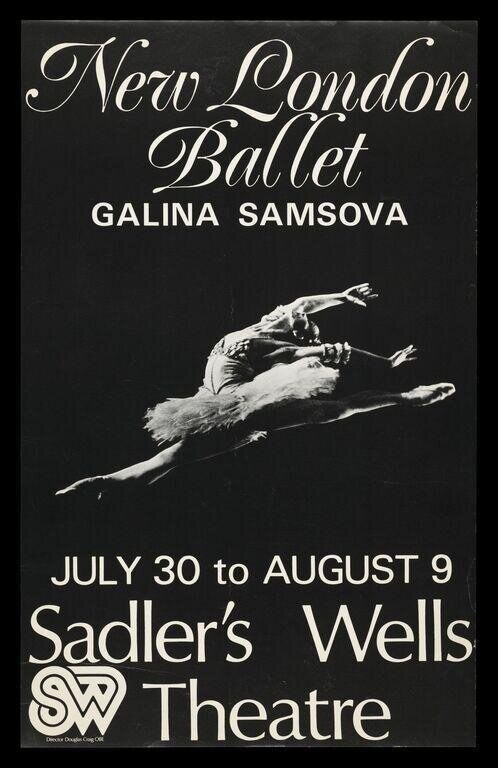
This is a theatrical poster for the New London Ballet, featuring the Soviet prima ballerina Galina Samsova. Against a black background, a single female dancer is captured mid-leap in a dramatic diagonal trajectory across the composition. She wears a classical tutu with a fitted bodice and pointe shoes, her body fully extended in a grand jeté or similar traveling jump. Her arms are positioned in a classical fifth position épaulement, with the upper arm lifted and the lower arm extended forward. The image is rendered as a high-contrast photographic or printed halftone, emphasizing the sculptural quality of her extended limbs and the weightlessness of her flight. The white lettering announcing the venue—Sadler's Wells Theatre—and the dates (July 30 to August 9) frames the dancer, with the New London Ballet company name arching above in an elegant serif typeface.
The dancing
A single ballerina is shown in an unambiguous classical ballet position—a grand jeté or similar aerial jump with full leg extension and turnout. Her upper body maintains the upright carriage and arm placement of classical technique; the lower arm extends forward while the upper arm is lifted and rotated, characteristic of Vaganova or Cecchetti épaulement. Her weight is clearly suspended in the air, with both legs in a fully stretched position. The photograph captures the instant of maximum elevation, demonstrating technical control and the balletic ideal of effortless flight.
The dance depicted
This is a poster for classical ballet, specifically Romantic or Neoclassical ballet of the mid-twentieth century. Galina Samsova was a leading Soviet ballerina trained in the Vaganova method, and her appearance with the New London Ballet in 1975 represents a significant moment of Cold War cultural exchange. The pose—a grand jeté or similar traveling jump—is a signature movement in classical ballet vocabulary and would have been a showstopping moment in any Romantic or Neoclassical repertory. The image emphasizes technical virtuosity and the ethereal quality central to the ballet aesthetic of this period.
How it was made
This is a lithographic or offset-printed poster, likely produced from a photographic source—the halftone quality and high contrast suggest a photomechanical reproduction process common in theatrical advertising of the 1970s. The medium allowed for rapid, economical production of multiple copies for distribution in London theatres and cultural venues. The stark black background and white figure create maximum visual impact on a distance, essential for street posters and foyer announcements. The photographic base gives the poster documentary authenticity while the printing process elevates it to a graphic design object.
About this work
A poster announcing a season of classical ballet at London's Sadler's Wells Theatre, featuring the celebrated Soviet ballerina Galina Samsova. The image captures her mid-jump in a grand jeté, the quintessential classical ballet vocabulary that best showcases technical achievement and the illusion of weightlessness. The poster is both a commercial advertisement and a miniature work of dance photography, selected to convey the excellence and prestige of the company. It dates to 1975, a period of increased cultural exchange between Soviet and Western dance institutions, and Samsova's appearance would have been a major draw for London audiences.
How to look at it
Attend to the instant chosen: this is not a posed studio photograph but a captured moment of maximum elevation, when the dancer is weightless and fully extended. The photographer has chosen the moment that most perfectly expresses the classical ideal—a body in complete control, defying gravity. The high contrast and dramatic lighting emphasize the musculature and line of the extended body, making the technical achievement visible. The isolation of the single figure against black background removes all distracting context and makes the body itself the sole subject, a common strategy in dance photography of the period.
The artist
The photographer of the original image is not identified in the catalogue record. The poster was designed for theatrical distribution by the New London Ballet, a company that operated in the 1970s with the mission of bringing classical ballet to wider London audiences. The graphic design—the elegant sans-serif and serif typography, the use of stark contrast, and the centered composition—is typical of 1970s theatre poster design in Britain.
The period
In 1975, classical ballet was at a high point of popular prestige in Britain, especially after the success of the Royal Ballet and the international tours of Soviet companies in the 1960s and early 1970s. The New London Ballet represented an attempt to establish a second-tier classical company that could perform Romantic and Neoclassical repertory at venues like Sadler's Wells. Galina Samsova's defection from the Soviet Union and her subsequent performances in the West were part of the broader narrative of artistic talent flowing from East to West during the Cold War. The poster reflects both the glamour attributed to Soviet-trained dancers and the competitive energy of London's dance scene in this era.
Where it lives
This is a theatrical poster held in the Victoria and Albert Museum's theatre collection. The poster is a printed advertisement, part of the documentary record of London's dance institutions in the 1970s.
Dance in this work
Questions about this work
Who was Galina Samsova?
Galina Samsova (1937–2016) was a Soviet prima ballerina trained at the Vaganova Academy in Leningrad. She danced with the Kirov Ballet before defecting to the West in 1961. She became a prominent guest artist in Britain and North America, performing with major companies and establishing herself as a leading interpreter of classical and Romantic ballet roles. Her performances in London, including this 1975 season, made her one of the most celebrated Soviet ballerinas of the era.
What is a grand jeté?
A grand jeté is a traveling jump in classical ballet in which the dancer propels herself forward while extending one leg to the front and the other to the back in a wide split in the air. It is one of the most visually spectacular movements in ballet vocabulary and requires significant strength, flexibility, and control. The grand jeté is often performed across the full diagonal of the stage and is a signature moment in Romantic and Neoclassical ballets.
What was the New London Ballet?
The New London Ballet was a classical ballet company active in London during the 1970s. It performed at Sadler's Wells Theatre and other venues, presenting Romantic and Neoclassical repertory alongside contemporary works. The company was part of the broader ecosystem of London dance institutions and provided opportunities for performances by major guest artists like Galina Samsova.
More dance artwork





