49 works in this view — arrow keys or swipe to move between them.
Dance in Art
Theatre costume
Wilhelm
- Collection:
- Theatre costume
- Source:
- Victoria and Albert Museum
- Rights:
- Rights vary by item — check the source record before reusing this image. Source record ↗
- Recorded as:
- V&A — check rights per item
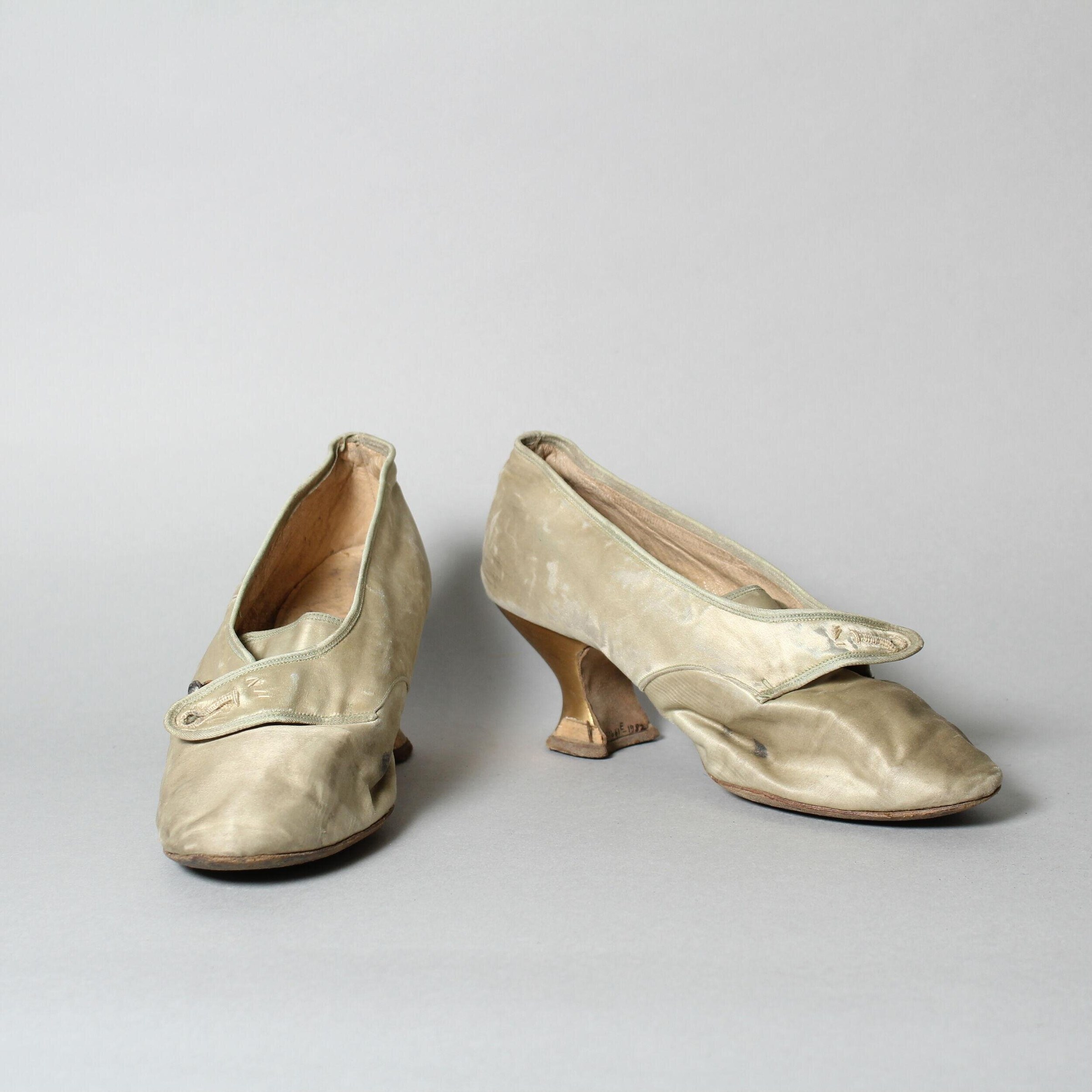
As material objects, these shoes show the intimate technical detail of theatre dance practice: the actual weight of the heel, the design of the throat for foot entry, and the choice of silk over more durable materials reveal priorities and constraints of early 20th-century stage costume. For a dancer or dance historian, handling or closely examining actual period footwear answers questions about fit, movement possibility, and the relationship between costume design and choreography that photographs and drawings cannot.
What you are looking at
A pair of pale silk shoes photographed against a neutral background, shown from two angles to display their full three-dimensional form. The shoes are made from a cream or pale gold silk material with a lustrous sheen, featuring pointed toes and modest heels of approximately 2-3 inches in a natural wood tone. Each shoe has a wide, gaping mouth at the throat, suggesting they close or fasten at the ankle with a band or strap. The construction is evidently soft and flexible, with the leather or silk upper collapsing inward when unsupported, giving them the appearance of drooping or deflated forms. The heels are slightly curved and tapered rather than contemporary geometric shapes. The photograph employs museum lighting that casts subtle shadows, emphasizing the shoes' three-dimensional volume and the texture of the fabric.
The dancing
These are shoes designed for the human foot, not dance in the sense of bodies in motion. The unpaired presentation—two individual shoes at different angles—suggests a museum or archive documentation purpose rather than a moment of wear. The gaping opening and structural collapse of the uppers when unworn indicate shoes that required the presence of a foot or wooden form to hold their shape.
The dance depicted
These are women's heeled shoes from the early 20th century, likely theatre dance costume pieces. The period, maker attribution to 'Wilhelm,' and delicate silk construction all point to theatrical footwear rather than street wear. The pointed toe, soft upper, and modest heel are consistent with early 1900s ballroom dance shoes or stage costume pieces. Without visual evidence of pointe reinforcement, these are not ballet pointe shoes. They may have been worn for court dances, ballroom scenes in musical theatre, or social dances depicted on stage. The specific identity of the dance cannot be confirmed from the shoes alone.
How it was made
These are three-dimensional objects—actual historical shoes—photographed in colour on a neutral ground as a museum catalogue piece. The photograph is a straightforward documentation image, likely made with raking light to emphasize form and material. This presentation suggests the shoes are held in a costume or theatrical archive and are being recorded for inventory and scholarly access rather than for exhibition publicity.
About this work
These are silk theatre shoes from 1912, attributed to a maker named Wilhelm and held in a theatre costume collection. They represent the footwear worn for social or ballroom dances on stage in the early 20th century. The delicate construction, pale silk material, and pointed toe conform to the aesthetic of Edwardian theatre costume, when dance scenes in musical comedy and revue were central to popular entertainment. The shoes survive as physical evidence of how dancers moved in this period and what materials and proportions were considered appropriate for different styles of theatrical dance.
How to look at it
Notice the gaping mouth of the shoe at the ankle: this tells you the shoe did not have a side zip or modern closure, but rather a strap or lace system now missing. Observe the taper and curve of the heel, which is far gentler than modern heels and distributes weight differently. The pointing of the toe and the lack of any visible arch support suggest a foot position quite different from contemporary stance. The choice to photograph both shoes unworn—collapsed and lifeless—is itself informative: it shows the shoe's true form without the human foot that gave it purpose.
The artist
Wilhelm is listed as the maker or creator in the catalogue record. This may refer to a costume maker, shoemaker, or theatrical outfitter active in the early 1900s, but no further biographical information is recorded. The attribution suggests these shoes were a custom commission for theatre rather than commercial retail footwear.
The period
In 1912, musical theatre and revue were the dominant forms of theatrical dance in Europe and America, often requiring dancers to perform in fashionable social dance positions and styles. Ballroom dance—waltz, foxtrot, and tango—were recently established and wildly popular, and stage versions featured frequently in musical comedy. Theatre costume makers competed to produce shoes that were both visually convincing (in line with fashion) and functional for the demands of performance. Silk and soft uppers were preferred for elegance, even at the cost of durability, because they read well from the house and allowed the foot to move expressively.
Where it lives
These shoes are held in a theatre costume collection with source credited as 'va' (possibly the Victoria and Albert Museum, London). They are catalogued as a single object pair within a larger holding of theatrical costume pieces and are preserved as evidence of dress and practice in early 20th-century stage performance.
Dance in this work
Questions about this work
Are these ballet pointe shoes?
No. Pointe shoes have a stiffened toe box and flat platform sole that allows a dancer to stand on the tips of the toes. These shoes have a flexible pointed toe and a curved heel, making them unsuitable for pointe work. They are ballroom or social dance shoes designed for heel-and-toe stepping.
How do we know these were worn for theatre rather than street wear?
The catalogue identifies them as theatre costume. The pale silk material, delicate construction, and careful preservation in a theatrical collection all support this. Ordinary street shoes of this period were more robust and were made from leather in darker, more practical colours.
What does 'Wilhelm' mean in the record?
Wilhelm is recorded as the maker or creator, but no additional biographical information survives. This may be a surname or a studio name. Many theatrical costume makers worked under a single name or studio designation rather than signing individual pieces.
Can you tell what dance these shoes were used for?
The shoe design is consistent with early 20th-century ballroom dances (waltz, foxtrot, tango) or stage versions of social dances. Without documentation of a specific production or context, the exact choreography cannot be confirmed.
More dance artwork





