49 works in this view — arrow keys or swipe to move between them.
Dance in Art
Poster
Unknown
- Collection:
- Poster
- Source:
- Victoria and Albert Museum
- Rights:
- Rights vary by item — check the source record before reusing this image. Source record ↗
- Recorded as:
- V&A — check rights per item
This poster documents the Dance Theatre of Harlem's visibility and reach in the 1970s, a crucial period in establishing African American ballet and contemporary dance as major American art forms. It is also a significant example of how modernist graphic design was applied to Black cultural promotion, capturing the visual language of an era when such design announced both artistic ambition and community presence.
What you are looking at
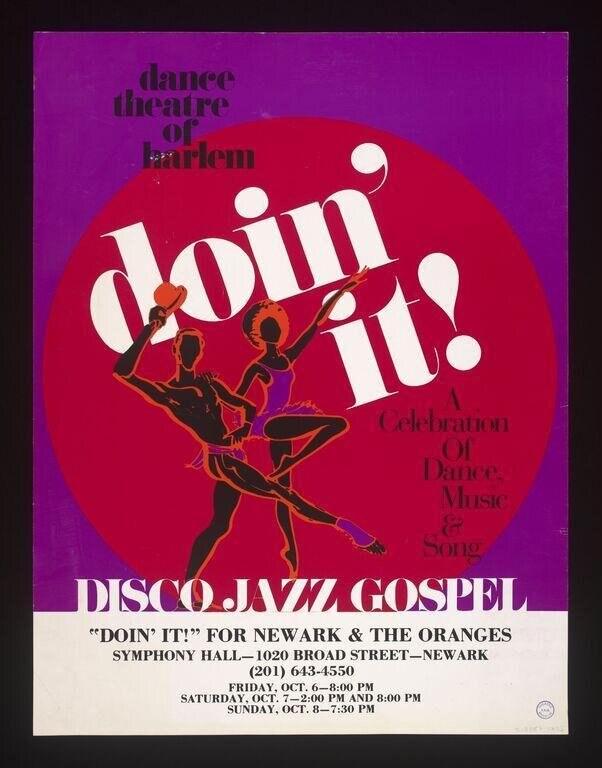
A vibrant concert poster for an event titled "doin' it!" with the subtitle "A Celebration of Dance, Music & Song." The composition features a large crimson circle dominating the center of a brilliant purple background. Within this circle, three stylized figures in silhouette—rendered in black with warm ochre and rust accents—are captured in dynamic dance poses. The figures are angular and energetic, with limbs extended in expressive gestures suggesting movement and joy. The typography is bold and modern, with the main title rendered in large white serif letters that overlap and interact with the dancing figures. The poster announces a performance by the Dance Theatre of Harlem at Symphony Hall in Newark, with performance dates and times listed at the bottom in white text. The overall design is graphic and high-contrast, typical of modernist concert promotion from the mid-twentieth century.
The dancing
Three dancers in silhouette occupy the central circle, their bodies twisted and extended in celebratory poses. The figure on the left appears to be in a lunge or stride with one arm raised; the center figure has arms extended outward in an open, welcoming gesture; the rightmost dancer's pose suggests a turning motion or arabesque-like line. None of the figures are in formal ballroom or classical ballet hold; instead, each occupies their own space within the composition, suggesting solo or individually expressive movement rather than partnered dance. The postures convey informality, freedom, and exuberance rather than technical precision.
The dance depicted
The poster advertises a performance by the Dance Theatre of Harlem, an historically significant African American dance company. The event title "A Celebration of Dance, Music & Song" and the generic poses suggest this was an eclectic evening drawing on multiple dance vocabularies rather than a single narrative work. The silhouetted figures and their open, joy-filled gestures point toward vernacular, theatrical, and possibly liturgical or celebratory movement traditions. Without more specific visual evidence (costume detail, footwork, spatial arrangement), the exact dance forms cannot be identified from the image alone, though the context—a major African American cultural institution in the 1970s—suggests likely inclusion of jazz, contemporary, and diaspora-rooted forms.
How it was made
This is a lithographic poster, identifiable by its bold color separation, high-contrast graphic aesthetic, and printerly technique. The clean registration of the vibrant purple, crimson, white, and ochre inks, combined with the flattened forms and hand-drawn quality of the typography and figures, is characteristic of mid-century concert poster production. Lithography allowed for rapid, economical mass production suitable for public promotion and distribution in Newark's communities, reaching broad audiences while maintaining visual sophistication and legibility at street scale.
About this work
This is a promotional poster for a Dance Theatre of Harlem performance in Newark in the 1970s, announcing a celebration of dance, music, and song. The work captures a moment of institutional cultural visibility for African American dance at a time when the company was establishing itself as a major force in American theatrical dance. The poster's graphic modernism—its bold color, silhouetted figures, and expressive typography—reflects both avant-garde design sensibility and the vernacular visual language of community arts promotion.
The poster matters to dance history as a documentary artifact of the Dance Theatre of Harlem's public presence and of how mid-twentieth-century African American dance institutions marketed themselves. It also represents a particular visual vocabulary of modernist graphic design deployed in service of Black cultural work, when such design had not yet been fully integrated into mainstream American institutional messaging.
How to look at it
Observe how the three dancers are positioned not in formal alignment but in individual expressive poses, each occupying their own space within the circle—a compositional choice that emphasizes freedom and individuality over uniformity. Notice the interplay between the geometric clarity of the circle and typography and the organic, gestural quality of the silhouetted bodies; this tension between order and movement is central to the poster's visual energy. The color choices—the warm circle against the cool purple ground—create spatial depth and make the dancing figures advance toward the viewer. The open, welcoming postures of the figures and the celebratory tone of the text suggest the poster's intended message: that this is a joyful, inclusive event.
The period
The Dance Theatre of Harlem was founded in 1968 by Arthur Mitchell, a pioneering Black ballet dancer who had performed with New York City Ballet. The company emerged during the Civil Rights era and the cultural nationalism of the late 1960s, at a moment when African American artists were asserting control over representation and creating institutional alternatives to white-dominated cultural gatekeeping. By the early 1970s, when this poster was produced, the company had already achieved national recognition and was expanding into regional tours. The poster's visit to Newark reflects the company's outreach into East Coast urban centers with significant African American populations. Graphically, the design reflects the bold, modernist aesthetic of 1970s cultural promotion, sharing visual DNA with concert posters of the era across music, theater, and dance.
Where it lives
This poster is held in a poster collection (source code 'va'); the original collection or archive context is not further specified in the catalogue record. It is a printed promotional object designed for public distribution and display, part of the material culture of African American arts institutions in the 1970s.
Dance in this work
Questions about this work
Who was the Dance Theatre of Harlem?
Founded in 1968 by Arthur Mitchell, a Black ballet dancer who had danced with New York City Ballet, the Dance Theatre of Harlem was a pioneering institutional response to the exclusion of Black dancers from mainstream American ballet. By the 1970s, it was touring nationally and internationally, establishing African American classical and contemporary dance as major American art forms. The company played a crucial role in diversifying American dance and creating performance and training opportunities for Black dancers.
What does the design style tell us about the era?
The bold graphic modernism of this poster—its flat color, silhouettes, hand-drawn typography, and dynamic composition—reflects the visual vocabulary of 1970s cultural promotion. Such design was deployed across concert, theater, and dance announcements and conveyed both artistic sophistication and accessibility. For an African American arts institution, this high-design approach was also a statement: that Black cultural work warranted the same visual authority and modernist credibility as any mainstream cultural event.
What dances were performed?
The poster does not specify; the title 'A Celebration of Dance, Music & Song' suggests an evening of varied work. The Dance Theatre of Harlem's repertory of this era included classical ballet, contemporary dance, and works drawing on African diaspora movement vocabularies. The silhouetted figures suggest celebratory and expressive rather than strictly classical forms, but without a program or additional documentation, the specific works cannot be determined from the image alone.
Why was this performed in Newark?
Newark had a substantial African American population and was a major urban center in the Northeast. As a newly established and ambitious company, the Dance Theatre of Harlem toured regionally to build audiences and establish its national presence. Symphony Hall was a significant venue, and the company's appearance there signals both its institutional legitimacy and the city's role as an important market for African American arts.
More dance artwork





