49 works in this view — arrow keys or swipe to move between them.
Dance in Art
The Song
C. A. H.
- Collection:
- Drawing
- Source:
- Victoria and Albert Museum
- Rights:
- Rights vary by item — check the source record before reusing this image. Source record ↗
- Recorded as:
- V&A — check rights per item
This work documents the actual appearance and gesture of a named performer in a specific theatrical role, making it primary evidence for the study of late 19th-century musical-theatre dance. The open, expressive arm position and the absence of balletic vocabulary reveal what theatrical dance looked like before the dominance of classical ballet technique in the 20th century, and how dancers of this period moved and were presented to audiences.
What you are looking at
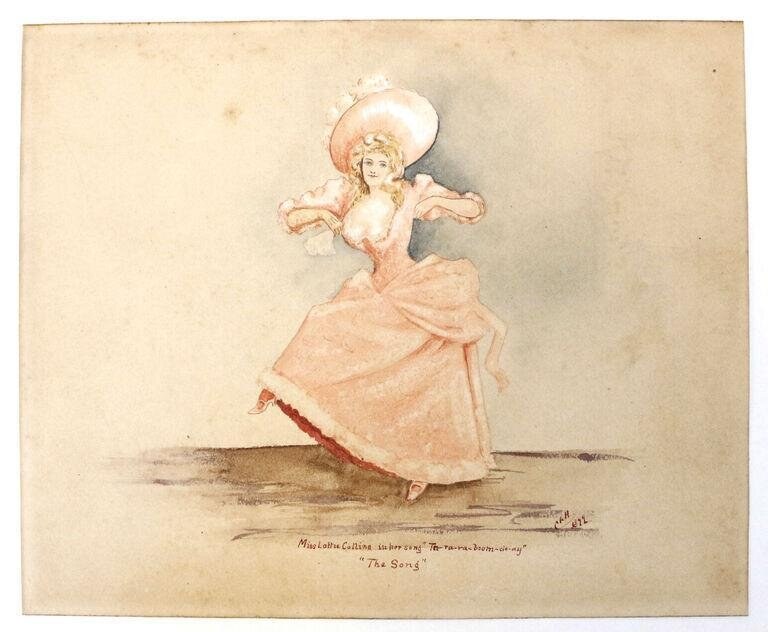
A single female figure stands alone against a pale, neutral ground, dressed in a flowing peach or salmon-colored gown with a full skirt caught in animated motion. She wears a large, fashionable hat tilted at a jaunty angle, its pale brim prominent. Her posture is characteristically theatrical of the 1890s: both arms extended outward in a gesture of openness or appeal, her torso lifted and graceful, her weight appearing to rest on one leg while the other supports the swirling skirt. The figure is rendered in watercolor or mixed media with soft washes of color; the background is plain and undefined, throwing the dancer into sharp relief. The inscription at the bottom reads "Mlle Lonie Cullina [or Cuilina] in her song 'The Tarras Dennsway' / 'The Song'"—indicating this is a portrait of a named performer, likely captured mid-performance.
The dancing
The dancer's frame is open and expansive: both arms raised to shoulder height or slightly higher, the elbows bent in a manner suggesting movement and emotional expression rather than balletic precision. The body appears light on its feet, with the torso held upright and the shoulders drawn back. The voluminous skirt dominates the silhouette, its folds and movement suggesting a spin or a sustained, lyrical pose. There is a single figure only, no partner or ensemble, and the gesture reads as one of vulnerability, joy, or dramatic declaration—more actress than technician.
The dance depicted
This is almost certainly theatrical dance of the 1890s Gilded Age, likely a musical-theatre or music-hall performance. The inscription names the performer (Mlle Lonie Cullina) and the piece ("The Song"), suggesting this is a portrait commemorating a specific solo role. The open, expressive arm position, the absence of pointe shoes or ballet vocabulary, and the emphasis on emotional gesture point toward interpretive or dramatic dance of the theatrical kind rather than classical ballet. The full skirt and the theatrical presentation suggest this may be a theatrical dance or a solo in a musical or operetta.
How it was made
The work appears to be watercolor or gouache on paper, with the figure built up in soft washes and highlights. The artist has used pale, warm tones for the flesh and dress, with darker washes for definition and shadow, and a careful reserve of white paper for the hat's brightness. This technique—economical, sketch-like yet refined—was typical of theatrical portraiture and illustration of the period, intended for reproduction or circulation among theatre patrons. The tinted paper visible beneath suggests a working method common in late 19th-century theatrical illustration, where artists often worked on tinted or pre-prepared grounds to accelerate production.
About this work
This is a watercolor portrait of a theatrical dancer, dated 1892, commemorating the performance of Mlle Lonie Cullina in a solo piece titled "The Song." It belongs to the tradition of late 19th-century theatrical illustration, where artists documented celebrated performers and memorable roles for circulation among theatre audiences and in the press. The work captures the aesthetic of the Gilded Age stage: the emphasis on costume, grace, and emotional expression rather than technical display. It is a valuable document of how a performer of this era was seen and promoted, and what kind of movement and presence was valued in musical theatre at the turn of the century.
How to look at it
Attend to the gesture of the arms and hands: they are not pulled up and back in the classical frame, but opened and extended, suggesting a moment of declaration or plea rather than a technical display. Notice how the artist has made the skirt the dominant visual element, rendering it with movement and volume to convey the impression of motion and presence even in a still pose. The soft, warm tones of the flesh and dress, set against the neutral ground, invite the viewer into an intimate space of performance—this is not a grand theatrical scene but a portrait of a soloist, meant to capture her appeal and charisma to an audience that knew her by name.
The artist
The signature reads "C. A. H.," followed by what may be a date. The artist is not further identified in the catalogue record. The work is consistent with the output of theatrical illustrators of the 1890s, who were often not major fine artists but working professionals producing portraits, costume studies, and role documentation for theatres, agents, and the illustrated press. Such artists typically had a refined line, understood stagecraft and costume, and worked quickly to meet deadlines.
The period
In 1892, theatrical dance in Europe and America was undergoing rapid change. Classical ballet was being codified and professionalized in Russia under figures like Marius Petipa, while in the West, musical theatre, operetta, and music-hall entertainment dominated the popular stage. Dancers in these genres often had no formal ballet training and were valued for charisma, beauty, and the ability to carry a dramatic narrative or song. The 1890s also saw the rise of illustrated theatrical magazines and the systematic documentation of performers through prints, photographs, and drawings—a form of early celebrity culture. Women performers, particularly soloists, were heavily marketed through such imagery.
Where it lives
The work is held as a drawing in a collection marked "va" in the catalogue record. No further provenance information is recorded.
Dance in this work
Questions about this work
Who was Mlle Lonie Cullina?
The catalogue record does not identify her beyond the inscription on the artwork. She was evidently a performer of sufficient reputation in 1892 that an artist was commissioned to document her in a celebrated role. She is not widely remembered today, which reflects both the passage of time and the fact that most performers of her era, even successful ones, have left little trace.
Is this classical ballet?
No. The open arm position, the emphasis on the skirt as costume rather than as a vehicle for footwork, and the overall gesture point to theatrical or musical-theatre dance of the Gilded Age—a category that included operetta, music-hall, and dramatic theatre with dance, but not the codified classical technique that would dominate the 20th century.
Why is the figure alone?
This is a portrait of a soloist and her role. Many musical-theatre pieces featured solo numbers in which a female performer carried a scene or act, and such roles were celebrated and marketed as starring vehicles, much as songs are today.
What was 'The Song' that Cullina performed?
The catalogue does not identify the source—whether it was a standalone musical number, a scene from an operetta or play, or a suite piece. The title is generic enough that without additional documentation, it cannot be traced.
More dance artwork





