49 works in this view — arrow keys or swipe to move between them.
Dance in Art
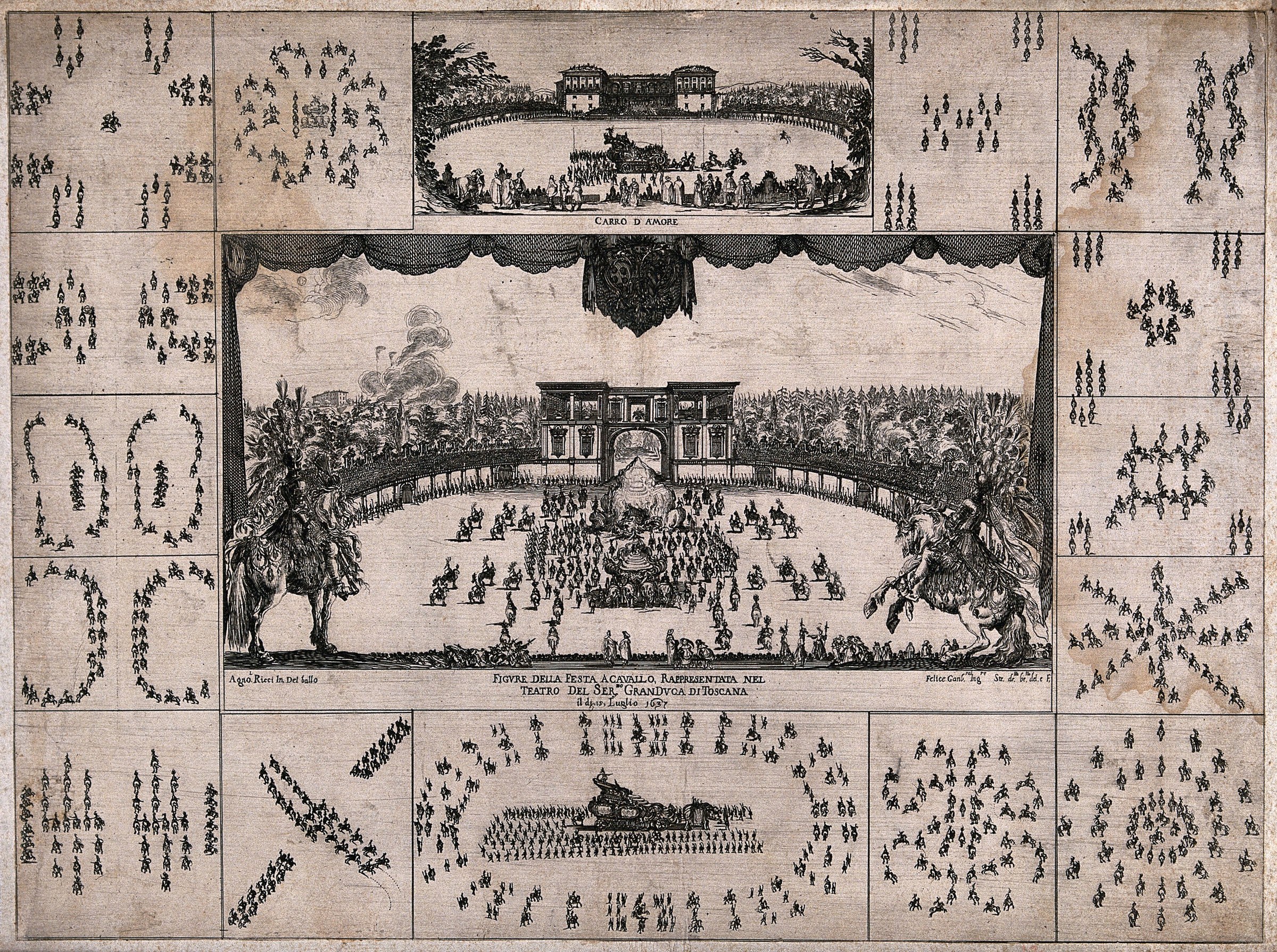
An equestrian entertainment in the Boboli gardens, Florence, celebrating the wedding of Grand Duke Ferdinand II of Tuscany and Vittoria della Rovere, 1637: the carriage viewed against the Pitti Palace, the arena, and bird's eye views of the formations. Etching by S. Della Bella after A. Ricci and F. Gambrai.
Unknown artist
- Source:
- Wellcome Collection
- Rights:
- Public domain — free to use, share and adapt.
- Recorded as:
- Public Domain Mark
This image is one of the earliest detailed visual records of large-scale aristocratic spectacle involving choreographed movement. It shows us that the formal, controlled, ornamental approach to movement we associate with Baroque dance emerged first in equestrian contexts and court ceremony, and that dancers and riders inhabited the same aesthetic world. For historians of courtly entertainment, it is a rare opportunity to see how an actual event was documented, staged, and circulated—not as a description or a score, but as a detailed visual record meant to preserve and celebrate the spectacle for those who could not attend.
What you are looking at
This is a bird's-eye view documentation of an elaborate equestrian spectacle held in the Boboli Gardens, Florence. The composition arranges multiple views across a single sheet: a central large panel shows a formal arena with a classical palace facade (the Pitti Palace), surrounded by a curved barrier and packed with spectators lining the perimeter. The arena itself contains densely arranged figures on horseback performing choreographed formations and maneuvers. Surrounding this central image are six smaller panels showing alternative perspectives and detailed views of the same event—some depicting the gardens from above with troops arranged in geometric patterns, others showing processions and gatherings. The entire composition reads as a technical record of the event's scale and organization, with hundreds of figures rendered in miniature across the page. The etching technique allows fine detail in the architectural elements and dense crowds while maintaining clarity across the complex spatial arrangement.
The dancing
The riders and horses occupy a formal, regimented space. In the central arena, they are arranged in tight formations—some moving in linear processions, others in circular or rectangular patterns that suggest choreographed maneuvers rather than free movement. The riders appear upright and controlled, seated with the formal bearing expected of equestrian performance. The surrounding spectators—both mounted and on foot—stand or sit in orderly clusters, creating human barriers that define the arena. The scale of the image makes individual bodies hard to read, but the overall effect is of strict hierarchical organization: riders demonstrating mastery and discipline, crowds witnessing and framing the action.
The dance depicted
This is not dance in the modern sense, but equestrian ballet or theatrical horsemanship—a courtly entertainment form central to Renaissance and early modern aristocratic spectacle. The Boboli event of 1637 was a wedding celebration, and such spectacles combined elements of processional display, military-style formations, and choreographed movement designed to showcase aristocratic control and refinement. The riders would have executed managed gaits, synchronized turns, and geometric patterns that required both horsemanship and theatrical discipline. This belongs to the broader history of court spectacle that influenced the development of ballet, as both forms emphasize formality, symmetry, and the transformation of the body into a vehicle for dynastic display. The image documents a specific historical moment when dance, equestrian skill, and architectural grandeur merged in aristocratic ceremony.
How it was made
This is an etching by Stefano della Bella, recognizable from the technique's characteristic fine lines and cross-hatching used to build tone and texture. Etchings allowed della Bella to render architectural detail with precision while creating a sense of vast scale and crowd through repetitive linear marks. The bird's-eye and sectional views suggest this was both a documentary work—a record of the event for those who did not attend—and a demonstration of the artist's ability to organize complex spatial information. Multiple viewpoints on a single sheet were common in celebration prints, allowing viewers to understand both the whole spectacle and its detailed components. The work would have been printed in multiple impressions for distribution among the Florentine elite, serving as both commemoration and propaganda for the ducal house.
About this work
This etching documents a spectacular equestrian entertainment staged in the Boboli Gardens to celebrate the 1637 wedding of Grand Duke Ferdinand II of Tuscany and Vittoria della Rovere. Stefano della Bella's composition presents multiple simultaneous views—a central arena scene rendered in precise architectural detail, surrounded by six auxiliary panels showing formations, processions, and alternative perspectives—allowing viewers to understand the event's scale, organization, and magnificence. The work sits at the intersection of court performance, military spectacle, and early modern graphic documentation. It records a moment when horsemanship, choreographed movement, and theatrical display merged to produce a form of aristocratic entertainment that was both visually spectacular and politically significant.
For students of dance history, this is important evidence of court spectacle in the decades before ballet crystallized as a distinct art form. The geometric formations, the emphasis on synchronized group movement, and the transformation of natural motion into formal display are all proto-balletic. The work also documents the role of the body—human and equine—as a medium for the expression of power and refinement in early modern court culture.
How to look at it
Start with the central panel to understand the main event: trace the curved architecture of the arena, follow the dense formations of riders, and notice how the composition uses geometry to create order from spectacle. Then examine the surrounding six panels: each offers a different vantage point or moment, showing how a single event could be understood from multiple viewpoints—a principle that would become important in both court ceremony and the emerging visual grammar of theater. Pay attention to the way the artist has layered information: the precision of the Pitti Palace in the background contrasts with the fluid, dense massing of crowds and horses, creating a sense of both control and energy. The bird's-eye perspective was unusual for the time and required sophisticated spatial reasoning to render convincingly.
The artist
Stefano della Bella (1610–1664) was a prolific Florentine etcher and printmaker who specialized in court celebrations, military scenes, and architectural perspectives. He worked for the Medici court and developed a distinctive style combining narrative detail with technical precision. His prints documented the visual culture of Florence during a period of high artistic ambition, and he was skilled at condensing complex spatial and temporal events into legible compositions. Della Bella's work as a documentarian of court spectacle makes him a crucial source for understanding Renaissance and early modern aristocratic performance.
The period
In 1637, court spectacle was at its height across European principalities. The Medici were among the most ambitious patrons, using theatrical events to assert dynastic power and cultural refinement. Weddings of major dynastic figures prompted months of planning and vast expenditure on entertainments, which combined elements of older tournament traditions with newer developments in scenography and choreography influenced by the commedia dell'arte and emerging operatic forms. Equestrian performance was a particularly prestigious form, associated with military virtue and aristocratic mastery. The elaborate documentation of the event in printed form—multiple impressions distributed among the elite—reflects the extent to which spectacle itself had become a medium of political communication. The date also falls in the period when early ballet was crystallizing in France and Italy, and court entertainment was becoming increasingly formalized and theatrical.
Where it lives
The work is held in the Wellcome Collection. It survives as a print, likely one of multiple impressions from della Bella's plate. As a commemorative print documenting a ducal event, it would have been distributed to courtiers, collectors, and institutions as a record of Medici magnificence.
Dance in this work
Questions about this work
Was this actually a 'dance'?
Not in the modern sense. This was equestrian ballet or theatrical horsemanship—a courtly entertainment that combined military drill, synchronized movement, and artistic display. The horses and riders executed choreographed maneuvers meant to be viewed as an organized spectacle. It belongs to the genealogy of dance because it shares the essential features: bodies (and animals) moving in time and space according to formal rules, arranged for an audience's viewing pleasure and to convey meaning about power and refinement.
How do we know this is from 1637?
The inscription on the print identifies it as a celebration of the wedding of Grand Duke Ferdinand II and Vittoria della Rovere, which took place in 1637. The date and titles confirm this, and the work is documented in records of Florentine court celebration. Della Bella was the official documentarian of major Medici events.
What do the smaller panels around the edges show?
They are alternative views and detailed studies of the same event. Some show bird's-eye views of troops arranged in formations; others show processions or the overall spatial arrangement of spectators. This multi-panel approach was common in celebratory prints, allowing viewers to understand the event from different perspectives and to grasp both its overall scale and its detailed organization.
Why was this event documented so carefully?
Ducal weddings were major political and ceremonial events. Elaborate documentation in printed form served multiple purposes: it celebrated the event and the ducal house, it circulated that celebration among the elite, and it created a permanent record of magnificence and power. The distribution of such prints was itself a form of political communication.
More dance artwork





