49 works in this view — arrow keys or swipe to move between them.
Dance in Art
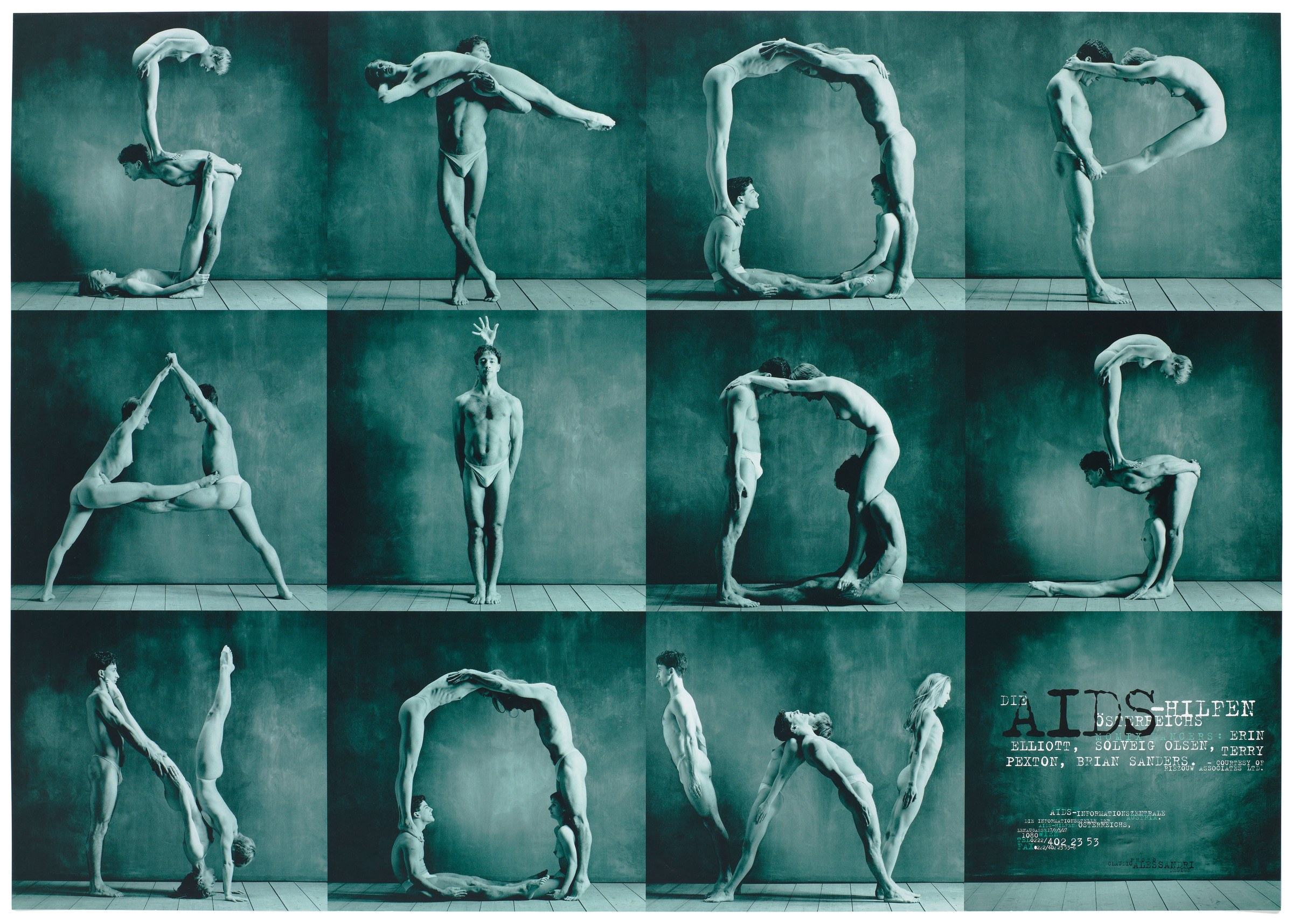
Semi-naked men and women from the dance company Momix Dancers use their bodies to form the words 'Stop AIDS Now', an advertisement by the AIDS-Hilfen Österreichischs. Colour lithograph by Claudio Alessandri Design, ca. 1995.
Unknown artist
- Source:
- Wellcome Collection
- Rights:
- Rights reserved by the holding institution — do not reuse without permission. Source record ↗
- Recorded as:
- In copyright
This work demonstrates how late 20th-century dance companies blurred the boundary between dance and visual art, using the body as sculpture and typography in service of urgent social messaging. For historians of AIDS activism and cultural representation, it captures a moment when the dancing or acrobatic body became a vehicle for public health communication—reclaiming and celebrating bodily display in the context of an epidemic that had rendered queer and marginal bodies dangerous or invisible in mainstream discourse.
What you are looking at
A grid of sixteen photographs arranged in four rows documents multiple nude or semi-nude performers forming letter-shapes and wordforms with their bodies against a teal-green backdrop. Each panel shows a different configuration: in the top row, individual and paired figures create curved and angular letters; the middle rows show groups of two to four performers interlocking, stretching, and contorting to spell recognisable letterforms and geometric shapes. The figures are lit from the front against a flat, textured background. A text panel in the bottom-right corner identifies this as a campaign for AIDS-Hilfen Österreichischs (Austrian AIDS Support). The overall effect is of a visual alphabet or word-puzzle composed of human bodies—a technique demanding extreme flexibility, precise spatial awareness, and intimate physical collaboration.
The dancing
The performers demonstrate extraordinary flexibility and body control. Bodies fold, extend, and interlock to create letter-shapes: some curl into tight balls while partners stretch over or around them; others bridge or contort their spines into curves and angles. The weight distribution shifts dramatically from panel to panel—some figures are fully supported by partners, others balance on minimal contact points. The lack of shoes or costume detail emphasizes the precision of line and angle the bodies themselves must hold. The groupings range from one to four dancers per configuration, with physical trust and spatial accuracy evident in every frame.
The dance depicted
This is not conventional dance but rather a contemporary body-art practice aligned with acro-dance and partner acrobatics (adagio), blending dance, gymnastics, and sculptural practice. The work uses the human body as a graphic element—a fusion technique common to commercial and conceptual dance work from the 1990s onward. The performers, identified as members of Momix Dancers (a company founded in 1981 known for acrobatic fusion and visual spectacle), execute controlled, held positions rather than flowing movement. The grammar is closer to live typography than to dance proper, though it demands the flexibility and partnering skill of trained dancers.
How it was made
The record identifies this as a colour lithograph by Claudio Alessandri Design, circa 1995. Lithography allowed for the reproduction and distribution of this campaign image to a broad public audience—the medium was chosen for its capacity to render halftone photographic source material at scale and with colour saturation. The vivid teal background and white figure-photography combination creates high contrast and immediate visual impact suited to public health advertising. Lithography in the 1990s was established print-advertising technology, indicating this was a professional campaign rather than a one-off or fine-art production.
About this work
This is a public-health campaign artwork documenting the body-art practice of Momix Dancers, in which performers arrange themselves to spell 'Stop AIDS Now' as an advertisement for Austrian AIDS Support. The work sits at the intersection of acro-dance, live typography, and conceptual art—a practice that emerged in the 1980s and 1990s as contemporary dance companies adopted gymnastics, contact improvisation, and sculptural principles. The lithograph format and grid composition suggest this was widely circulated as a poster or magazine advertisement. The work is significant both as a document of Momix's distinctive visual language and as a cultural artefact from the AIDS crisis, repurposing the flexible, expressive body as a tool for public health messaging.
How to look at it
Attend to the precision required in each frame: the performers have frozen mid-gesture, holding positions that would be difficult or impossible to sustain without extraordinary training and partner support. Notice how the eye reads the letter-shapes—some are immediately legible, others require a moment of spatial parsing. Observe the different strategies performers use to create lines and curves: some extend limbs, others bend and compress the torso, still others serve as anchoring points for partners. The teal ground is not incidental—it frames the white bodies as pure graphic elements, making the legibility of the letterforms paramount. The grid format invites comparison across frames, showing the vocabulary of human configurations available to spellers with extreme flexibility and trust.
The artist
Claudio Alessandri Design was the credited lithographic designer of this campaign, but the original concept and performance came from Momix, an American contemporary dance company founded by Moses Pendleton in 1981. Momix became known for fusing dance, acrobatics, and visual spectacle, creating a hybrid performance language that rejected conventional narrative in favour of pure physicality and visual surprise. The company's work frequently appeared in commercial advertising and public campaigns throughout the 1980s and 1990s, bringing dance and acrobatic practice into the visual language of mainstream media. Momix dancers were among the most publicly visible performers working outside traditional theatrical ballet.
The period
By the mid-1990s, the AIDS crisis had become a defining global health emergency and a catalyst for activist art. Contemporary dance in this period was already engaged with acrobatics, contact improvisation, and post-modern practice; companies like Momix accelerated the fusion of gymnastics and theatrical spectacle. Public health campaigns increasingly adopted visual shock and body-positive imagery to counter stigma—this campaign represents a significant moment in which the flexible, vulnerable, queer-coded body was reclaimed as capable, collaborative, and powerful. The work also emerged during lithography's last major phase as a primary medium for advertising before digital printing became dominant.
Where it lives
The image is held in the Wellcome Collection, a major archive of medical and social-history materials including visual culture from health campaigns and activism. The work is catalogued as a colour lithograph from approximately 1995, credited to Claudio Alessandri Design and featuring Momix Dancers. The precise accession details and current location within the Wellcome are not recorded in the available catalogue entry.
Dance in this work
Questions about this work
Is this actually dance?
It is better described as acro-dance or body art—a practice using trained dancers and acrobats to create sculptural, graphic, or architectural forms with the human body. Momix pioneered this fusion language, which demands dance training but uses bodies as static or near-static visual elements rather than for movement itself. It represents a late-20th-century expansion of what dance practice could be and do.
Who were Momix Dancers?
An American contemporary dance company founded by Moses Pendleton in 1981, known for visually spectacular fusions of dance, acrobatics, theatre, and multimedia. Momix performed internationally and became visible in mainstream media and advertising. The company challenged the conventions of dance-theatre by prioritizing visual innovation and physical virtuosity over narrative.
How did they train to do this?
Momix dancers had backgrounds in dance, acrobatics, gymnastics, and martial arts combined. The specific skill of forming legible letterforms required years of flexibility training, partner work and contact improvisation, and spatial awareness. Each configuration was likely choreographed and rehearsed extensively to ensure safety, legibility, and aesthetic precision.
Why use this imagery for an AIDS campaign?
In the 1990s, AIDS activism sought to counter stigma and reclaim the body—especially marginalised and queer bodies—as beautiful, capable, and worthy of care and celebration. Using flexible, collaborative, intertwined bodies to spell 'Stop AIDS Now' directly challenged the dehumanisation and fear that surrounded the epidemic while celebrating bodily intimacy and trust.
More dance artwork





