49 works in this view — arrow keys or swipe to move between them.
Dance in Art
Birth of a Ballet "Béjart Style".
Unknown artist
- Collection:
- Prints & Photographs
- Source:
- Library of Congress
- Rights:
- Rights vary by item — check the source record before reusing this image. Source record ↗
- Recorded as:
- Library of Congress — no known restrictions (verify per item)
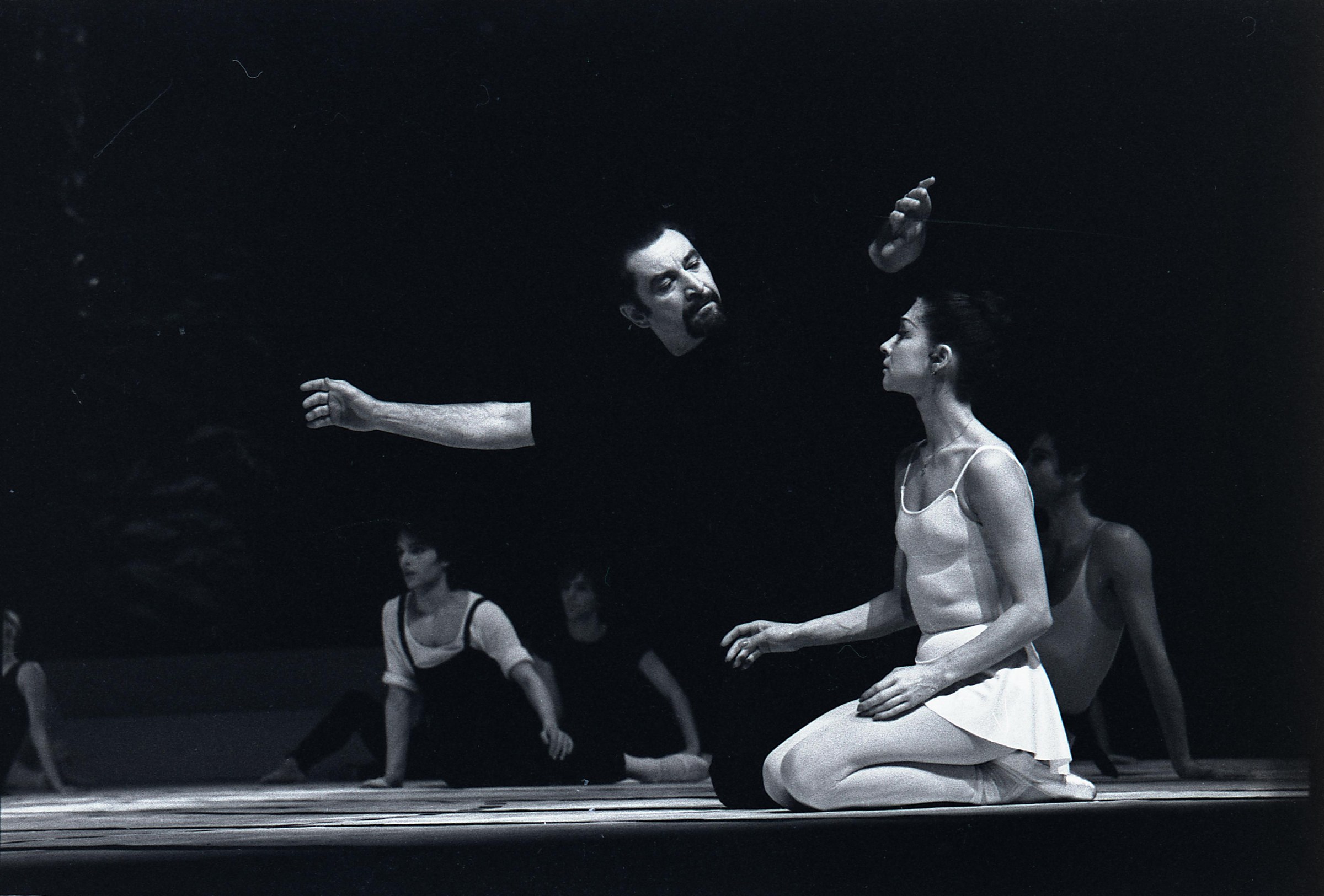
This image is essential evidence of Béjart's creative method and the state of ballet innovation in the 1970s. It shows the moment when a major choreographer was breaking ballet's rules—kneeling, inverting, humanizing—and doing so in a collaborative studio space rather than a finished theatrical frame. For dancers and historians, this is a primary source for understanding how ballet was being reimagined at the moment when contemporary dance and classical technique began to merge.
What you are looking at
A black-and-white photograph captures a moment of choreographic creation or rehearsal, shot against a deep black background that isolates the dancers in stark relief. In the foreground, a shirtless male dancer kneels on the stage floor, his torso upright and one arm extended forward in a gesture of offering or supplication. He gazes upward toward a second male figure suspended or floating in the upper frame, whose body is inverted or tilted at an acute angle—a striking visual that defies ordinary gravity and suggests either a moment of lift, fall, or conceptual abstraction. To the left, partially visible figures in tank tops sit or crouch on the floor, watching or waiting. The composition is austere and modernist, with the kneeling dancer's vulnerability and the floating figure's impossible position creating a sense of dramatic rupture or transformation. The title's reference to Béjart suggests a deliberate exploration of the meeting between classical ballet vocabulary and contemporary physical invention.
The dancing
The primary dancer in the foreground is in a deep kneel with an extended arm and an upward gaze—a posture that reads as yearning, prayer, or supplication. His body is centered and grounded despite the gestural reach. The suspended figure above appears weightless or in defiance of gravity, suggesting either a partner-supported lift or a conceptual image of levitation. Witness dancers sit passively on the floor, their attention directed toward the central pair. The hold and frame are non-classical: there is no closed ballroom position or pointe-work alignment. Instead, the bodies read as modern and exploratory, suggesting contemporary dance or the physical experimentation Béjart was known for.
The dance depicted
This is almost certainly a documentation of Maurice Béjart's choreographic method or a work in his idiom. Béjart (1927–2007) was a Belgian choreographer who radically reimagined ballet by fusing classical technique with modern movement, theatrical staging, and often sculptural or architectural body positions. The image captures the studio or rehearsal process—the title 'Birth of a Ballet' suggests we are witnessing creation rather than a finished performance. The kneeling figure and impossible levitation of the second dancer exemplify Béjart's signature vocabulary: the rejection of weightlessness in favor of earthed, sculptural bodies, combined with moments of theatrical transcendence. The witnesses suggest a teaching or collaborative moment, central to Béjart's ensemble-based practice. The photograph documents the 1970s moment when Béjart's approach was at its height of influence.
How it was made
This is a black-and-white photograph, likely taken during a rehearsal or studio session in 1978. The stark studio lighting and deep black surround are characteristic of professional dance photography from that era, designed to isolate the performers and emphasize body line and sculptural form. The use of black background and high contrast creates an almost sculptural effect, treating the dancers' bodies as three-dimensional forms in space. The photographic medium allows a freeze-frame moment that would be impossible to sustain in live performance, capturing either a genuine lift/position or a staged moment created for the camera. This type of documentation was crucial for disseminating Béjart's work beyond the theatre and into archives and publications.
About this work
This photograph documents a moment in the creative process or studio practice of Maurice Béjart, the influential Belgian choreographer who transformed ballet in the late 20th century. The image shows two male dancers in a composition that defies conventional ballet positions: one kneeling in a gesture of supplication, the other floating or lifted in an inverted position, with witnesses observing from the floor. The work belongs in a gallery of dance art as a document of modernist dance-making—not a finished performance, but evidence of the laboratory where Béjart invented his radical fusion of classical technique, contemporary physicality, and theatrical sculpture. It represents a pivotal moment when ballet was being decolonized from its rigid academic traditions and opened to expressionism, collaboration, and the body's full sculptural potential.
How to look at it
Notice first the composition: the kneeling figure commands the lower frame and our attention, while the suspended or inverted figure above creates a visual paradox—defying the photograph's own temporal and spatial logic. The upward gaze of the kneeling dancer is the gesture that anchors the image; it reads as prayer, yearning, or address. Observe the passivity of the witness-dancers on the left—they are not dancing but observing, which tells you this is a teaching or rehearsal moment, not a performance. The black background is not theatrical scenery but a studio convention designed to make the body visible as a sculptural object. The impossible geometry of the two main dancers' relationship—one earthed, one weightless—is the whole statement: this is ballet that refuses the classical body and invents new possibilities from the collision of weight and lift, ground and air.
The artist
Maurice Béjart (1927–2007) was a Belgian-Swiss choreographer and founder of the Ballet du XXe Siècle (1960–1988), one of the most influential ballet companies of the late 20th century. Born as Berger, he adopted the stage name Béjart and became known for a radical, humanistic approach to ballet that rejected the ethereal, otherworldly aesthetic of classical romanticism in favor of earthed, sculptural, emotionally direct movement. He worked across genres—ballet, modern dance, theatre, multimedia—and collaborated extensively with composers, visual artists, and his own ensemble. His work was politically progressive, often addressing themes of love, death, human vulnerability, and social upheaval. By 1978, when this photograph was taken, Béjart was at the height of his influence, and his studio practice was a site of constant experimentation and renewal.
The period
In the 1970s, ballet was in the midst of a profound reinvention. The post-war generation of choreographers—including Béjart, Forsythe, Cunningham, and others—were dismantling the hierarchy and aesthetic assumptions of classical technique. Béjart had been leading this charge since the 1950s, but the 1970s saw his mature period, when his fusion of styles was most assured and his influence most widespread. Simultaneously, photography and video documentation were becoming central to how dance was disseminated and archived. The studio photograph, rather than the stage shot, was emerging as a way to capture the raw materiality and creative process of dance-making. This image sits at the intersection of both movements: it documents Béjart's mature work and the new media ecology in which that work was being circulated.
Where it lives
This photograph is held in the Prints & Photographs collection of the Library of Congress. It is catalogued as documentation from 1978 and is identified as related to Maurice Béjart's practice or choreography, though the specific work, company, and photographer are not recorded in the catalogue. It belongs to the corpus of dance documentation that began to accumulate in American archives during the 1970s–1980s as dance photography became a recognized form of artistic and historical record.
Dance in this work
Questions about this work
Who is Maurice Béjart and why is he important?
Béjart (1927–2007) was a Belgian choreographer who revolutionized ballet by fusing classical technique with modern movement, emotional directness, and theatrical spectacle. His company, the Ballet du XXe Siècle, was one of the most influential dance organizations of the late 20th century. He broke ballet's rules—making it earthed, human, collaborative, and politically engaged—and his influence shaped how ballet is made and understood today.
What does 'Birth of a Ballet Béjart Style' mean?
The title suggests this photograph documents the moment of choreographic creation or studio rehearsal, not a finished performance. It shows us the laboratory where a new work or new movement vocabulary was being invented. 'Béjart Style' refers to his characteristic approach: the fusion of classical and contemporary technique, the emphasis on sculptural body positions, emotional vulnerability, and collaborative ensemble work.
Why is one dancer floating or inverted?
The inverted or floating position could be a partner-supported lift (common in Béjart's work), a moment captured mid-movement, or a position staged for the photograph. Béjart was known for exploring impossible or unconventional body positions that defied classical ballet's logic. The effect here—one figure earthed and kneeling, the other weightless—creates a visual metaphor for transcendence, vulnerability, or the meeting of opposites.
Is this a performance or a rehearsal?
This appears to be a rehearsal or studio documentation, not a stage performance. The black studio background, the presence of watching dancers, and the title's reference to 'birth' or creation all suggest we are seeing the process of making, not the finished product. This type of documentation was central to how Béjart's work was circulated and understood.
More dance artwork





