49 works in this view — arrow keys or swipe to move between them.
Dance in Art
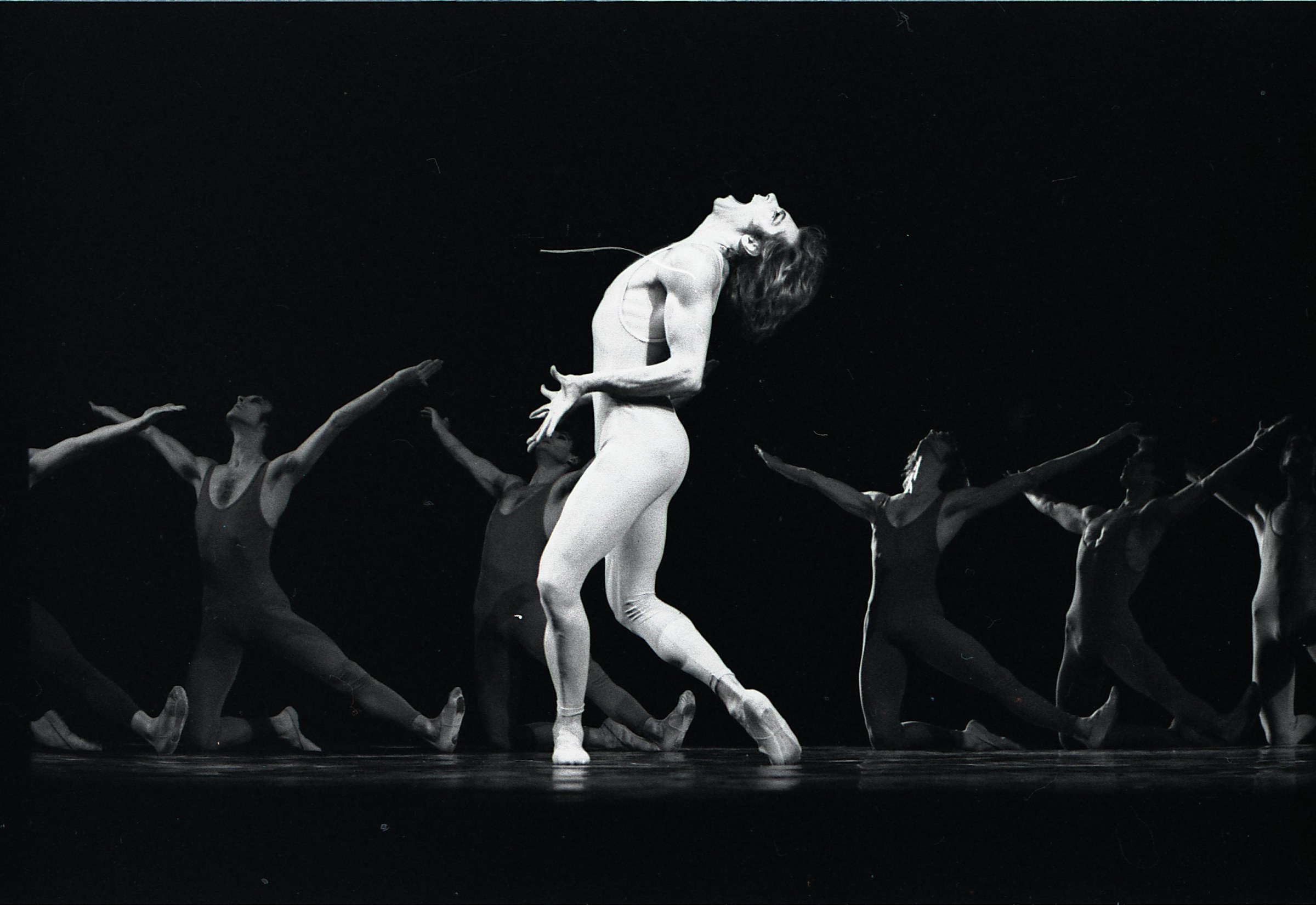
Jorge Donn in the Ballet "The Rite of Spring".
Unknown artist
- Collection:
- Prints & Photographs
- Source:
- Library of Congress
- Rights:
- Rights vary by item — check the source record before reusing this image. Source record ↗
- Recorded as:
- Library of Congress — no known restrictions (verify per item)
This work is significant as documentation of how *The Rite of Spring*—a foundational modernist score—was embodied and interpreted in late-twentieth-century ballet. It shows the continued influence of Nijinsky's 1913 choreography on later generations and the evolution of ballet technique toward greater flexibility and dramatic abandon. The photograph also documents Donn's prominent role in American ballet during the 1970s.
What you are looking at
A soloist in a pale leotard stands center stage in a dramatic backbend, head dropped back and body arched, one arm extended and fingers splayed expressively. The figure is framed by six dancers in dark costumes arranged symmetrically on either side—three to the left and three to the right—all kneeling or in low lunges with arms extended upward in unison. The stage is lit against deep black, creating stark contrast that isolates the pale figure and emphasizes the geometric arrangement of the ensemble. The lighting and positioning suggest a moment of ecstatic or sacrificial intensity, with the soloist as the focal point of collective attention.
The dancing
The central dancer's body is in full extension with the back deeply arched, suggesting flexibility and dramatic vulnerability. The torso is exposed, the supporting leg is straight, and the free leg and arms create an open, expansive frame. The surrounding ensemble members move in strict unison, their bodies bent forward from the knees with both arms raised at sharp angles—a formal, hieratic pose that emphasizes collective participation rather than individual expression. The asymmetry of the soloist's body against the bilateral symmetry of the group creates visual tension.
The dance depicted
This is a scene from a theatrical production of Stravinsky's *The Rite of Spring*, likely a neoclassical or contemporary interpretation. The catalogue identifies the soloist as Jorge Donn, the Argentine dancer and principal of American Ballet Theatre, known for roles in works by Alvin Ailey and other contemporary choreographers. The composition—a solo figure surrounded by a ritually arranged ensemble—echoes the work's themes of sacrifice and primitive ritual. The extreme backbend and exposed torso suggest a vocabulary influenced by contemporary ballet or modern dance rather than classical technique alone.
How it was made
This is a black-and-white photograph, likely taken during a theatrical performance under stage lighting. The photographer has captured the moment with sharp focus and high contrast, isolating the figures against the dark surround. The professional studio lighting and composition suggest this was a press or production photograph rather than an informal snapshot, made for documentation and distribution to critics and the public.
About this work
This photograph documents a scene from a 1978 theatrical production of *The Rite of Spring*, featuring the principal dancer Jorge Donn at the moment of dramatic climax or ritual culmination. The image captures contemporary ballet's engagement with primitive and sacrificial themes through the body, staging, and lighting. The symmetrical positioning of the ensemble around the virtuosic soloist reflects the work's tension between individual identity and collective ritual.
How to look at it
Observe the moment frozen here: not a moment of movement, but of held intensity—the soloist suspended in a backbend that hovers between ecstasy and collapse, while the ensemble kneels in witness. The photographer has chosen to emphasize verticality through the raised arms of the surrounding dancers, creating a visual architecture of ritual around the central figure. The symmetry is rigorous and geometric, a formal convention inherited from both classical ballet and modernist theater design.
The artist
The photographer is not identified in the catalogue record. The image comes from the Library of Congress Prints & Photographs collection and carries the provenance markers of professional theatrical documentation from the late 1970s. The technical quality and composition suggest a staff or commissioned photographer working for a major ballet company or news bureau.
The period
In 1978, *The Rite of Spring* had been in the ballet repertory for over sixty years, and the work was regularly re-choreographed and reinterpreted. This production dates to the height of the American Ballet Theatre's prominence under Mikhail Baryshnikov and reflects the company's interest in both classical technique and contemporary innovation. Jorge Donn was known for his work in modern dance-inflected ballet, bridging the worlds of classical and contemporary movement. The extreme flexibility and expressionism visible here reflect the broadening of acceptable ballet technique in this period.
Where it lives
This photograph is held by the Library of Congress Prints & Photographs Online Catalog (LOC) and is available through the digital collections. It was made as part of theatrical documentation, likely for press circulation or company archives, and reflects the professional standards of major institutional photography in the 1970s.
Dance in this work
Questions about this work
Is this a photograph of an actual performance?
Yes. This is a production photograph made during or for a 1978 performance of *The Rite of Spring* featuring Jorge Donn as the central soloist. The professional lighting and framing suggest it was taken either during a dress rehearsal or a performance, captured specifically for documentation and press use.
Who was Jorge Donn?
Jorge Donn (1947–1992) was an Argentine dancer and a principal of American Ballet Theatre. He was known for his roles in contemporary works and for his technical facility and expressiveness, bridging classical ballet and modern dance idioms. He danced with Alvin Ailey and other choreographers and was a prominent figure in late-twentieth-century ballet.
Why is the ensemble arranged symmetrically around the soloist?
The symmetry reflects both the work's engagement with ritual and sacrifice (a common theme in mid-twentieth-century ballet) and modernist staging conventions. The geometric arrangement elevates the soloist as the focal point of collective attention and suggests both reverence and potential danger.
What is the dance vocabulary being used here?
The extreme backbend and the open, expansive arm positions suggest a vocabulary that blends classical ballet technique with the greater flexibility and dramatic expressionism of contemporary and modern dance. This reflects American ballet's increasing incorporation of modern movement idioms during the 1970s and 1980s.
More dance artwork





