49 works in this view — arrow keys or swipe to move between them.
Dance in Art
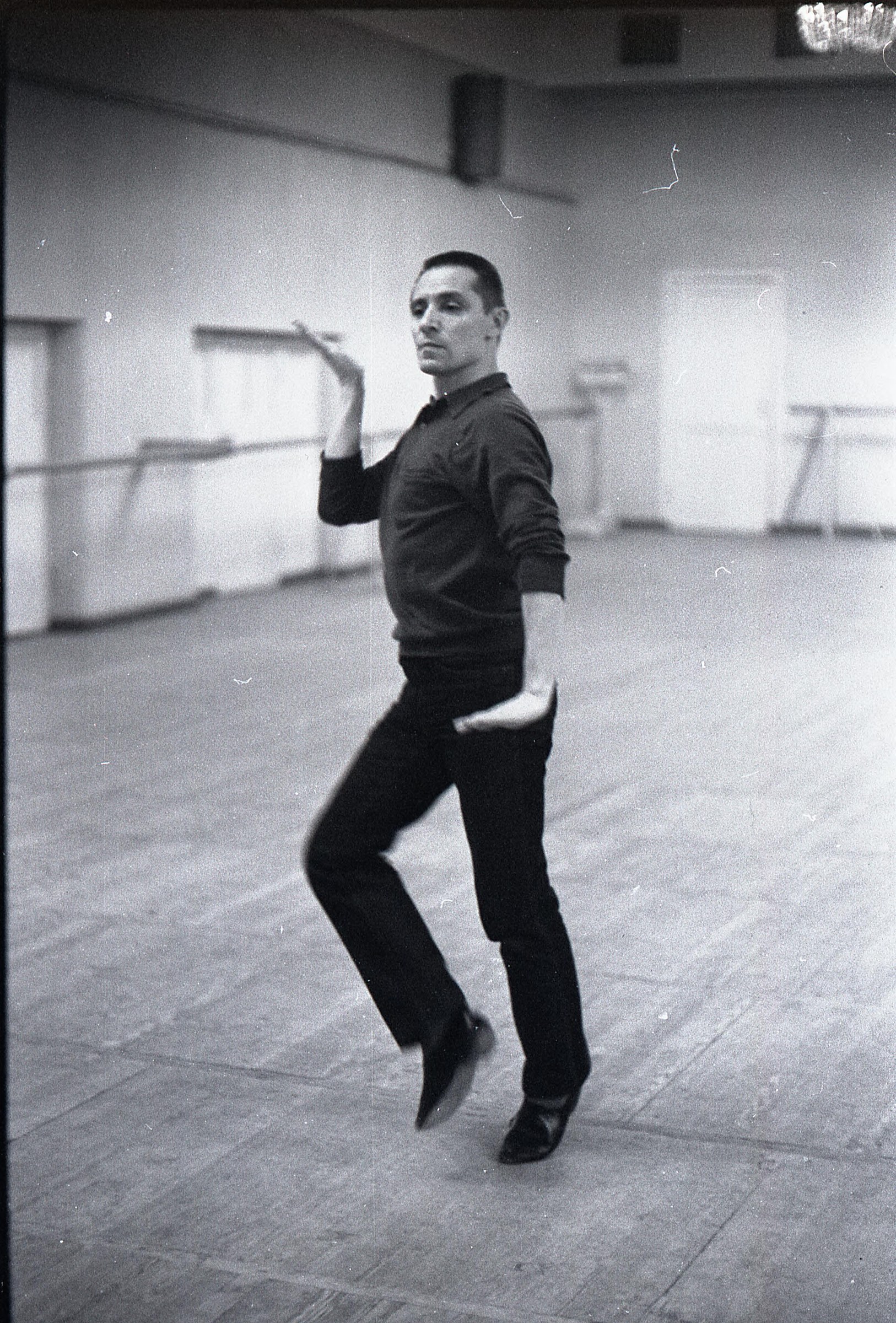
Grigorovich Dancing.
Unknown artist
- Collection:
- Prints & Photographs
- Source:
- Library of Congress
- Rights:
- Rights vary by item — check the source record before reusing this image. Source record ↗
- Recorded as:
- Library of Congress — no known restrictions (verify per item)
This photograph documents a specific moment in Bolshoi Ballet history and the particular aesthetic of Grigorovich's choreography during the height of the Soviet ballet tradition. It is a rare instance of ballet technique being recorded in an entirely neutral, decontextualized setting—stripping away stage, costume, and narrative to isolate the geometry of the body itself. For dance historians and choreographers, it is evidence of how classical technique was being reimagined in the 1970s, and a record of a performance tradition that has largely survived only through film, notation, and photographs like this one.
What you are looking at
A male dancer is captured mid-movement in a stark, minimalist interior space. He wears an all-black long-sleeved shirt and dark trousers, photographed against a plain white or pale gray wall with a few architectural features—a dark pillar or post visible in the middle distance, and geometric lines suggesting window frames or wall panels. The dancer is airborne or at the peak of a jump, his body twisted in a dynamic spiral: his left leg is extended upward and back, his right knee bent, torso rotated, and his right arm raised toward the wall he faces while his left arm angles back. The photograph is black and white, grainy with visible film grain and scratches consistent with mid-20th-century photography. The light is even and diffused, with no dramatic shadows, suggesting studio or institutional lighting. The emptiness of the space emphasizes the isolation and formal clarity of the movement.
The dancing
A single male dancer, lean and spare in build. He is captured in a vertical twist or spiral—a moment of apparent weightlessness in which the lower body appears to rotate against an extended upper body. The right arm reaches toward the wall plane, while the left trails back. The head is turned to follow the direction of the torso. The movement reads as controlled and articulate rather than explosive—a moment of geometric intensity held within the body's axis. The posture suggests rigorous classical or neoclassical training: the limbs are precise, the frame economical, the line unbroken.
The dance depicted
This appears to be a moment from classical or neoclassical ballet, or possibly contemporary ballet of the 1970s. The formal vocabulary—the vertical lift, the controlled spiral, the articulation of the limbs around a stable center—is consistent with mid-20th-century ballet technique. The cataloguing of this work as "Grigorovich Dancing" (1973) suggests the subject may be a member of Yuri Grigorovich's company, likely the Bolshoi Ballet. Grigorovich was the Bolshoi's chief choreographer from 1964 to 1995 and known for ballets that combined classical technique with dramatic intensity and contemporary spatial exploration. The photograph captures the kind of pure, deconstructed movement phrase that characterizes neoclassical choreography of that era.
How it was made
This is a black-and-white photograph, almost certainly silver gelatin given the graininess, tonal range, and surface artifacts visible. The image bears the hallmarks of studio or institutional photography from the early 1970s: even lighting, centered composition, and minimal post-processing. The grainy texture and visible scratches suggest this is a print of the period or a later print from an aging negative. As a photograph, it was designed to circulate among dance professionals, archives, and possibly the press—a documentary record of a performed or posed moment rather than an artistic interpretation. The technique allows for arrest of movement and precise detail impossible in drawing or painting, though the flat lighting flattens some of the three-dimensional spatial relationships the live movement would have had.
About this work
This is a documentary photograph of a male ballet dancer at the moment of peak elevation in a complex, spiraling movement. The work is catalogued as "Grigorovich Dancing" (1973) and held in the Library of Congress Prints & Photographs collection. It represents a moment in Soviet ballet during Yuri Grigorovich's leadership of the Bolshoi Ballet—an era marked by a synthesis of classical virtuosity and contemporary spatial innovation. The photograph is direct and forensic in its approach: no stage spectacle, no theatrical costume or décor, just the body itself in pure movement against neutral space.
As a work of dance documentation, it belongs to a long tradition of trying to preserve choreography through photography—a medium always struggling to capture the essence of a temporal art. What survives in this image is not the full arc of the movement, but rather a single caesura, a moment of suspension that crystallizes the dancer's control and the choreographer's geometric intention. For viewers unfamiliar with the work itself, it becomes a meditation on form and weightlessness.
How to look at it
Attend to the moment of suspension the photographer has chosen: the dancer is neither rising nor falling, but held at the apex of the movement, when all the twisting energy is concentrated in a single geometric form. The neutral background and even lighting force the viewer to read the body as pure line and volume—notice how the extended left leg, the curved spine, and the reaching right arm create an overall S-curve or helix in space. The photograph asks you to read dance not as spectacle or narrative, but as sculpture in motion. The stillness of the image makes the implied velocity and control all the more apparent.
The artist
The photographer is not identified in the catalogue record. The work is held as part of the Library of Congress general Prints & Photographs collection, suggesting it may have been acquired as documentary or archival material rather than as a signed artistic photograph. The style and institutional context suggest it may be the work of a Soviet photographer or press photographer documenting the Bolshoi Ballet, or possibly a Western photographer covering Soviet dance during the Cold War cultural exchange period.
The period
In 1973, Soviet ballet was at a peak of international prestige under Yuri Grigorovich's direction. Grigorovich had become Bolshoi Ballet master-in-chief in 1964 and was known for revitalizing the classical repertory while creating new works that emphasized dramatic intensity, contemporary spatial design, and sculptural line. In the West, the late 1960s and early 1970s saw a widespread turn toward documentation of dance—photography, film, and notation projects aimed at preserving ephemeral work. Simultaneously, Western contemporary dance (Graham, Limón, Cunningham) was exploring pure movement divorced from spectacle. This photograph reflects both the Soviet classical tradition's confidence in formal rigor and the era's broader investment in dance documentation as an art form in itself.
Where it lives
This photograph is held in the Library of Congress Prints & Photographs Online Catalog, indicating it is part of the LC's general photographs collection rather than a specialized dance archive. The cataloguing is minimal (no photographer name, no medium annotation), suggesting the work was acquired as documentary material of Soviet ballet rather than as a signed artistic photograph. It may have been part of a larger press or archival collection related to Bolshoi Ballet documentation or Cold War-era cultural coverage.
Dance in this work
Questions about this work
Who was Grigorovich and why would a photograph be titled with his name?
Yuri Grigorovich was the chief choreographer and ballet master of the Bolshoi Ballet from 1964 to 1995, one of the most influential figures in Soviet and international ballet. A photograph titled "Grigorovich Dancing" likely documents a rehearsal or performance moment from one of his productions, or possibly a posed documentation of his choreographic style. It could also mean a photograph of Grigorovich himself dancing, though given the dancer's apparent age in 1973, this is less likely.
Is this a performance photograph or a posed studio shot?
The neutral white walls, even lighting, and isolated setting suggest this is a studio photograph—possibly a posed documentation session rather than a captured stage moment. However, the naturalistic quality of the movement and the dancer's focus suggest it may be a rehearsal photograph rather than an artificially constructed pose. Without knowing the original context, both readings are possible.
What is the dancer doing—what step or movement is this?
The movement reads as a compound spiral or twist in the air, combining a vertical lift with a rotational element through the body. In classical ballet vocabulary, this might be related to a traveling turn or a controlled elevation with a complex port de bras. The exact identity of the step cannot be determined from a single still image without knowledge of the original choreography.
Why is there no color, costume, or stage setting?
The stark, documentary approach reflects the 1970s interest in isolating and studying movement itself, separate from theatrical apparatus. This kind of neutral-background dance photography was common in both Soviet and Western dance practice as a way to preserve technique and analyze movement scientifically. It also allowed the formal, geometric qualities of Grigorovich's choreography to be visible without distraction.
More dance artwork





