49 works in this view — arrow keys or swipe to move between them.
Dance in Art
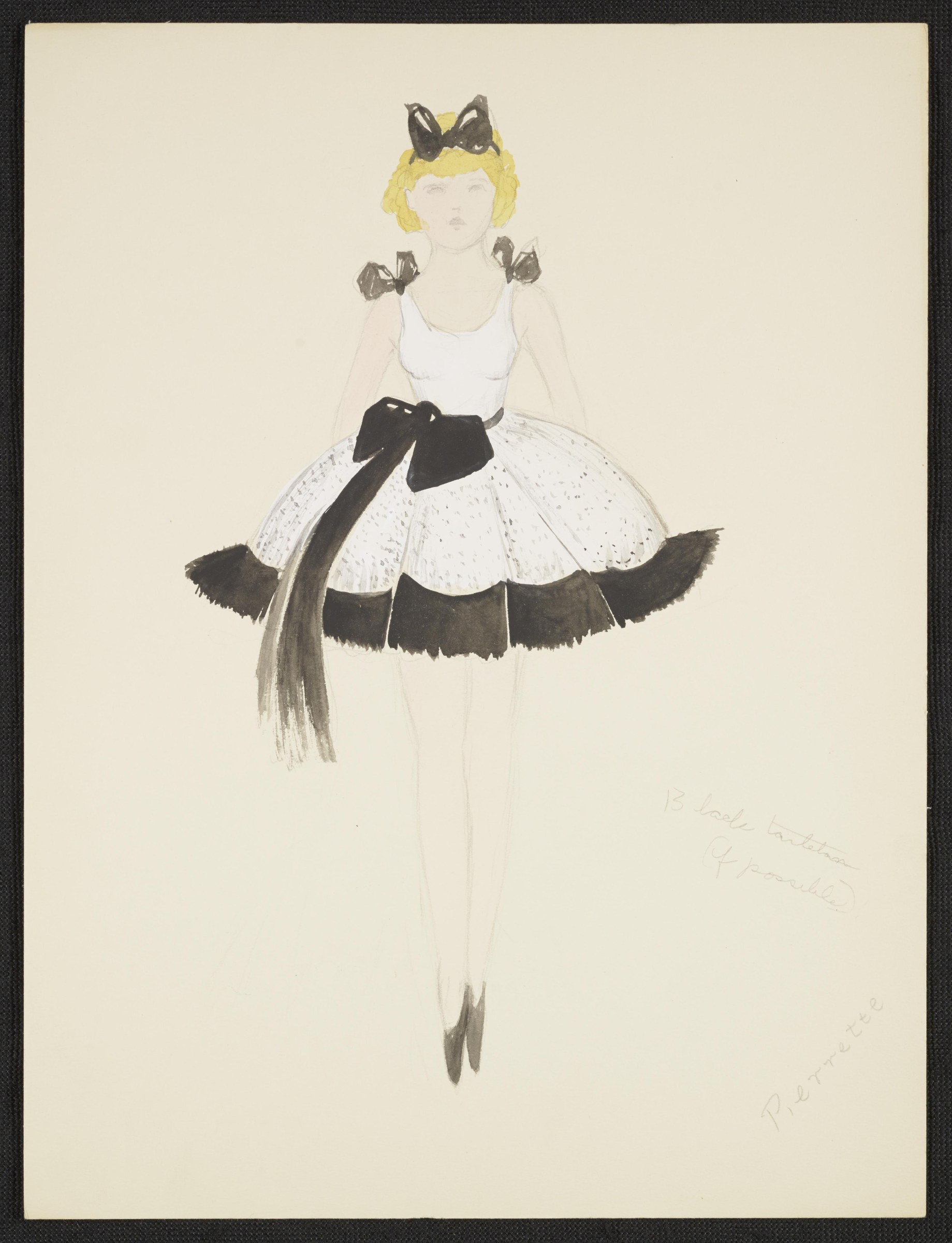
[Runaway Clown: Pierrette. White ballerina costume with black hem and bows.]
Unknown artist
- Collection:
- Prints & Photographs
- Source:
- Library of Congress
- Rights:
- Rights vary by item — check the source record before reusing this image. Source record ↗
- Recorded as:
- Library of Congress — no known restrictions (verify per item)
This drawing documents a moment when theatrical ballet was expanding beyond classical technique into character work and visual spectacle, when costume design was understood as essential to meaning and movement. The image shows how designers of the period communicated the comic, playful, or grotesque dimensions of a role through color, silhouette, and accessory—a crucial aspect of twentieth-century dance practice that often survives only in sketches like this one.
What you are looking at
A single figure stands against a plain cream background in a three-quarter pose. The dancer wears a white sleeveless leotard or tank top and a striking tiered skirt with white upper layers and a deep black hem and underskirt that creates a dramatic color contrast. Black feathered or fur-trimmed edges accent the skirt's tiers. The figure has short blonde hair crowned with a large black bow, and wears matching black bows at the shoulders. The face is rendered minimally with pale features. The skirt appears to float or splay outward, suggesting either arrested motion or a pose held for display. A long black ribbon or streamer trails from the figure's left side. The overall composition is elegant and deliberately stylized, with clean lines and a graphic quality typical of theatrical design illustration.
The dancing
The figure stands in a frontal stance with weight evenly distributed, arms at rest at the sides. The skirt creates volume and suggests a moment of rotation or lift, though the body above remains still and posed. There is no visible footwork or dynamic weight shift. The posture is upright and formal, the bearing more display than action. This is a single isolated figure, not engaged with a partner or group.
The dance depicted
The white tutu with black hem and the theatrical styling identify this as a ballet costume, likely for a character role rather than classical technique. The title 'Runaway Clown: Pierrette' signals a commedia dell'arte character adapted for theatrical dance—Pierrette is the female counterpart to Pierrot, a stock figure of pantomime and ballet. The costume combines balletic tutu structure with the playful, whimsical accessories (bows, feathered shoulders) typical of early twentieth-century theatrical ballet's engagement with avant-garde design and character-driven work. This appears to be a costume design or character study rather than documentation of an actual performance.
How it was made
This is a drawing in mixed media—pencil or graphite forms the structural lines and the figures' faces, while watercolor or gouache provides the color. The white paper shows through in places, creating luminosity, particularly in the skirt. The technique is economical: strong, confident line work in the garment outlines, delicate shading on the face, and bold color masses in hair, bows, and feathering. The style is typical of early twentieth-century theatrical design illustration, where quick, gestural drawing conveyed the designer's vision for the stage. The work appears to be a single preparatory study or presentation sketch, not a finished exhibition piece.
About this work
This is a costume design study for a character ballet role, dating to 1934 and depicting a Pierrette—a female clown figure drawn from commedia dell'arte tradition. The image is a working design document, likely created for theatrical production. The costume synthesizes classical ballet form (the tiered tutu) with theatrical character invention (the playful bows and feathered trim), showing the hybrid aesthetic that dominated European and American stage dance in the 1920s and 1930s. The work belongs in a dance archive both as evidence of how dancers were costumed and as testimony to the visual language designers used to communicate movement possibilities to performers and audiences.
How to look at it
Attend to the tension between the figure's stillness and the skirt's apparent motion. The tutu splays outward in a way that suggests either a jump caught mid-air or a turn frozen at its widest point, yet the body above—the torso, the arms, the minimal face—remains absolutely still and posed. This contradiction is the designer's choice: to show both the potential for movement and the character's self-aware performance. Notice also how color is used: the black accents (bow, feathers, ribbon) read as playful, even comic, against the pristine white of the tutu. The bow atop the head and at the shoulders flatten the figure slightly, making it graphic and doll-like rather than naturalistic.
The period
The 1930s saw ballet companies across Europe and North America experimenting with character roles, national idioms, and theatrical design partnerships that challenged academic classical technique. The Russian Imperial Ballet's influence was waning; companies like the Ballets Suédois and the work of designers like Léon Bakst had demonstrated the power of bold, decorative costume to transform movement meaning. American and European theaters embraced Pierrot and Pierrette figures—figures of whimsy, pathos, and social comment—as vehicles for modern choreographic expression. This sketch reflects that context: the Pierrette is not a classical role but a character study, and the costume signals playfulness and theatricality rather than technical virtuosity.
Where it lives
The work is held in the Library of Congress Prints & Photographs collection, catalogued as a costume design study. It appears to be a single sheet work, likely part of a larger series of designs for a production or choreographer.
Dance in this work
Questions about this work
What is a Pierrette?
Pierrette is the female counterpart to Pierrot, stock characters from commedia dell'arte—Italian improvised theater. These figures became beloved subjects for ballet, mime, and theatrical dance in the nineteenth and twentieth centuries, often portrayed as melancholic, comic, or wistful. The costume—striped, patched, or whimsical—is instantly recognizable.
Why is this called 'Runaway Clown'?
The title suggests a narrative or character dimension beyond pure technique: a Pierrette in motion, fleeing or playing-acting escape. The costume's playful bows and feathered edges support this theatrical, comedic reading. The sketch likely accompanied a ballet or theatrical dance work built around this character.
How would a dancer use this design?
This is a costume design study—a visual instruction to a costume maker and a communication of the character to the dancer. The designer has specified the silhouette, color palette, and decorative elements. The dancer would interpret how the costume shaped movement: a full tiered skirt changes the body line and suggests particular qualities of jump, turn, or port de bras.
Is this a famous design or production?
The artist is not recorded, and without additional documentation, the specific production is unknown. However, the style and date place it within a recognizable moment in twentieth-century theatrical design when character ballet and avant-garde aesthetics intersected.
More dance artwork





