49 works in this view — arrow keys or swipe to move between them.
Dance in Art
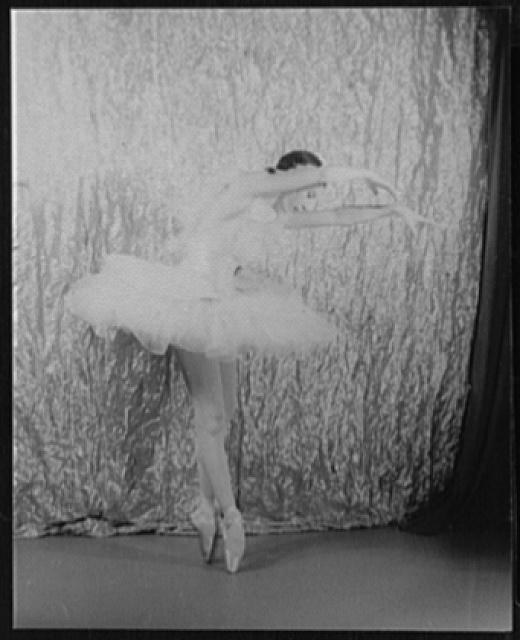
[Portrait of Alicia Markova, "The Dying Swan"]
Unknown artist
- Collection:
- Prints & Photographs
- Source:
- Library of Congress
- Rights:
- Rights vary by item — check the source record before reusing this image. Source record ↗
- Recorded as:
- Library of Congress — no known restrictions (verify per item)
Markova's performance of *The Dying Swan* was central to 20th-century dance history and cultural memory. The role became inseparable from her artistic identity, and her interpretation—characterized by extraordinary delicacy and emotional subtlety—influenced how generations of dancers approached the work. This photograph preserves evidence of how one of ballet's greatest interpreters inhabited one of its most iconic roles.
What you are looking at
A solo female dancer stands in profile against a textured backdrop, frozen in a moment of profound stillness and introspection. She wears a white classical tutu and pointe shoes, her body angled downward in a posture of melancholy. Her left arm extends gracefully downward while her right arm curves inward, creating a sense of fragility and withdrawal. The lighting is soft and even, emphasizing the delicate geometry of the figure against what appears to be a heavily textured or draped background. The black-and-white photograph captures an instant of stillness within what must be sustained movement—the dancer appears suspended in a moment of artistic reverie rather than active motion.
The dancing
The dancer stands on pointe with her weight settled into the supporting leg, creating an impression of deliberate, controlled descent rather than buoyancy. Her head is bowed and tilted downward, her gaze directed toward the stage floor. The upper torso inclines forward slightly, and the arms are positioned asymmetrically—one reaching down, the other folded inward—creating a vocabulary of resignation and emotional introspection. The posture is one of profound vulnerability, the body language suggesting not technical display but emotional surrender.
The dance depicted
This is almost certainly a documentation of Michel Fokine's *The Dying Swan* (Le Cygne), created in 1905, a solo that became Alicia Markova's signature role. The title, costume, pointe work, and emotional register all align with this iconic four-minute ballet. The image captures the essence of Fokine's revolutionary choreography: a rejection of technical fireworks in favor of emotional truth and naturalistic gesture. Rather than traditional ballet's upward aspiration, *The Dying Swan* bends the body downward in an arc of decline, using simple movements—port de bras, swaying, the trembling of a single leg—to communicate a creature's final moments. This photograph documents not a spectacular feat but a masterpiece of emotional restraint.
How it was made
This is a black-and-white photograph, likely a studio or stage photograph taken during performance or in controlled lighting conditions. The photographic medium allowed for precise documentation of a moment that would otherwise vanish in live performance. The texture and grain suggest professional theatrical photography of the mid-20th century, probably a gelatin silver print. Photography made such images reproducible and distributable in ways that drawings or paintings could not, allowing famous performances to circulate widely through publications, lobby cards, and archives—crucial for dancers' legacies before film and video.
About this work
This is a photograph of Alicia Markova performing *The Dying Swan*, the four-minute solo choreographed by Michel Fokine in 1905 and danced by Markova throughout her long career. The image documents one of the most emotionally significant works in ballet history—a piece that broke with 19th-century conventions of spectacle and virtuosity in favor of lyric economy and psychological depth. Markova's interpretation became legendary: she danced the role hundreds of times across six decades, beginning in the 1920s, and is considered one of its definitive interpreters alongside the role's original dancer, Anna Pavlova.
The photograph captures the work's central artistic gesture: the body inclined downward, the arms speaking a language of surrender rather than control. Where classical ballet typically lifted the dancer skyward, *The Dying Swan* asks her to descend—not in defeat but in acknowledgment of mortality and transformation. The work became a test of a dancer's ability to communicate without spectacle, making it one of the most frequently performed and most symbolically weighted short works in the repertoire. Markova's interpretation defined an era of ballet performance.
How to look at it
Look at the inclination of the spine and head: this is the visual language Fokine used instead of virtuoso steps. The arm positions, particularly the drooping quality of the limbs, are not descriptive of a swan's anatomy but expressive of human emotion—exhaustion, acceptance, release. Notice that the dancer is on pointe but in a posture of diminishment, not ascension: the technical facility of ballet is deployed here not for spectacle but for poetry. The photograph freezes a moment that was always supposed to flow; in performance, the phrase would be continuous, the transitions seamless. What you see here is a single frame extracted from a meditation on mortality.
The period
*The Dying Swan* was created by Michel Fokine in 1905 specifically for Anna Pavlova, who danced it thousands of times and became synonymous with the role. By the time this photograph was taken in 1948, Markova had already established herself as one of the great classical ballerinas of the 20th century. She danced the role from the 1920s onward, and by 1948 she was in her mid-forties but remained a major international figure. The 1940s saw ballet consolidating its place in concert halls and opera houses worldwide, and photographs like this one helped canonize certain roles and certain performers. Photography in this period was essential to ballet's dissemination and mythologizing—a single iconic image could define a role across decades.
Where it lives
The photograph is held in the Library of Congress Prints and Photographs Online Catalog. It is a professional theatrical photograph, likely made during or shortly after a performance or in a studio session. Such photographs were commissioned by dance companies, theaters, and dancers themselves for publicity, documentation, and archival purposes.
Dance in this work
Questions about this work
Why is this called 'The Dying Swan' if it doesn't look like a swan?
Fokine's choreography is not literal mimicry of animal movement but a poetic use of the swan as a symbol—of beauty, vulnerability, and mortality. The gestures are human gestures that evoke the idea of a creature in its final moments. The focus is on the emotional content, not anatomical accuracy. Later interpreters have emphasized this lyrical rather than descriptive approach.
Did Alicia Markova create this ballet?
No. *The Dying Swan* was created by Michel Fokine in 1905 for Anna Pavlova, the Russian prima ballerina. Markova learned the role from other dancers and from the living tradition of the role. She made it her own through decades of performance, but she was interpreting Fokine's choreography, not creating it.
How often did Markova perform this role?
Markova danced *The Dying Swan* hundreds of times across her career, which spanned from the 1920s into the 1970s. The role became closely associated with her identity as a dancer, and she performed it for cinema and television as well as in live performance. It was one of the most frequently performed works in her repertoire.
What makes this photograph significant?
It documents one of dance's most iconic roles performed by one of its greatest interpreters at the height of her career. Before video recording became standard, photographs were the primary means of documenting how performances actually looked. This image preserves evidence of mid-20th-century classical ballet technique and interpretation.
More dance artwork





