49 works in this view — arrow keys or swipe to move between them.
Dance in Art
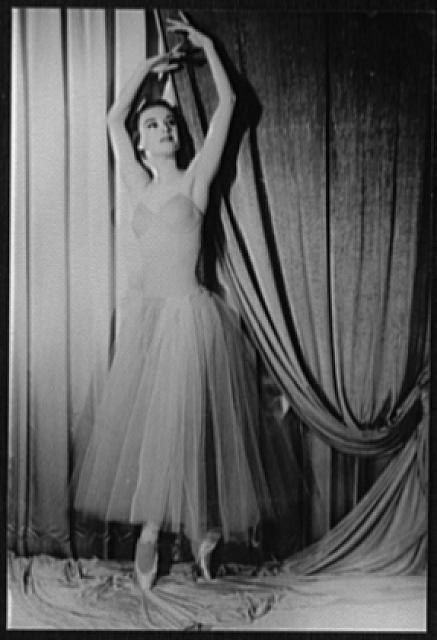
[Portrait of Violette Verdy, in Serenade]
Unknown artist
- Collection:
- Prints & Photographs
- Source:
- Library of Congress
- Rights:
- Rights vary by item — check the source record before reusing this image. Source record ↗
- Recorded as:
- Library of Congress — no known restrictions (verify per item)
For ballet historians and dancers, this image documents one of the canonical ballets of modernism and a principal interpreter at the moment of the work's greatest influence. The photograph shows how Balanchine's revolution in classical technique—the emphasis on clarity, speed, and continuous flow rather than dramatic poses—actually looked in the body of a trained dancer. For photographic history, it exemplifies the aesthetic of mid-century dance documentation: the use of sculptural lighting and the careful framing of the isolated, extended body as both technical demonstration and romantic vision.
What you are looking at
A woman in a long, translucent tulle skirt stands in profile against a dark background, her body arched and arms raised overhead in an elegant, elongated line. She appears to be gathering or lifting voluminous fabric—possibly her own skirt or an adjacent drapery—which sweeps dramatically around her in curved folds. The lighting is strongly directional, creating sharp contrasts that emphasize the delicate texture of the tulle against darker draped curtains or scenery behind her. The composition is vertical and deeply classical: the dancer's pose suggests a moment of sustained, ethereal extension rather than dynamic movement, with her weight appearing to lift through a long spine. The setting is theatrical—bare stage floor visible at her feet, minimal props, the kind of studio or stage environment typical of mid-twentieth-century ballet photography.
The dancing
A single female dancer frames the entire composition, captured mid-extension with an arched back and both arms raised overhead in a graceful port de bras. Her body shows significant elongation through the torso and neck—the hallmark of trained classical ballet carriage. The dancer's legs are fully extended, suggesting either a high arabesque, attitude derrière, or similar sustained vertical lift. The relationship between her body and the gathered fabric (whether skirt or property) creates visual flow, with the tulle falling in soft folds that echo and extend the line of her limbs. No partner is visible; this is a solo study of feminine form and classical line.
The dance depicted
This is a moment from Balanchine's *Serenade*, the 1934 masterwork that became a signature of New York City Ballet. Violette Verdy was a principal dancer with NYCB in the 1950s and 1960s, known for her musicality and clarity in Balanchine's neoclassical vocabulary. *Serenade* is choreographed to Tchaikovsky's string serenade and is famous for its opening tableau of women in a V-formation, its emphasis on port de bras and the floating, almost weightless quality of classical line set to romantic music. The photograph captures the ethereal, romantic quality central to the ballet—the sustained extensions and the relationship between the dancer's body and the surrounding space that defines the Balanchine aesthetic.
How it was made
This is a black and white studio or stage photograph, likely taken during a performance or professional rehearsal documentation session in the early 1960s. The photographic technique uses strong directional lighting to model the dancer's form and the texture of the tulle, creating sculptural definition. The contrast and grain characteristic of silver gelatin prints of the era are visible; this was the standard medium for dance documentation before digital photography. Such photographs were typically distributed to press, archives, and promotional channels, making them both performance records and publicity materials—a dual function that shapes how the image was composed and lit.
About this work
This photograph documents Violette Verdy in a moment from George Balanchine's *Serenade*, one of the most influential ballets of the twentieth century. The image freezes a single gesture of classical extension, capturing the romantic, ethereal aesthetic that defined Balanchine's neoclassical language and NYCB's distinctive house style. Verdy was a celebrated interpreter of Balanchine's work, known for the musicality and clarity visible here—the way the dancer's body seems to float in space, supported by nothing but her own technique and line. The photograph is both a record of a specific performance moment and a study in the visual principles of classical ballet as reimagined in the mid-twentieth century.
How to look at it
Look at the vertical line the dancer creates from her feet through her extended arms: this is the essence of what Balanchine meant by clarity of line. Notice how the photographer has lit the tulle to catch its translucence and texture—the fabric is not incidental but part of the composition, a visual extension of the dancer's form. The dancer's arched back and the way her arms are positioned overhead without tension or strain shows the Balanchine principle of ease within difficulty. This is not a dramatic moment of maximum exertion but rather a sustained, almost floating state—the opposite of the theatrical intensity you might expect from earlier ballet photography.
The period
This photograph was taken during the height of New York City Ballet's dominance in American dance. George Balanchine's *Serenade* (1934) had become, by the 1960s, the company's unofficial signature work—a ballet that defined American classical ballet for generations and established the aesthetic that still influences ballet worldwide. By the time this photograph was made, Verdy had become one of the principal interpreters of the Balanchine repertory. The early 1960s saw intensified documentation of NYCB through photography, partly to build the company's reputation during a period of rapid growth and partly to preserve a repertory that existed only in living memory and the bodies of the dancers. The style of the photograph—the studio lighting, the attention to the single dancer's line—reflects the conventions of dance photography in this era, which treated the dancing body as a subject worthy of the same formal photographic study as fine art sculpture.
Where it lives
The image is held in the Prints & Photographs collection at the Library of Congress, indicating it was entered into the national collection—likely as part of the documentation efforts supporting NYCB or as a contribution from the company itself. This type of studio photograph, rather than a performance documentation, suggests it may have been created for archival or promotional purposes during Verdy's tenure with the company.
Dance in this work
Questions about this work
What is Serenade, and why is it important?
*Serenade* is a 1934 George Balanchine ballet set to Tchaikovsky's string serenade. It was one of the first ballets Balanchine created in America and became foundational to the American classical ballet aesthetic. The work emphasizes pure dance, musical phrasing, and the classical line, with minimal narrative or decoration. It remains in the active repertory of major ballet companies worldwide and is considered essential to understanding twentieth-century ballet.
Who was Violette Verdy?
Violette Verdy (1933–2016) was a French-born ballerina who became a principal dancer with New York City Ballet. She was known for her musicality, clarity of line, and intelligence in interpreting Balanchine's work. She danced with NYCB from 1958 to 1977 and created roles in several Balanchine ballets. After her performing career, she became a répétiteur and ballet master, helping preserve and transmit the Balanchine style.
What makes this photograph distinctive as a record of dance?
Rather than capturing a dramatic climax or recognizable formation, the photograph isolates a single sustained moment of classical extension. This approach treats the dancing body as a sculptural subject and emphasizes the technical and aesthetic principles underlying the dance—clarity, line, and effortlessness—over theatrical spectacle. It reflects the modern turn in dance photography toward documentation of pure technique.
Why is the fabric such a prominent part of this image?
In *Serenade*, the tutus and the way dancers manipulate their skirts are choreographically significant. The photograph captures what appears to be a moment in which the dancer is lifting, gathering, or otherwise engaging with her skirt as part of the movement. The tulle's translucence and volume extend the visual line of the dancer's body and contribute to the ethereal, romantic quality of the ballet.
More dance artwork





