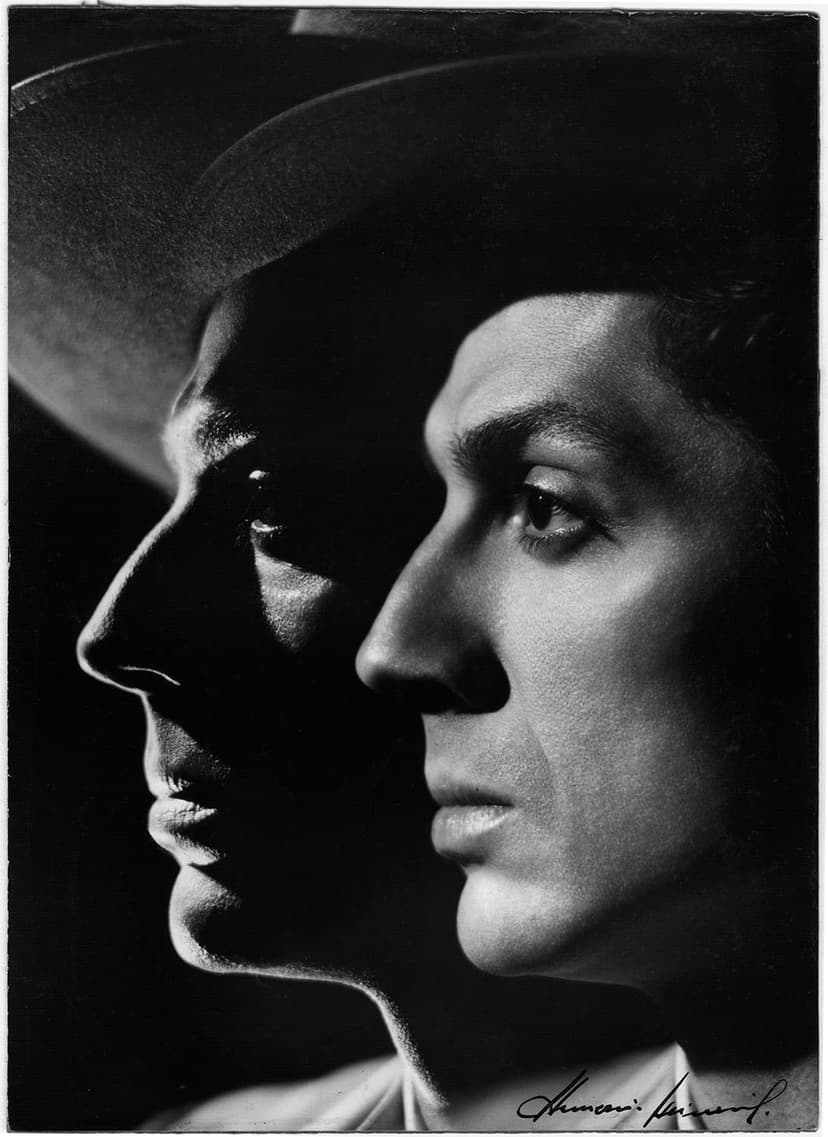
Antonio Ruiz Soler Antonio El Bailarin
Legend of Dance
Why They Matter
Antonio’s importance rests in the scale and synthesis of his Spanish dance. He brought the rhythmic authority of flamenco, the articulated footwork and épaulement of escuela bolera, the spatial architecture of staged ensemble dance, and a commanding male theatrical presence into one career. His…
Biography
Antonio Ruiz Soler was born in Seville on 4 November 1921 and entered professional dance as a child, appearing at the Teatro Duque de Sevilla at about seven years old. In 1928 he formed a partnership with Florencia Pérez Padilla, known as Rosario, that would define the first half of his career. As Rosario y Antonio, the pair developed a concert act spanning flamenco, escuela bolera, and stylized Spanish dance, achieving international prominence through stage touring and film. During their years in the United States, Antonio appeared in Hollywood productions including *Ziegfeld Girl* (1941) and *Hollywood Canteen* (1944), bringing Spanish dance to cinema audiences far beyond the theatre.
Anton's engagement with film extended across three decades. Between 1941 and 1974 he appeared in 24 films, including Edgar Neville's *Duende y misterio del flamenco* (1952), a significant document of the period, and Michael Powell's *Honeymoon* (1959). These appearances disseminated his stage vocabulary and charisma widely. The partnership with Rosario lasted until 1952, after which Antonio founded his own company, Antonio y los Ballets de Madrid, in 1953. The company gave him a larger choreographic frame in which to combine flamenco, regional material, escuela bolera, classical technique, music, and theatrical design, establishing his model of ballet español as a major international touring form.
Anton retired from his performing career in 1978. In 1980 the Spanish Ministry of Culture appointed him director of the Ballet Nacional de España, succeeding Antonio Gades. He directed the national company from 1980 to 1983, bringing his repertory and performance values into Spain's foremost public dance institution. Recognition of his contributions included Spain's Gold Medal of Merit in the Fine Arts in 1991. Antonio died in Madrid on 5 February 1996. The Ballet Nacional de España marked his 2021 centenary by reviving central choreographies, confirming that his legacy persists not only in biography and film but in repertory still taught and performed.
Career Highlights
At about seven, Antonio gives an early professional performance in Seville and begins the partnership with Rosario.
Rosario and Antonio appear in the Hollywood musical Ziegfeld Girl.
The pair appear in Hollywood Canteen during their United States period.
Their long partnership ends; Antonio appears in Duende y misterio del flamenco.
Antonio establishes his own Spanish ballet company, Antonio y los Ballets de Madrid.
He appears in Michael Powell’s film Honeymoon.
Antonio retires from his professional performing career in Sapporo, Japan.
He is appointed artistic director of the Ballet Nacional de España.
His directorship of the Ballet Nacional de España concludes.
Spain awards him the Gold Medal of Merit in the Fine Arts.
Antonio dies in Madrid on 5 February.
The Ballet Nacional de España revives major works for the centenary of his birth.
Gallery
Legacy & Impact
Antonio's significance lies in the scale and synthesis of his Spanish dance vocabulary. He fused the rhythmic authority of flamenco, the articulated footwork and épaulement of escuela bolera, the spatial architecture of staged ensemble dance, and a commanding male theatrical presence into a coherent theatrical form. His films carried that vision internationally; his company trained generations of performers; and his directorship of the Ballet Nacional de España embedded his repertory within a national institution. Dancers and companies continue to study and revive his choreographies, making him a foundational figure in twentieth-century Spanish dance theatre.


Explore More Legends
Discover the dancers, teachers, choreographers, and cultural icons who shaped how the world moves.
Keep the thread going
Dance history, technique, and the occasional rabbit hole — in your inbox. Thoughtful, infrequent, unsubscribe anytime.
Free. No spam. One click to leave.