Chitresh Das
Legend of Dance
Why They Matter
Das’s legacy is both artistic and infrastructural. He demonstrated that kathak’s traditional solo architecture—live rhythmic exchange, recited syllables, footwork, spins, and narrative expression—could take root in a North American environment without being reduced to a museum object. He also create
Watch
Pt. Chitresh Das performs his legendary traditional Kathak solo - Pt. 1
chhandam
Extended solo material can support close study of Das's rhythmic command and performance architecture.
Pandit Chitresh Das' teachings - Chhandam School of Kathak
chhandam
First-person teaching context helps distinguish Das's pedagogy from later summaries.
Chitresh Das Dance Company & Chhandam 30th Anniversary
chhandam
Documents the institutional network built around Das's work.
Biography
Chitresh Das was born in Calcutta in 1944 and grew up inside Nritya Bharati, the dance school founded by his parents. At age nine he began formal kathak study with Pandit Ram Narayan Misra, training that crossed two major stylistic lineages: the grace and expressive refinement associated with Lucknow and the vigorous rhythmic power associated with Jaipur. His early performances in India gained momentum after Ravi Shankar invited him to perform at the first Rimpa Festival in Benares.
In 1970 Das traveled to the United States on a Whitney Fellowship connected with the University of Maryland, where he taught kathak and encountered American modern dance. The following year, sarod master Ali Akbar Khan invited him to California to establish a kathak program at the Ali Akbar College of Music. These appointments placed a young Indian classical dancer inside emerging U.S. institutions for South Asian music at a moment when American audiences were rapidly expanding their engagement with Indian arts.
By 1980 Das had founded the Chitresh Das Dance Company and Chhandam School of Kathak in California. He combined the traditional guru–disciple relationship with classes, touring, and university teaching, building a network of students who later created their own schools and performance practices. The Alliance for California Traditional Arts describes Chhandam as a major North American institution for Indian classical dance; in 2002 he also re-established his parents' Nritya Bharati institution in Kolkata.
Das's stage identity joined formidable technique to spontaneous composition. The kathak solo tradition he inherited involved a demanding encounter with live musicians in which rhythmic sequences, storytelling, and improvisation could unfold for hours. His teaching stressed speed and readiness, command of complex rhythmic cycles, clear footwork, turning, expressive storytelling, and the simultaneous cultivation of power and delicacy. His "kathak yoga" practice asked a dancer to coordinate movement, vocal recitation, and rhythm at once—a pedagogical and performance innovation that became distinctive to his method.
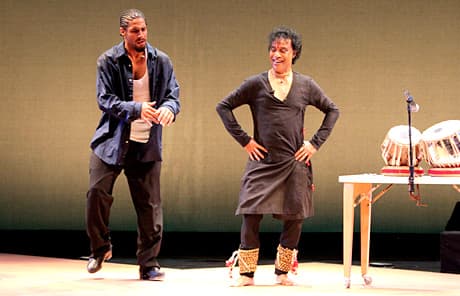
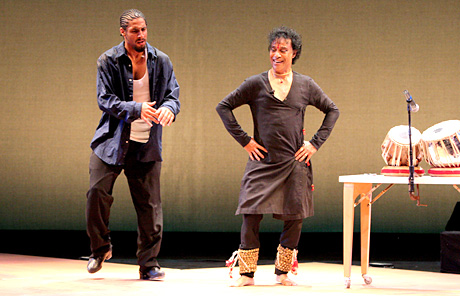
Collaboration became another route for testing the form's possibilities. In *India Jazz Suites*, Das and tap dancer Jason Samuels Smith did not fuse their dances into a generic hybrid. As Das explained in an NEA interview, each retained his own tradition while meeting through rhythmic structure and improvisation. The project toured internationally, and the documentary *Upaj: Improvise* brought their exchange to film festivals and a national PBS broadcast in 2014.
In 2009 the National Endowment for the Arts named Das a National Heritage Fellow, the U.S. government's highest honor in folk and traditional arts. He continued to perform, teach, choreograph, and tour until his death in January 2015 at age seventy. The institutions and disciples that developed around his practice—including the present-day Chitresh Das Institute—remain evidence of his impact on North American kathak.
Career Highlights
Began studying kathak at age nine with Pandit Ram Narayan Misra.
Came to the United States on a Whitney Fellowship to teach kathak at the University of Maryland.
Joined the Ali Akbar College of Music in California at Ustad Ali Akbar Khan’s invitation and established a kathak program.
Founded the Chitresh Das Dance Company and Chhandam School of Kathak.
Re-established his parents’ Nritya Bharati institution in Kolkata.
Developed the touring rhythmic collaboration India Jazz Suites with tap artist Jason Samuels Smith; the exact premiere date should be confirmed before publication.
Received an NEA National Heritage Fellowship as a kathak dancer and choreographer.
Upaj: Improvise, documenting his collaboration with Smith, screened at international film festivals.
Upaj: Improvise aired nationally on PBS.
Died on January 4 after a career of performance, choreography, institution building, and teaching in India and the United States.
Gallery
Legacy & Impact
Das demonstrated that kathak's traditional solo architecture—live rhythmic exchange, recited syllables, footwork, spins, and narrative expression—could take root in a North American environment without becoming a museum object. He created schools, companies, and teaching relationships through which that knowledge could continue. His collaborations with tap dancer Jason Samuels Smith modeled intercultural dance based on rhythmic encounter and mutual skill rather than superficial blending. The result is a lineage that shaped generations of kathak artists and broadened how U.S. audiences understand Indian classical dance.


Explore More Legends
Discover the dancers, teachers, choreographers, and cultural icons who shaped how the world moves.
Keep the thread going
Dance history, technique, and the occasional rabbit hole — in your inbox. Thoughtful, infrequent, unsubscribe anytime.
Free. No spam. One click to leave.