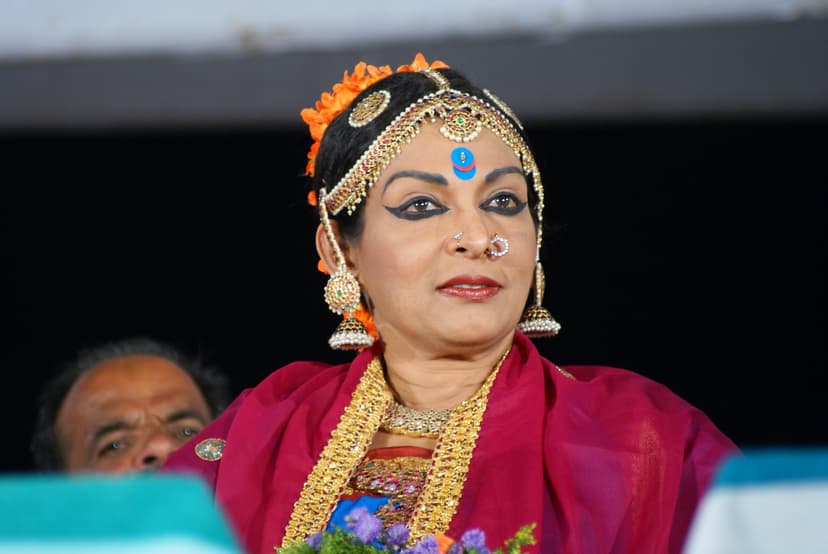
Mallika Sarabhai
Legend of Dance
Why They Matter
Mallika Sarabhai matters because she demonstrates that classical form and political address need not be opposites. Through Darpana and her own repertory, she has used disciplined movement, theatre, text and media to make gender, violence, health, ecology and civic memory visible to broad audiences.
Watch
Mallika Sarabhai: Dance to change the world
TED
First-person articulation of how she connects performance and social change
Mallika Sarabhai | Performance, Learning, and Life
NCPA Mumbai
A recent institutional conversation placing technique, learning and activism in one career narrative
Biography
Mallika Sarabhai is a Bharatanatyam and Kuchipudi dancer, choreographer, actor, writer and arts leader who has made classical Indian dance a sustained vehicle for feminist and social critique. Born on 9 May in Ahmedabad, Gujarat, she grew up in a family where scientific inquiry and performance were equally central—her father Vikram Sarabhai was a physicist and institution-builder, and her mother Mrinalini Sarabhai a dancer-choreographer. Sarabhai trained in both classical forms and later completed advanced study in management and organisational behaviour, establishing by the 1970s a professional career that spanned dance, theatre and film.
Her international profile crystallised when Peter Brook cast her as Draupadi in his multilingual, multinational adaptation of *The Mahabharata*, first staged in the mid-1980s and later adapted for film and television. The role became central to her public identity, though her 2025 account of the production emphasises how it also complicated questions of cultural translation. In 1977, she had received the Golden Star recognition as a dance soloist at Théâtre des Champs-Élysées, Paris.
From the late 1980s onward, Sarabhai increasingly made performance a direct instrument of public argument. *Shakti: The Power of Women* (1989) and *Sita's Daughters* (1990) reworked familiar narratives through women's experience rather than treating classical repertoire as sealed inheritance. *Sita's Daughters* went on to accumulate more than 500 performances in three languages, with later reports placing the total above 600.
At Darpana Academy of Performing Arts—founded by her parents in 1949—Sarabhai became a major co-director and expanded the institution's social-communication mandate. Her work has included staged productions, television, educational programs and campaigns concerned with gender, violence, public health, the environment and marginalised communities. The through-line is not the abandonment of classical training but its redeployment inside contemporary dramaturgy and advocacy.
National recognition followed: the Sangeet Natak Akademi Award in creative dance (1999–2000) and the Padma Bhushan from the Government of India in the field of art (2010). Her later productions continue to treat cities, memory and inequality as choreographic material. In 2014, *Kadak Badshaahi* used multimedia theatre to engage Ahmedabad's history. In 2025, *Meanwhile, Elsewhere*—made with Indian and Italian collaborators and inspired by Italo Calvino's *Invisible Cities*—explored urban transformation, isolation and memory. These works show an artist whose mature practice moves across classical vocabulary, speech, ensemble theatre and media rather than fitting a single genre label.
Career Highlights
Established a professional career spanning Indian classical dance, theatre and film. Official biography Official biography
Received the Golden Star recognition as a dance soloist at Théâtre des Champs-Élysées, Paris; retain the exact award wording as cited by her official biography. Official biography Official biography
Appeared as Draupadi in Peter Brook’s stage production of The Mahabharata, later adapted for film and television. Indian Express Indian Express
Developed and performed Shakti: The Power of Women, marking a major turn toward explicitly feminist dance-theatre. Kerala Kalamandalam Kerala Kalamandalam
Sita’s Daughters began its long international performance life; later sources report more than 500 and, by 2025, more than 600 performances. Kerala Kalamandalam; Mint Kerala Kalamandalam
Received the Sangeet Natak Akademi Award in creative dance. Sangeet Natak Akademi Sangeet Natak Akademi
Performed in an Ahmedabad adaptation of Brecht’s The Good Person of Szechwan, directed by Arvind Gaur. Official biography Official biography
Received the Padma Bhushan from the Government of India in the field of art. Padma Awards Padma Awards
Co-directed Women with Broken Wings, addressing violence against women, with Yadavan Chandran and pianist Elizabeth Sombart. Official biography Official biography
Created Kadak Badshaahi, a multimedia work on Ahmedabad’s history, with Yadavan Chandran. Official biography Official biography
Participated in Meanwhile, Elsewhere, an Indo-Italian production inspired by Invisible Cities and centred on urban memory and change. Times of India Times of India
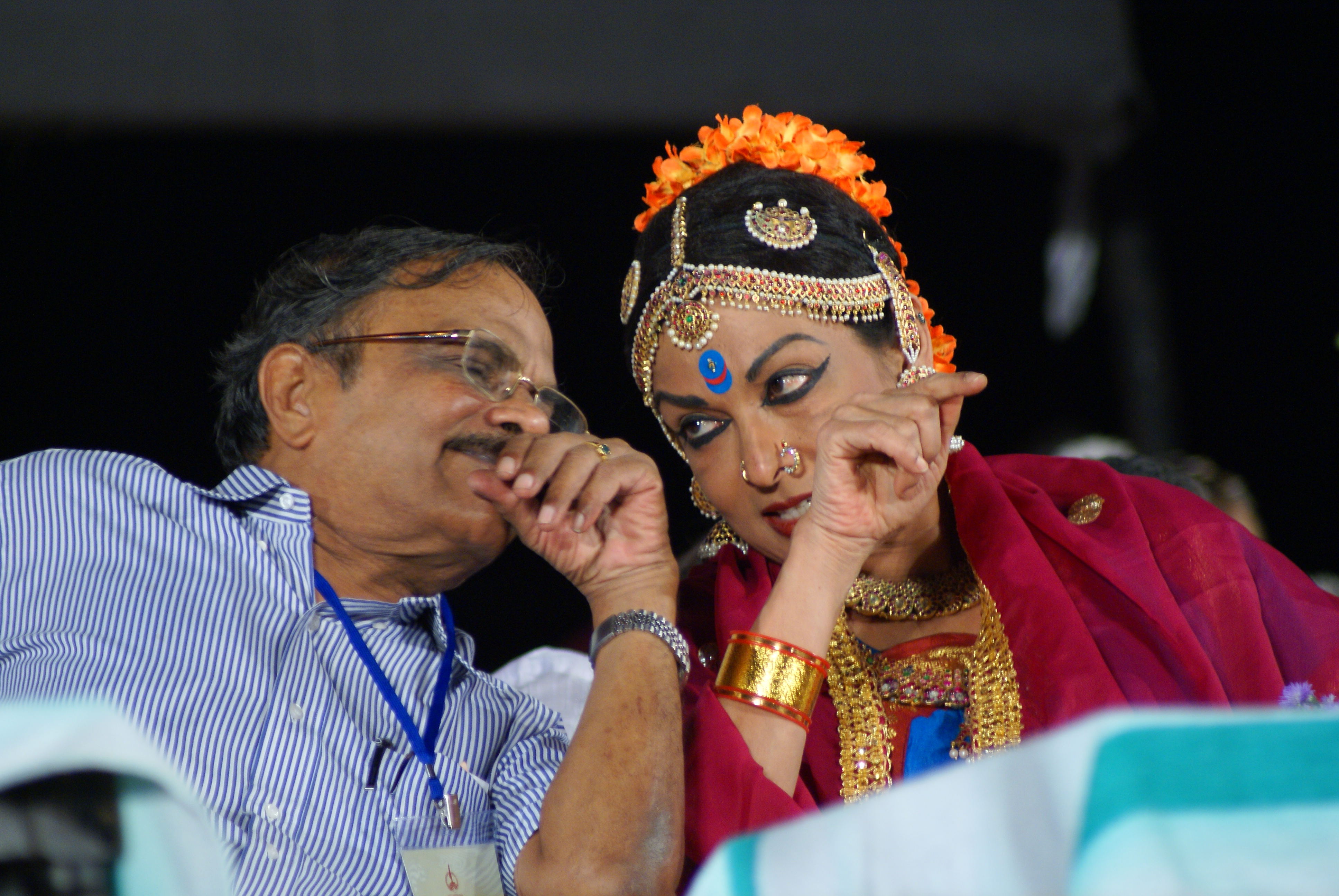
Gallery
Legacy & Impact
Mallika Sarabhai matters because she has demonstrated that classical form and political address need not be opposites. Through Darpana and her own repertory, she has used disciplined movement, theatre, text and media to make gender, violence, health, ecology and civic memory visible to broad audiences. Her legacy is both choreographic and institutional: a model of dance as artistic practice, public pedagogy and democratic intervention.


Explore More Legends
Discover the dancers, teachers, choreographers, and cultural icons who shaped how the world moves.
Keep the thread going
Dance history, technique, and the occasional rabbit hole — in your inbox. Thoughtful, infrequent, unsubscribe anytime.
Free. No spam. One click to leave.