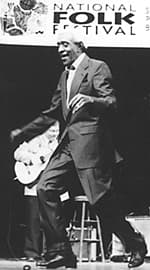
Jimmy Slyde
Legend of Dance
Why They Matter
Slyde matters because he demonstrated that tap can be spacious without becoming empty and virtuosic without becoming merely busy. His career linked Black vaudeville, jazz clubs, European stages, Hollywood, Broadway, festivals and apprenticeship. More important than any single step was the listening
Biography
James Titus Godbolt, known professionally as Jimmy Slyde, was born in Atlanta, Georgia, on October 2, 1927, and raised largely in Boston. His mother initially directed him toward violin study, but the proximity of Stanley Brown's dance studio drew him toward tap. The musical ear cultivated through violin remained central to his artistry: the mature Slyde treated a tap phrase as an improvised instrumental line rather than a string of tricks. Boston's tap community shaped his artistic vocabulary from the start.
As a teenager, Slyde learned sliding steps from Eddie "Schoolboy" Ford and formed an act with Jimmy "Sir Slyde" Mitchell. The pair became the Slyde Brothers, and Godbolt's stage name grew from their shared specialty. Their act worked clubs, theaters, and the Black entertainment circuit, often in dialogue with jazz bands. Slyde's long, apparently frictionless travel across the floor became his signature, sustained by exact weight placement and finely judged arrivals into the next rhythmic idea.
Like many tap artists of his generation, Slyde faced shrinking opportunities as big-band and variety circuits contracted. He nevertheless continued to perform, including substantial work in Europe, and returned to wider American visibility during the tap revival of the 1970s and 1980s. Film appearances in *The Cotton Club*, *Round Midnight*, and *Tap* placed his dancing within projects that explicitly framed tap as a living jazz tradition rather than nostalgia.
In 1989, Slyde appeared on Broadway as a "Hoofer" in *Black and Blue*, the revue devoted to African American jazz and popular performance. The production ran from January 26, 1989, through January 20, 1991. The credit mattered not simply as a Broadway milestone but as public recognition of an improvisational artist whose authority came from decades of club, bandstand, and social-performance practice.
Slyde became an unusually consequential mentor. His New York jam sessions encouraged young dancers to trade phrases, listen, take risks, and recover visibly from error. The combination of elegance, timing, and generosity made him an elder statesman of rhythm tap. Artists associated with the resurgence of rhythm tap encountered him not only onstage but in a culture of circles, exchanges, and apprenticeship.
His honors included the National Heritage Fellowship in 1999, federal recognition of his mastery and transmission of African American tap; a Guggenheim Fellowship in 2003; and the Dance Magazine Award in 2005. He died at his home in Hanson, Massachusetts, on May 16, 2008. His influence persists whenever tap is approached as improvised music made through the whole moving body.
Career Highlights
Forms the Slyde Brothers act with Jimmy “Sir Slyde” Mitchell and develops the sliding vocabulary that gives him his professional name. NEA
Works extensively in Europe as American tap opportunities contract, sustaining rhythm tap as a contemporary performance practice. Jacob’s Pillow
Appears as a hoofer in Francis Ford Coppola’s The Cotton Club; credit wording varies across databases and should be checked against the film itself.
Appears dancing in Bertrand Tavernier’s jazz film Round Midnight.
Appears in the feature film Tap and opens on Broadway in Black and Blue. IBDB
Hosts and guides New York jam sessions that function as an informal school for younger rhythm-tap artists. Jacob’s Pillow
Performs at Jacob’s Pillow during the period in which he is celebrated as an elder statesman of tap. Jacob’s Pillow
Receives an NEA National Heritage Fellowship. NEA
Receives a John Simon Guggenheim Memorial Foundation fellowship. ATDF
Receives the Dance Magazine Award. ATDF
Dies in Hanson, Massachusetts; ATDF subsequently lists him among its International Tap Dance Hall of Fame honorees. Mass Cultural Council
Gallery
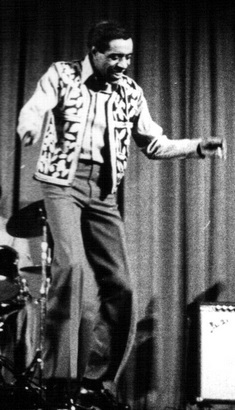
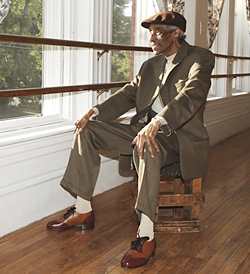
Legacy & Impact
Slyde demonstrated that tap can be spacious without becoming empty and virtuosic without becoming merely busy. His career linked Black vaudeville, jazz clubs, European stages, Hollywood, Broadway, festivals, and apprenticeship. More important than any single step was the listening practice he modeled: a dancer could enter an ensemble as a musician, shape silence as carefully as sound, and invite the next generation into the conversation. That culture of exchange remains his most enduring gift.


Explore More Legends
Discover the dancers, teachers, choreographers, and cultural icons who shaped how the world moves.
Keep the thread going
Dance history, technique, and the occasional rabbit hole — in your inbox. Thoughtful, infrequent, unsubscribe anytime.
Free. No spam. One click to leave.