Tap Dance
An American percussive dance in which metal-plated shoes make the dancer an audible rhythm-maker; it fused African and African American step traditions with the Irish jig and British clog and Lancashire step, and split into a grounded, jazz-rooted rhythm (hoofing) style and a lighter, presentational Broadway style.
4 dance styles in this genre
Historical Origins
Tap dance developed in the United States across the 17th–19th centuries from the collision of West and Central African step and body-percussion traditions with the Irish jig, the English and Lancashire clog, and related British step dancing, in settings ranging from plantations to the minstrel stage. The mid-19th-century dancer William Henry Lane ('Master Juba') is a pivotal early figure, blending Irish step with African American rhythm. Vernacular forms such as buck-and-wing and the soft shoe circulated through minstrelsy, vaudeville, and Black musical theater into the early 20th century. Bill 'Bojangles' Robinson brought tap 'up on the toes,' dancing on the balls of the feet for clean, light, rolling sounds, while a parallel jazz-rooted line—John Bubbles and later the bebop-era hoofers—pushed tap into dense, grounded, improvised rhythm. Metal taps on the shoe became standard in the early 20th century. After a mid-century decline, tap revived from the 1970s–1980s; Savion Glover's percussive 'hitting' style and shows such as Bring in 'da Noise, Bring in 'da Funk (1996) renewed rhythm tap for new generations.
Cultural Significance
Tap is one of the defining American vernacular art forms, born from the exchange and forced proximity of African and European peoples and inseparable from the development of jazz. It carries a complicated history—its early commercial life ran through minstrelsy and its racial caricatures, even as Black dancers created and advanced the art and frequently went uncredited. Tap has no single governing body; its lineage has been transmitted largely person-to-person, from the hoofers of the Hoofers Club through master teachers to today's rhythm-tap community, and its scholarship (notably Constance Valis Hill's work) actively documents that oral tradition.
Musical Characteristics
In rhythm tap the dancer is a musician: the feet are a percussion instrument improvising with or against a jazz rhythm section, typically over swung 4/4. Broadway tap is more often set to show tunes and arranged accompaniment with the rhythm serving choreography and presentation. The soft shoe is performed at an easy, lilting tempo, sometimes on a sand-strewn floor for a brushed sound, and class tap exercises are counted and phrased to support clarity of sound.
Core Movement Principles
Tap technique centers on producing clear, articulate sound with the feet through named elements—shuffle, flap, ball-change, time step, cramp roll, wings, pullbacks—executed with relaxed ankles and weight management so that each tap reads distinctly. The two major styles diverge in orientation: rhythm tap (hoofing) is grounded, weighted, and improvisational, dancing 'into the floor' with emphasis on stamps, drops, and complex syncopation, and aligns itself with the jazz tradition; Broadway tap is lighter and more upright, oriented to line, travel, and visual presentation in musical theater. Soft shoe is the smooth, gliding, low-volume idiom that precedes and underlies both.
Modern Usage
Tap is taught in studios worldwide and remains a fixture of musical theater, while rhythm tap thrives as a concert and jam-session art with a strong improvisational, jazz-aligned community. Festivals, university programs, and master teachers sustain the form, and figures such as Savion Glover, Michelle Dorrance, and Dormeshia have kept rhythm tap at the center of contemporary American dance.
Dance Styles
Soft Shoe
Also known as: Song and dance
The smooth, light, low-volume tap idiom—historically sometimes danced on a sanded floor—that precedes and underlies both rhythm and Broadway tap.
Rhythm Tap (Hoofing)
Also known as: Hoofing, Jazz tap
The grounded, weighted, jazz-rooted tap style in which the dancer is a percussive musician improvising complex syncopation 'into the floor.'
Broadway Tap
Also known as: Show tap
The lighter, more upright, presentational tap style of musical theater, oriented to line, travel, and choreography for the proscenium stage.
Buck-and-Wing
Also known as: Buck dancing
A fast, vernacular late-19th-century precursor of modern tap, combining flat-footed 'buck' rhythms with springing 'wing' steps on the minstrel and vaudeville stage.
Legends of Tap Dance
Dancers, choreographers and teachers whose work shaped the styles in this genre.
Tap Dance on screen
Films and television where tap dance appears, with the sequences worth watching for.
 No Maps on My Taps (1979)7 sequences indexedHoward “Sandman” Sims jams with a young dancer in the alleyChuck Green explains and demonstrates floating heel qualityHoward “Sandman” Sims performs his sand dance
 Singin' in the Rain (1952)7 sequences indexedYou Were Meant for Me · 00:41:30 · chor. Gene Kelly; Stanley DonenSingin' in the Rain title number · chor. Gene Kelly; Stanley DonenDignity flashback and Fit as a Fiddle · 00:04:46 · chor. Gene Kelly; Stanley Donen
 Top Hat (1935)5 sequences indexedOpening-credit feet and cane chorus · chor. Fred Astaire (uncredited); Hermes PanNo Strings (I'm Fancy Free) · 00:08:18 · chor. Fred Astaire (uncredited); Hermes PanTop Hat, White Tie and Tails · 00:40:52 · chor. Fred Astaire (uncredited); Hermes Pan
 Chicago (2002)4 sequences indexedBilly's courtroom tap dance · 01:30:31 · chor. Rob Marshall; Cynthia Onrubia (Richard Gere's tap steps)Hot Honey Rag finale · 01:42:58 · chor. Rob Marshall; John DeLuca (choreographic supervisor)Nowadays / Hot Honey Rag · chor. Rob Marshall
 Maurice Hines: Bring Them Back (2019)4 sequences indexedNicholas Brothers archival showcasePassing tap forward with the Manzari BrothersArchival Hines Brothers performances
 Tap (1989)4 sequences indexedBob Wythe’s Broadway solo audition · chor. Henry LeTang; Gregory Hines (improvography)Max’s prison-cell tap solo · chor. Henry LeTang; Gregory Hines (improvography)The veteran “Challenge” · chor. Henry LeTang
 The Band Wagon (1953)4 sequences indexedA Shine on Your Shoes · 00:13:20 · chor. Michael KiddShine on Your Shoes · chor. Michael KiddBy Myself · 00:06:17 · chor. Michael Kidd
 An American in Paris (1951)3 sequences indexedI Got Rhythm · 00:26:36 · chor. Gene KellyTra-la-la (This Time It's Really Love) · 00:46:17 · chor. Gene Kelly'S Wonderful · 01:20:24 · chor. Gene Kelly
 Bootmen (2000)3 sequences indexedWater-splashing pool ensemble · chor. Dein PerrySydney audition improvisation · chor. Dein PerryIndustrial concert finale · chor. Dein Perry
 Swing Time (1936)3 sequences indexedPick Yourself Up lesson and reveal · 00:22:48 · chor. Hermes Pan (dance director)Pick Yourself Up lesson · chor. Hermes Pan (dance direction; Fred Astaire collaborated)Bojangles of Harlem · 01:12:43 · chor. Hermes Pan (dance director)
 The Gay Divorcee (1934)3 sequences indexedA Needle in a Haystack · 00:17:47 · chor. Hermes Pan (dance director)Don't Let It Bother YouDon't Let It Bother You reprise — identity-proving solo · 00:06:39 · chor. Hermes Pan (dance director)
 An All-Colored Vaudeville Show (1935)2 sequences indexedAdelaide Hall high-heel tapNicholas Brothers two-number tap act
Poster artwork from TMDB.
 This site uses TMDB and the TMDB APIs but is not endorsed, certified, or otherwise approved by TMDB.
Showing the 12 most-documented of 22 titles — browse the full library.
Tap Dance FAQs
Tap Dance in art
Browse the gallery →Works our catalogue identifies as depicting tap dance.
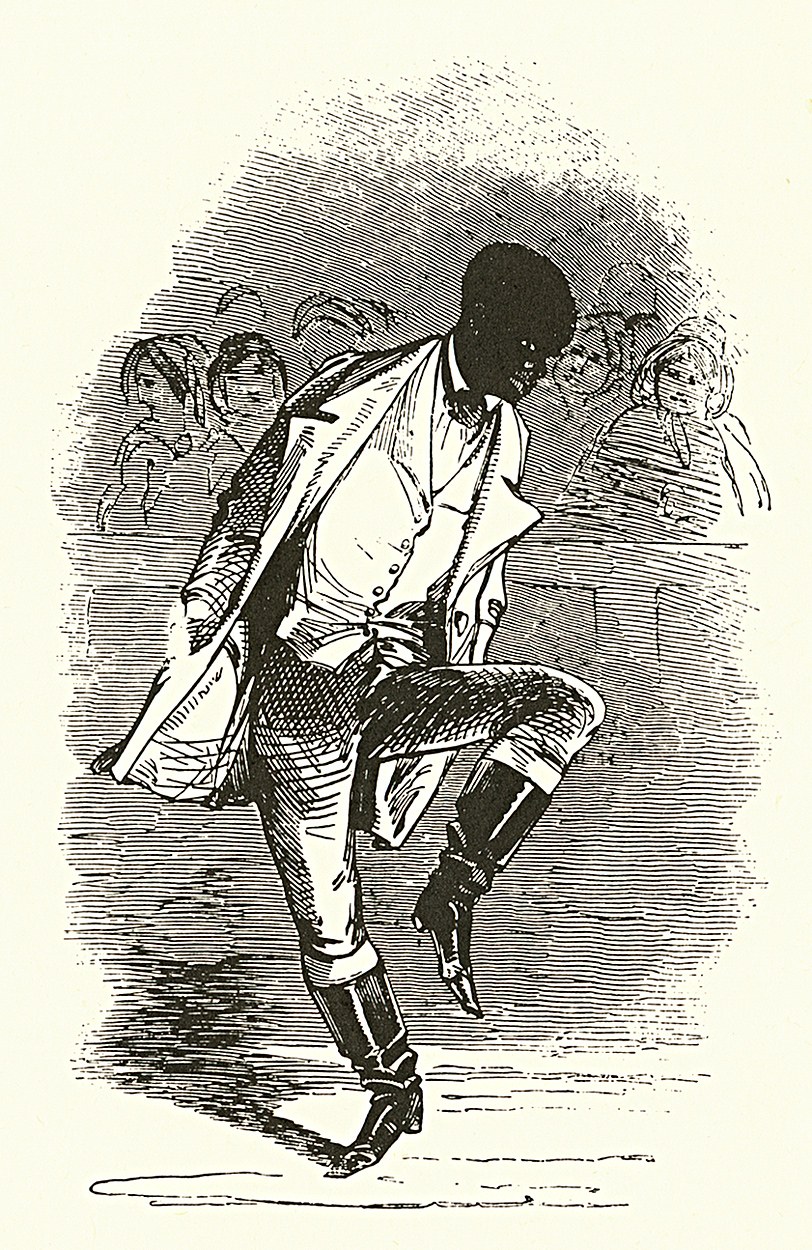
Master Juba
Hans Nathan · 1848
Public Domain